
Every year, the Office of the United States Trade Representative invites rightsholders and industry associations to nominate the foreign piracy platforms, services, and operations that pose the greatest economic threats to intellectual property. The resulting list of notorious markets has traditionally focused on conventional vectors of digital infringement, including large-scale torrent indexers, cyberlockers, and dedicated streaming portals. In recent years, however, the scope of these recommendations has broadened to encompass hosting providers, infrastructure intermediaries, and other foundational pillars of the digital piracy ecosystem.
Last week, the Entertainment Software Association, which represents many of the world’s leading video game developers and publishers, submitted its latest recommendations for the federal review. While the filing includes several familiar targets from previous years, it also trains its crosshairs on a high-profile entity that operates entirely without a traditional public website, challenging regulators to rethink how they classify and combat upstream digital piracy operations.
A Game Cracker as a Piracy Market
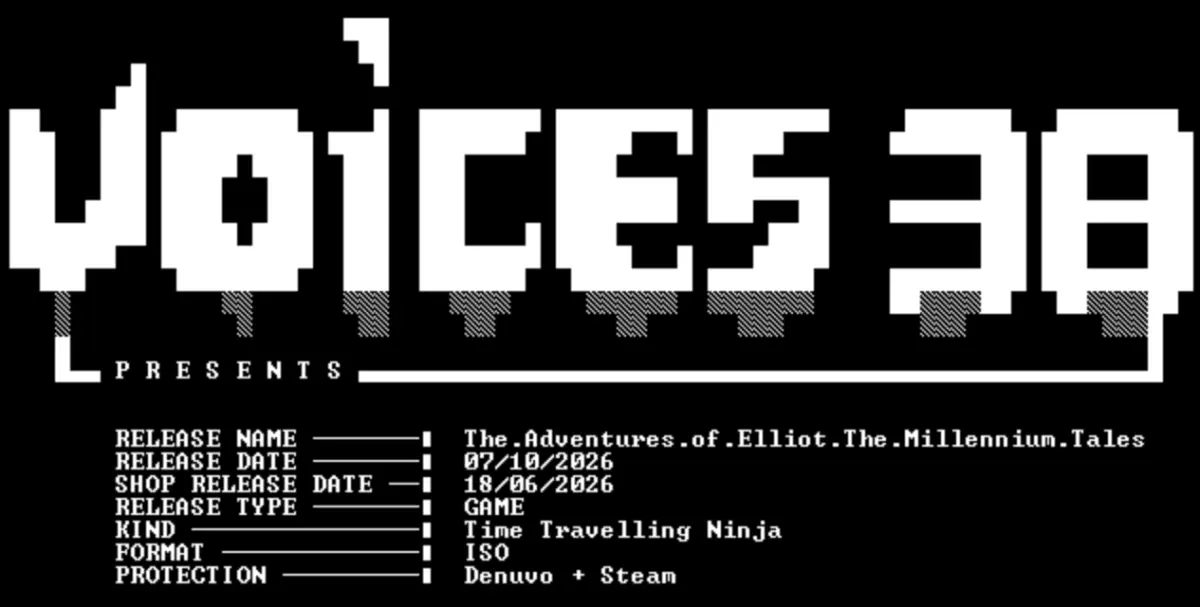
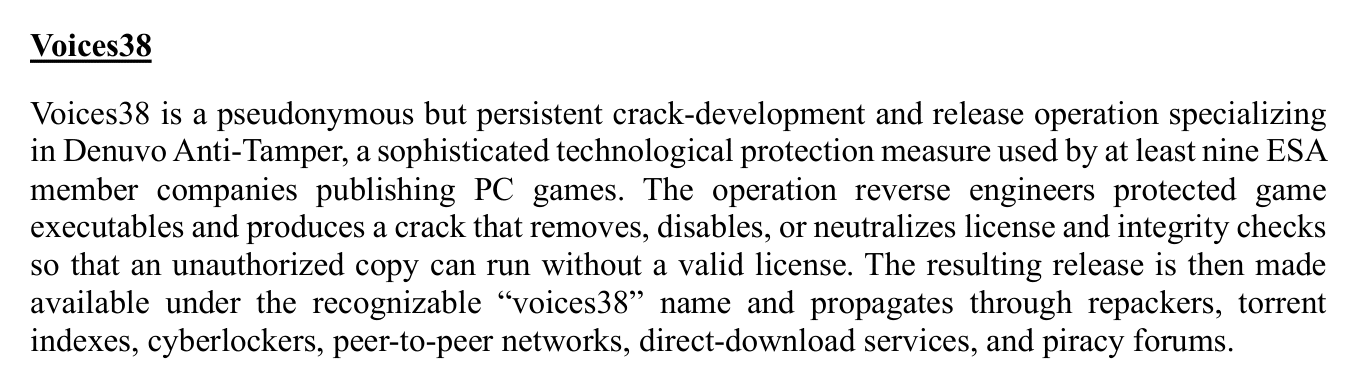
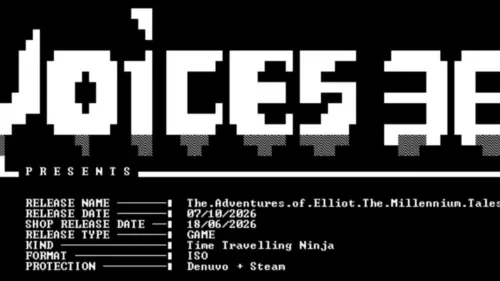
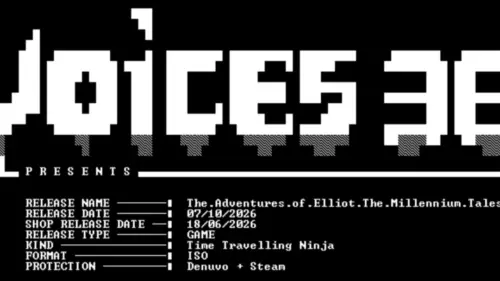
At the center of the ESA’s new recommendations is an anonymous actor identified as "voices38," a persistent game cracker specializing in dismantling Denuvo Anti-Tamper technology. Denuvo is a prominent digital rights management and technical protection measure utilized by at least nine major members of the gaming trade group to safeguard their software titles from unauthorized copying upon release.
According to the ESA’s submission, index listings on Reddit’s r/CrackWatch community attribute roughly two dozen successfully cracked or bypassed games to the elusive handle. The trade organization emphasizes that the operator plays an indispensable role within the broader piracy ecosystem, serving as the primary catalyst for downstream distribution networks. Once a protected title is cracked by voices38, the resulting files are swiftly picked up, bundled, and redistributed by popular repackers, torrent tracking sites, dedicated cyberlockers, and specialized piracy forums.

The submission argues that each individual crack effectively unlocks an entire downstream market for unauthorized copies of a video game. For titles that remain protected and unplayable through any other means, the bypass provided by voices38 represents the sole entry point, without which secondary distribution markets would have nothing to offer. Consequently, the ESA contends that focusing exclusively on downstream services overlooks the critical upstream source that dictates whether protected games can be compromised and distributed in the first place.
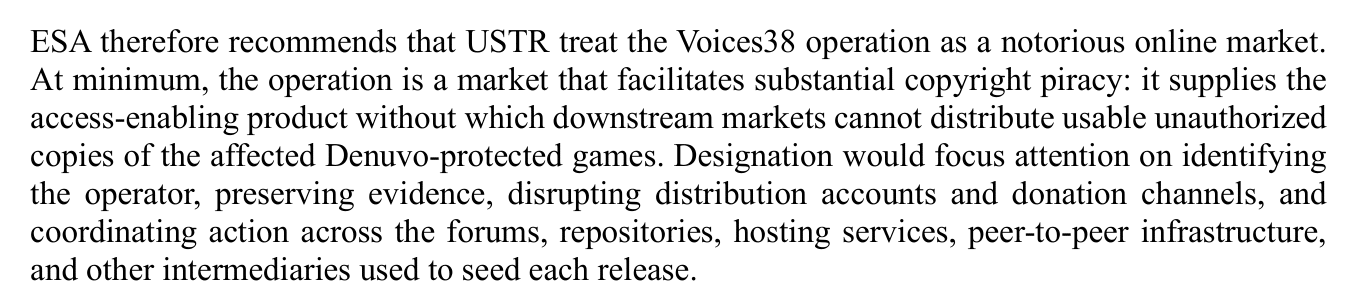
The absence of a traditional public homepage or a known identity should not disqualify an operation from being designated as a notorious market, the trade group asserts. On the contrary, securing an official designation could focus much-needed international and domestic attention on identifying the operator, preserving vital digital evidence, disrupting distribution accounts and financial donation channels, and coordinating targeted enforcement actions across the diverse array of forums, repositories, hosting services, and peer-to-peer infrastructure used to seed each release.
Ideally, the ESA hopes to unmask the individual or collective behind the handles and operations of the popular cracker. This objective aligns with parallel legal efforts currently underway in the United States judicial system.
Ongoing Lawsuits and Relentless Releases
While the ESA’s strategic filing targets the systemic impact of the operation, separate legal actions are attempting to pierce the veil of anonymity through the courts. Last month, Denuvo initiated formal legal proceedings against voices38 in a California federal court, subsequently requesting judicial permission to issue subpoenas to major technology and community platforms including Discord, Valve, and Reddit in an effort to uncover identifying cryptocurrency transactions and account data. The ESA submission does not explicitly reference this ongoing federal lawsuit.
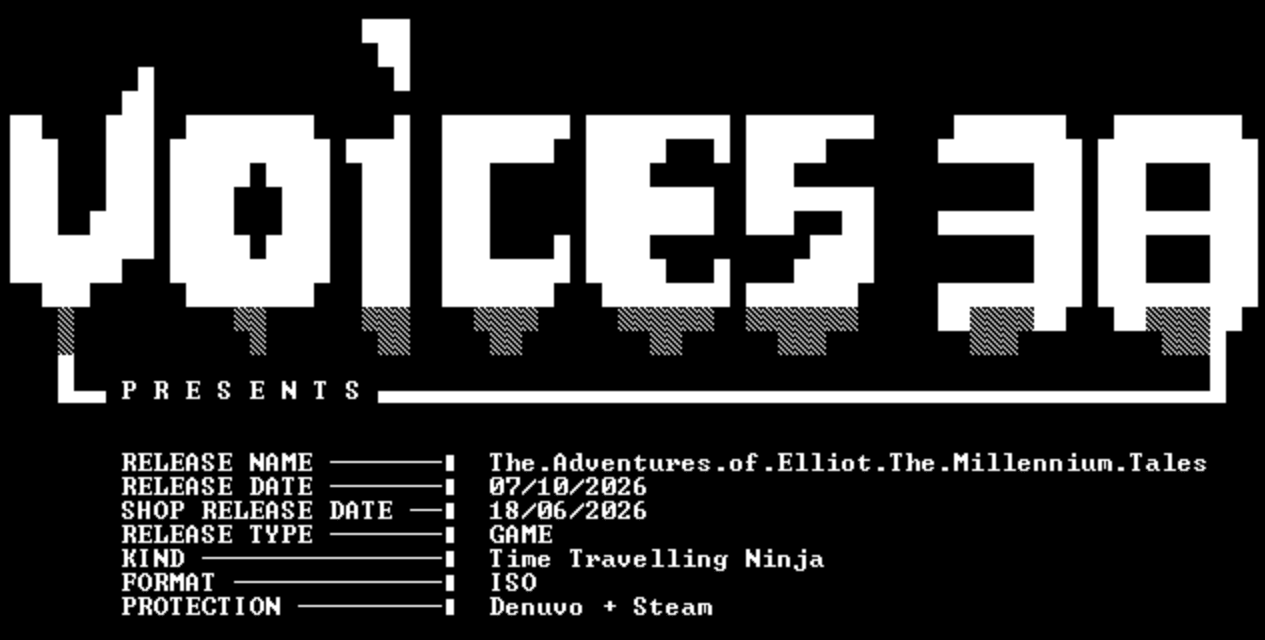
Despite the mounting legal pressure and the scrutiny from rights protection agencies, the release schedule of cracks has maintained a steady pace. Following a brief quiet period, the handle released bypasses for titles such as Atomfall and The Adventures of Elliot: The Millennium Tales, alongside a specialized crackfix for the Dead Space Remake.
These newly freed releases quickly propagated across peer-to-peer networks, torrent trackers, and cyberlockers, eventually making their way to high-profile repackers like FitGirl, drawing fresh regulatory attention to the monumental scale of secondary distribution platforms.
The Massive Scale of FitGirl Repacks
FitGirl, a widely known repack operation that compresses large video game files into manageable downloads, has been a fixture of the U.S. Trade Representative’s notorious markets lists for consecutive years and remains a primary target in the ESA’s latest recommendations.
Despite being subjected to domain blocks and judicial injunctions in several jurisdictions, including Germany, Italy, and Spain, the site continues to operate with staggering user engagement. According to the ESA’s filing, the repack portal recorded 41.77 million visits in the single month of August, continuing to host and distribute unauthorized copies of games published by ESA member companies.
The trade group notes that the sheer scale and persistence of the operation demonstrate that prior blocking measures and official market designations have failed to induce meaningful compliance or remediation from the site’s anonymous operator. Furthermore, formal takedown notices sent by the ESA have been completely ignored, with the organization reporting zero voluntary link removals between August of the previous year and August of the current year.
To illustrate the economic impact of these distribution channels, the video game industry representatives calculated substantial potential revenue losses based on user activity within peer-to-peer swarms. Between March and August, the ESA detected 15,484,145 individual users participating in torrent swarms for games repacked by FitGirl. Multiplying that user count by a standard retail price of $69.99 per title yielded an estimated lost value exceeding one billion dollars, reported down to the exact cent in the official filing.
Other major distribution hubs exhibit a similar lack of responsiveness to industry enforcement efforts. Platforms such as DODI-Repacks removed only a fraction of reported links, while the prominent Russian torrent index RuTracker complied with a mere 3% of the copyright removal notices submitted by the ESA over the past year.
To combat these entrenched entities, the trade group highlights the utility of tracking complex financial flows, noting that scrutinizing cryptocurrency transactions directed toward Know Your Customer-vetted platforms like Binance could provide critical leads for identifying the individuals profiting from unauthorized distribution.
Handheld Emulation Devices and Digital Marketplaces
Beyond traditional software piracy networks, the USTR’s ongoing review features a specialized emphasis on high-quality counterfeit physical goods, often referred to as superfakes. Capitalizing on this focus, the ESA has formally nominated handheld emulation consoles that arrive preloaded with thousands of unauthorized video games, describing them as the physical hardware equivalent of digital superfakes.
The association singled out Anbernic.com, the official storefront for a popular line of portable emulation devices. According to the submission, these hardware systems are routinely distributed or shipped alongside MicroSD cards packed with massive libraries of pirated video games, and they are widely available for purchase through mainstream retail platforms such as Amazon and eBay.
The comprehensive filing also extends its scope to digital trading platforms and auxiliary service providers. The ESA nominated online marketplaces including G2A, FunPay, and Eldorado.gg, where verified user accounts and in-game virtual items are frequently traded. Additionally, the group targeted commercial cheat vendors such as Cronus Zen, arguing that unauthorized modification devices and cheat software should be classified under piracy because they actively circumvent the technological protection measures and digital locks implemented by game developers.
The responsibility now rests with the Office of the United States Trade Representative to review these extensive industry recommendations and determine which entities will ultimately be codified into the final Notorious Markets list. Given that the previous edition was published in March, stakeholders anticipate a waiting period before the official federal report is finalized and released to the public.

Leave a Reply