
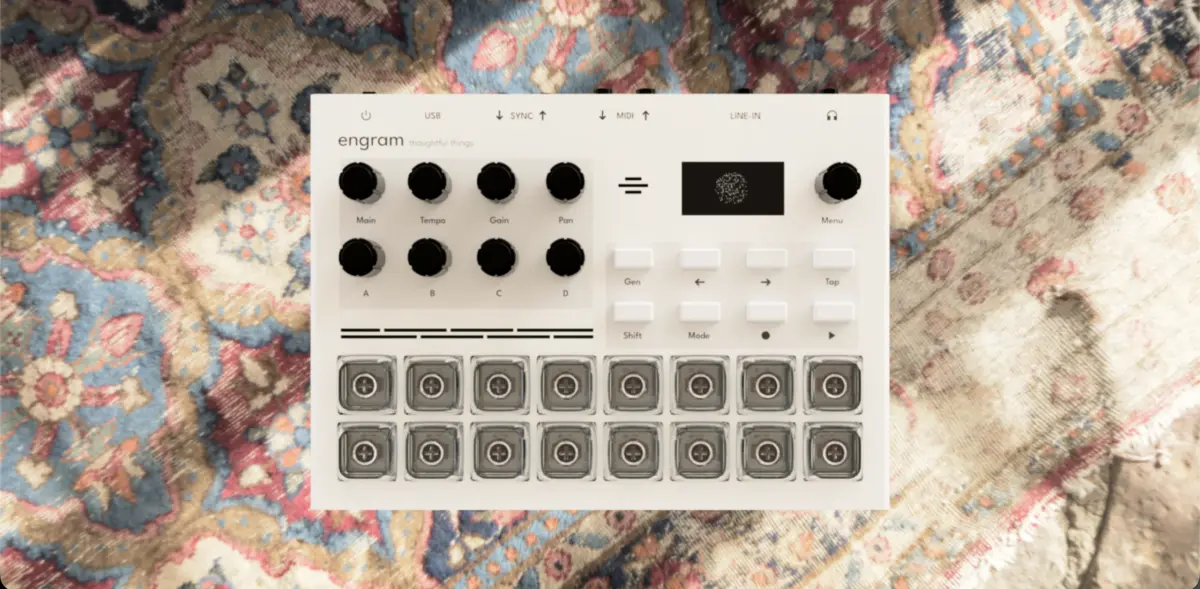
Rather than functioning as a "push-button, get-song" device aimed at mimicking platforms like Suno or creating standard pop-ready tracks for top-40 radio, Engram is explicitly designed for the adventurous producer. It embraces the weird, the glitchy, and the uncanny, pushing AI audio models far beyond their conventional commercial limits to serve as an unconventional tool for avant-garde sound design.
What sets Engram apart from many cloud-dependent or software-based generative music tools currently flooding the market is its architecture. The device is completely offline and not connected to the internet. Instead of relying on massive, server-hosted networks to process audio, it runs a specialized "tiny AI" model directly and locally on the hardware.
According to the official Kickstarter campaign listing, this custom-trained model has been thoughtfully designed in-house by the Thoughtful Things team. The startup has also emphasized its commitment to ethical AI development practices, explicitly stating that their audio models have been trained exclusively on open datasets containing audio licensed strictly for commercial use, such as Creative Commons Attribution (CC-BY) licenses or similar frameworks. The company has made a point to clarify that they have never trained, and will never train, their proprietary models on non-commercial, pirated, or otherwise misappropriated data.

In addition to its custom-trained local model, Thoughtful Things has built a level of openness into the hardware’s architecture. The company has announced plans to open up Engram’s firmware, allowing electronic musicians, developers, and hardware enthusiasts to tweak the system, experiment with its parameters, or even load their own custom models onto the device, inviting a deep level of hardware hacking and personalization.
In the introductory campaign video released alongside the Kickstarter launch, founder Evan King demonstrates the groovebox’s eccentric capabilities. By speaking into the device and asking for a "piano," King prompts Engram to output a sound that is decidedly un-piano-like: a glitchy, fragmented, and heavily processed interpretation that leans heavily into digital artifacting. King encourages users to think of Engram not as a traditional virtual instrument, but rather as a "field recorder for latent space." The overarching philosophy of the device is to explore the unpredictable world of AI hallucinations and experimental sound manipulation, drawing direct philosophical inspiration from the rich history of circuit bending—allowing musicians to push, tweak, and even intentionally break its tiny AI models to discover wholly unique sonic textures.
Thoughtful Things is introducing Engram to the market via a limited production run available exclusively through its initial Kickstarter crowdfunding campaign. Early-backer tiers for the device begin at $675. While the startup has not yet publicly disclosed what the final retail price will be once the hardware hits broader commercial distribution channels, the $675 pledge level is currently marketed as a 30 percent discount, suggesting a projected retail price point falling somewhere between $850 and $900.

Leave a Reply