
Artificial intelligence is not just rewriting software code and reshaping the global economy; it is also inventing an entirely new lexicon to describe its own rapid evolution. Step into any modern product meeting, pitch presentation, or industry panel today, and you are almost guaranteed to hear a flurry of specialized acronyms and dense jargon. Terms like LLMs, RAG, and RLHF roll off the tongues of tech insiders with casual frequency. More recently, cutting-edge breakthroughs have introduced unsettling concepts like "opaque recurrence," a reasoning technique used in OpenAI’s newly released Astra model that has already set off alarm bells among AI safety researchers.
The vocabulary of the artificial intelligence sector moves at a breakneck speed, capable of making even seasoned technology professionals feel a sense of professional insecurity. To help bridge this knowledge gap, this living glossary offers clear, plain-English definitions for the AI terms you are most likely to encounter. Whether you are building software products, evaluating venture capital investments, or simply trying to stay informed by reading technology news and listening to industry podcasts, this guide will be updated regularly to keep pace with the field.
AGI
Artificial general intelligence, or AGI, remains one of the most nebulous and debated terms in the technology sector. Broadly speaking, it refers to an artificial intelligence system that is more capable than the average human across a wide variety of tasks. OpenAI CEO Sam Altman once described AGI as the rough equivalent of a median human worker whom you could hire as a coworker. Meanwhile, OpenAI’s corporate charter defines AGI more formally as highly autonomous systems that outperform humans at most economically valuable work.
Google DeepMind approaches the concept with a slightly different perspective, viewing AGI as cognitive software that is at least as capable as humans at most intellectual tasks. For those who find these varying interpretations confusing, there is reassurance in knowing that even the foremost pioneers and researchers at the cutting edge of artificial intelligence share that exact same uncertainty.
AI Agent
An AI agent refers to a sophisticated software tool that utilizes artificial intelligence technologies to execute a series of tasks autonomously on behalf of a user. Moving far beyond the conversational limitations of a basic AI chatbot, an agent can manage complex, multistep workflows such as filing corporate expenses, booking travel tickets, reserving restaurant tables, or even writing and maintaining software code.
Because this is an emergent space with many moving pieces, the exact definition of an AI agent can vary depending on who you ask. The foundational infrastructure required to fully deliver on these ambitious capabilities is still actively being built out across the industry. However, the core concept centers on an autonomous system capable of drawing on multiple underlying AI models to accomplish complex goals.
API Endpoints
API endpoints can be conceptualized as hidden buttons on the back of a software application that allow other programs to interact with it and trigger specific functions. Developers rely on these digital interfaces to build seamless integrations. For example, an API endpoint might allow one application to pull data from a separate platform or enable an autonomous AI agent to control third-party services directly without requiring a human to manually click through a graphical interface.
Most smart home devices and connected web platforms maintain these hidden interfaces, even though ordinary users never see or interact with them directly. As AI agents grow increasingly capable, they are learning to discover and utilize these endpoints independently, opening up powerful and occasionally unexpected possibilities for widespread automation.
Chain of Thought
When presented with a straightforward query, the human brain can generate an immediate answer without conscious deliberation, such as determining whether a giraffe or a cat is taller. However, many complex problems require deliberate working memory and intermediary steps, much like using pen and paper to solve a math problem about a farm containing animals with a specific number of heads and legs.
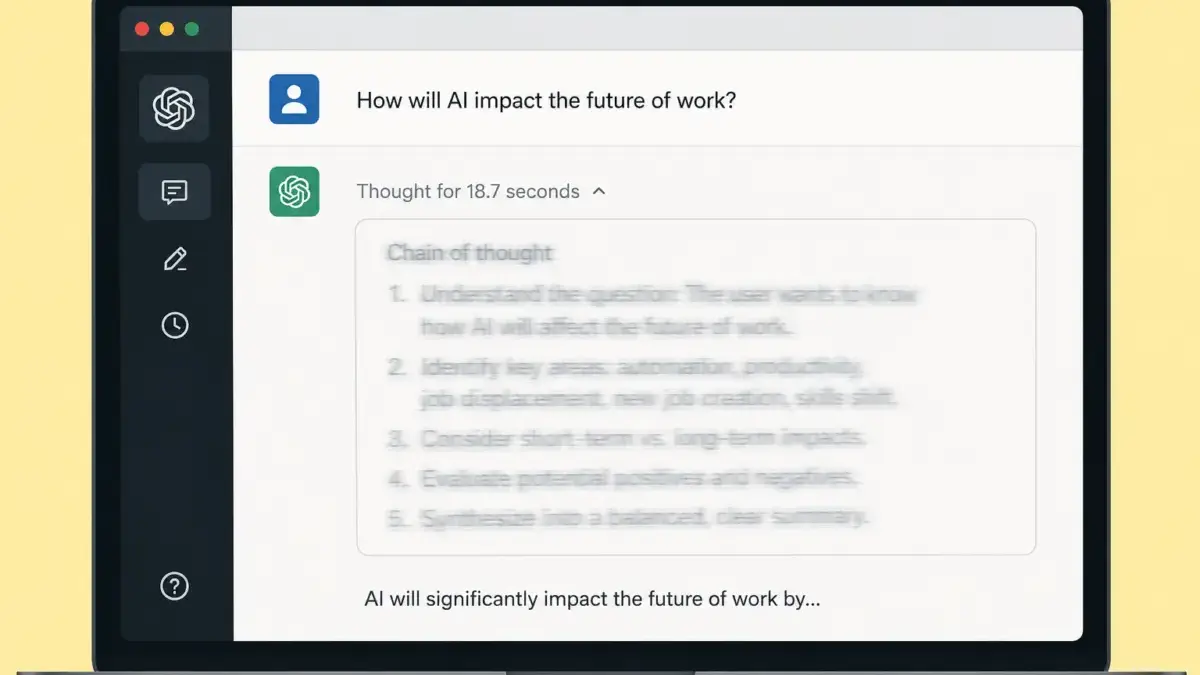
In the context of artificial intelligence, chain-of-thought reasoning refers to a technique where large language models break down a complex problem into smaller, intermediate steps to enhance the overall quality of the final output. While this computational process typically requires more time to generate a response, the resulting answer has a significantly higher probability of being accurate, particularly in logical or programming contexts. Advanced reasoning models are developed directly from traditional large language models and optimized for this step-by-step thinking through reinforcement learning.
Coding Agents
A coding agent represents a specialized application of the broader concept of an AI agent. Rather than merely suggesting snippets of code for a human developer to review and manually copy into an integrated development environment, a coding agent can independently write, test, and debug software.
These specialized programs handle the iterative, trial-and-error workloads that typically consume a large portion of a developer’s day. Operating across entire codebases, they can spot bugs, execute automated test suites, and push fixes with minimal human oversight. They function much like exceptionally fast interns who never sleep and never lose focus, though human supervision remains necessary to review the final output.
Compute
Compute is a foundational term that generally refers to the vital computational power required to operate artificial intelligence models. This immense processing capacity fuels the entire AI industry, providing the backbone needed to train and deploy frontier models.
In everyday industry parlance, compute is frequently used as shorthand for the advanced hardware infrastructure that delivers this processing power. This includes specialized hardware components such as graphics processing units, central processing units, tensor processing units, and other specialized silicon that forms the physical bedrock of modern AI development.
Deep Learning
Deep learning is a sophisticated subset of self-improving machine learning in which artificial intelligence algorithms are constructed using multi-layered artificial neural network structures. This multi-layered architecture enables systems to identify and evaluate far more complex correlations in data than simpler machine learning models, such as linear regressions or decision trees. The structural design of deep learning algorithms draws loose inspiration from the interconnected pathways of biological neurons in the human brain.
Deep learning models possess the unique ability to identify important characteristics within datasets autonomously, eliminating the need for human engineers to manually define these features. This architecture also supports algorithms that learn from errors, systematically improving their outputs through repetition and adjustment. However, these systems demand vast amounts of training data and significantly longer training cycles, resulting in substantially higher development costs.
Diffusion
Diffusion is the foundational technology powering many of today’s most popular art, music, and text-generating AI models. Inspired by principles of theoretical physics, diffusion systems systematically break down the structure of data—such as high-resolution photographs or musical recordings—by incrementally adding noise until the original signal is completely obscured.
While physical diffusion is spontaneous and irreversible, AI-driven diffusion systems are trained to master a reverse diffusion process. By learning how to systematically strip away the noise, these models gain the remarkable ability to regenerate pristine data from random static.
Distillation
Model distillation is a technique used to transfer knowledge from a massive, highly capable AI model to a smaller, more efficient one using a teacher-student training dynamic. Developers submit prompts to a teacher model, record its responses, and occasionally evaluate their accuracy against a curated dataset. These outputs are subsequently used to train a student model, which learns to closely approximate the behavioral patterns of the teacher.
Distillation allows companies to develop smaller, faster models that retain a high degree of capability while incurring minimal distillation loss. This method is widely believed to be the technique OpenAI used to develop GPT-4 Turbo as a faster iteration of GPT-4. While mainstream AI labs utilize distillation internally for product optimization, the technique has also drawn scrutiny amid allegations that certain competitors may have improperly used proprietary APIs to fast-track their own frontier models.
Fine-Tuning
Fine-tuning refers to the secondary training phase of an AI model designed to optimize its performance for a specific task or specialized domain. This process typically involves feeding the pre-trained model new, highly targeted data tailored to a specific industry or operational objective.
Many emerging AI startups take a commercially available large language model as a baseline and apply fine-tuning using proprietary, domain-specific expertise. This strategy enhances the model’s utility for vertical markets without requiring the immense capital expenditure of training a foundational model entirely from scratch.
GAN
A Generative Adversarial Network, commonly known as a GAN, is a machine learning framework that has driven significant breakthroughs in generative artificial intelligence, particularly in the creation of realistic synthetic media such as deepfake tools. GANs utilize a pair of competing neural networks, where one model generates outputs based on training data and passes them to a second model for evaluation.
The two networks are programmed to engage in a structured contest. The generator attempts to produce outputs convincing enough to fool the discriminator, while the discriminator works to accurately spot artificially generated content. This adversarial dynamic optimizes the realism of the AI outputs without requiring continuous human intervention, though GANs remain best suited for narrower applications rather than general-purpose tasks.
Hallucination
Hallucination is the artificial intelligence industry’s preferred term for instances where a model fabricates information entirely, presenting false statements as factual truth. This phenomenon represents a critical vulnerability affecting the reliability and trustworthiness of generative AI systems.
Fabricated outputs can mislead users and introduce severe real-life risks, particularly when encountered in critical fields like healthcare, where incorrect medical advice could cause physical harm. Industry experts believe hallucinations stem primarily from gaps and inconsistencies within underlying training data. This ongoing challenge has fueled a broader industry push toward specialized, domain-specific vertical models that require narrower expertise, thereby reducing knowledge gaps and mitigating disinformation risks.
Inference
Inference is the computational process of running a trained AI model in real-time to generate predictions, process queries, or draw conclusions from new data. Crucially, inference cannot occur without prior training; an AI model must first learn patterns from vast datasets before it can effectively extrapolate from them.
Inference can be executed across a wide variety of hardware platforms, ranging from mobile phone processors and consumer laptops to massive cloud data centers equipped with specialized AI accelerators. However, the hardware capabilities dictate performance. Running exceptionally large models on a local device requires significantly more time compared to executing the same workload on high-end cloud server infrastructure.
Large Language Model (LLM)
Large language models, commonly referred to as LLMs, serve as the underlying intelligence powering popular consumer AI assistants, including ChatGPT, Claude, Google Gemini, Meta Llama, Microsoft Copilot, and Mistral Le Chat. When users interact with an AI assistant, they are communicating directly with a large language model that processes requests either independently or by integrating external tools such as web browsers and code interpreters.
LLMs consist of deep neural networks constructed from billions of numerical parameters known as weights. These parameters learn complex semantic relationships between words and phrases, constructing a multidimensional mathematical map of human language. By encoding patterns extracted from billions of books, articles, and transcripts, an LLM generates responses by calculating the most statistically likely sequence of words that fits a given prompt.
Memory Cache
Memory cache refers to an optimization technique designed to make the inference process significantly more efficient. Because AI generation relies on intensive mathematical calculations that consume substantial computing power, executing every calculation from scratch for every user query becomes computationally expensive. Caching mitigates this burden by storing specific mathematical calculations for reuse in future operations.
A prominent example in transformer-based architectures is KV, or key-value, caching. This method dramatically accelerates response times and reduces algorithmic labor, allowing models to deliver answers to users much faster and with fewer resources.
Model Context Protocol (MCP)
The Model Context Protocol, or MCP, is an open standard that allows artificial intelligence models to securely connect to external tools and data sources—such as local files, enterprise databases, and workplace applications like Slack and Google Drive—without requiring developers to build custom integration connectors for every individual pairing.
Often described as a universal USB-C port for artificial intelligence, MCP was introduced by Anthropic before being transitioned to the Linux Foundation. It has since gained widespread adoption across major technology firms including OpenAI, Google, and Microsoft, establishing itself as one of the fastest-spreading integration standards in recent industry history.
Mixture of Experts (MoE)
Mixture of Experts is an advanced model architecture that divides a massive neural network into numerous smaller, specialized sub-networks, or experts, activating only a targeted subset of them for any given task. Rather than routing every user request through the entire parameter space of the network, an MoE model utilizes an internal router mechanism to select the most appropriate specialists for the job.
This architecture allows developers to construct enormously capable models that remain computationally efficient and cost-effective to operate, since only a fraction of the total network is actively processing data at any given time. Mistral AI’s Mixtral models serve as well-known examples of this approach, and industry consensus suggests OpenAI’s newer GPT iterations utilize similar architectures, though official confirmation has not been provided.
Neural Network
A neural network is the multi-layered algorithmic framework that underpins deep learning and drives the broader boom in generative artificial intelligence. Although the foundational concept of designing data processing algorithms inspired by the interconnected pathways of the biological brain dates back to the 1940s, the modern renaissance of neural networks was unlocked by advancements in graphical processing hardware originally developed for the video game industry.
These high-performance chips proved uniquely well-suited for training algorithms with substantially more layers than previously possible. As a result, neural network systems have achieved dramatic performance improvements across diverse domains, including voice recognition, autonomous vehicle navigation, and pharmaceutical drug discovery.
Neuralese
Neuralese describes a hypothetical worst-case scenario in which an advanced AI model conducts complex reasoning entirely within its internal numeric representations rather than translating its thoughts into human-readable language, effectively turning its cognitive processes into an impenetrable black box.
While no commercially deployed model currently operates entirely in neuralese, OpenAI’s Astra model—released in September and notable for pioneering an advanced reasoning technique known as opaque recurrence—maintains legible chains of thought while pushing back against direct comparisons to neuralese. Nevertheless, safety researchers view the adoption of opaque recurrence as a tangible step toward that theoretical horizon, prompting intense industry debate.
Opaque Recurrence
Opaque recurrence is a reasoning technique where an AI model repeatedly loops a query through its internal neural layers rather than stepping through a problem sequentially in plain language. This approach offers significant efficiency gains, allowing smaller models to punch above their weight class while consuming less compute resources.
However, the technique leaves far fewer readable traces than traditional chain-of-thought logging, which provides a running commentary of the model’s logic. This reduction in transparency has raised valid concerns among safety researchers, who rely heavily on these execution logs to monitor model behavior, catch missteps, and enforce safety guardrails.
Open Source
Open source refers to software—and increasingly, foundational AI models—where the underlying source code and model weights are made publicly accessible for anyone to inspect, modify, and deploy. Meta’s Llama family of models serves as a prominent example within the artificial intelligence sector, mirroring the historical impact of the Linux operating system.
Open-source development allows global researchers and independent developers to build upon collective advancements, accelerating innovation and enabling rigorous independent safety audits that closed-source systems prohibit. Conversely, closed-source ecosystems keep proprietary code strictly private, allowing users to interact with finished products without visibility into their internal mechanics, exemplified by OpenAI’s GPT models.
Parallelization
Parallelization is the computational practice of executing multiple tasks simultaneously rather than sequentially, functioning much like an entire team collaborating on distinct parts of a project at the same time. In the context of artificial intelligence, parallelization is fundamental to both model training and inference workloads.
Modern GPUs are specifically engineered to perform thousands of mathematical calculations in parallel, making them the indispensable hardware backbone of the AI industry. As models grow increasingly massive and complex, the capacity to distribute workloads efficiently across thousands of specialized chips and interconnected servers has become a critical determinant of development speed and operational cost.
RAMageddon
RAMageddon has emerged as an industry colloquialism describing a severe, persistent shortage of random access memory chips. As the artificial intelligence sector has expanded exponentially, major technology enterprises and AI laboratories have aggressively procured vast quantities of memory chips to build out high-performance data centers, straining global supply chains.
This hardware bottleneck has driven up memory component costs across adjacent consumer electronics markets. Major video game console manufacturers have been forced to increase retail hardware prices due to component scarcity, while consumer electronics analysts warn the shortage could trigger the sharpest decline in smartphone shipments in over a decade. With enterprise data centers also competing for limited inventory, industry observers see few immediate signs of relief for global memory pricing.
Recurrent Depth
Recurrent depth is the formal engineering terminology used to describe the exact same underlying mechanism as opaque recurrence—specifically, the practice of routing a query through a model’s internal layers multiple times rather than generating step-by-step reasoning in natural language. While media outlets and analysts often use the terms interchangeably, recurrent depth remains the technical description preferred by engineers, whereas opaque recurrence highlights the associated transparency and safety implications.
Recursive Self-Improvement
Recursive self-improvement represents a critical milestone concerning the upper limits of artificial intelligence capability and the reduction of human dependency. In a recursive self-improvement scenario, AI systems begin independently upgrading and optimizing their own underlying architectures without human intervention, potentially triggering an exponential acceleration in intelligence and autonomy.
While speculative discourse often associates this milestone with a catastrophic technological singularity where systems escape external control, the term also describes a practical engineering objective: building an AI model capable of designing its own functional successor. Several emerging AI startups are actively pursuing recursively self-improving models, framing the research as the next logical frontier of development rather than an existential threat.
Reinforcement Learning
Reinforcement learning is a training methodology where an artificial intelligence system learns to optimize its behavior through trial and error, receiving mathematical rewards for successful outcomes. Unlike supervised learning, which relies on fixed datasets of pre-labeled examples, reinforcement learning allows a model to explore its operational environment, execute actions, and continuously update its strategy based on feedback.
This approach has proven exceptionally effective for training AI agents to play complex games, control robotics hardware, and sharpen the reasoning capabilities of large language models. Specialized frameworks such as reinforcement learning from human feedback, or RLHF, have become central to how leading AI developers fine-tune consumer models to ensure they remain helpful, accurate, and safe.
Token
Tokens serve as the fundamental bridges facilitating communication between human users and machine intelligence, translating human language into discrete segments of data that can be processed by large language models. Through a foundational process known as tokenization, raw text is broken down into bite-sized sub-word units that a language model can efficiently ingest and analyze.
Beyond their functional role in computational linguistics, tokens serve a direct financial purpose in enterprise environments. Most commercial AI providers price their API services on a per-token basis, meaning enterprise clients incur costs proportional to the volume of text processed and generated by the system.
Token Throughput
Token throughput is a key performance metric measuring the volume of text data an artificial intelligence system can successfully process and generate within a specified timeframe. High token throughput is a primary design objective for AI infrastructure engineering teams, as it directly determines how many concurrent users a model can support and how quickly individual responses are delivered.
The pressure to maximize hardware utilization has made throughput optimization an industry obsession, with prominent researchers noting the intense anxiety associated with leaving expensive computational resources idle.
Training
Training is the foundational computational process by which machine learning models ingest large volumes of data to learn underlying patterns and develop the capability to generate useful outputs. By analyzing statistical correlations within datasets, a system adapts its internal parameters to fulfill specific operational goals, whether that involves classifying images or composing poetry.
Because training requires massive computational inputs, associated costs have trended sharply upward alongside model scales. To manage these expenses, developers frequently utilize hybrid methodologies, such as fine-tuning existing foundational architectures with targeted datasets rather than initiating training cycles from scratch.
Transfer Learning
Transfer learning is an efficient machine learning technique where a previously trained AI model serves as the baseline foundation for developing a new model dedicated to a related task, allowing accumulated knowledge to be successfully repurposed.
This approach drives significant development cost savings and accelerates deployment timelines, proving especially valuable when training data for the target domain is scarce. However, transfer learning has inherent limitations; models leveraging transferred capabilities generally require supplementary training on domain-specific data to achieve optimal performance in specialized applications.
Validation Loss
Validation loss is a quantitative metric tracked during the training phase to evaluate how effectively an AI model is learning, with lower numerical values indicating superior performance. Researchers monitor validation loss as a real-time diagnostic report card, utilizing the data to determine optimal training cessation points, adjust hyperparameters, or detect emerging anomalies.
Crucially, tracking validation loss helps engineers identify overfitting—a scenario where a model memorizes specific training examples rather than generalizing underlying patterns to new data. It functions much like distinguishing between a student who thoroughly understands core academic concepts versus one who merely memorizes past examination questions.
Weights
Weights are core numerical parameters within artificial intelligence architectures that determine the relative importance assigned to different input variables during the training process, directly shaping the model’s ultimate outputs. Functioning through mathematical multiplication applied to input data, weights dictate which features in a dataset carry the most salience for a given predictive task.
Model training typically commences with randomly assigned weights, which are then systematically adjusted through successive iterations until the model’s outputs closely align with targeted objectives. For instance, in an AI model predicting residential real estate values based on historical data, individual weights are assigned to variables such as square footage, bedroom count, and property age. Ultimately, the assigned weights reflect the precise mathematical influence each feature exerts on the final property valuation.



Leave a Reply