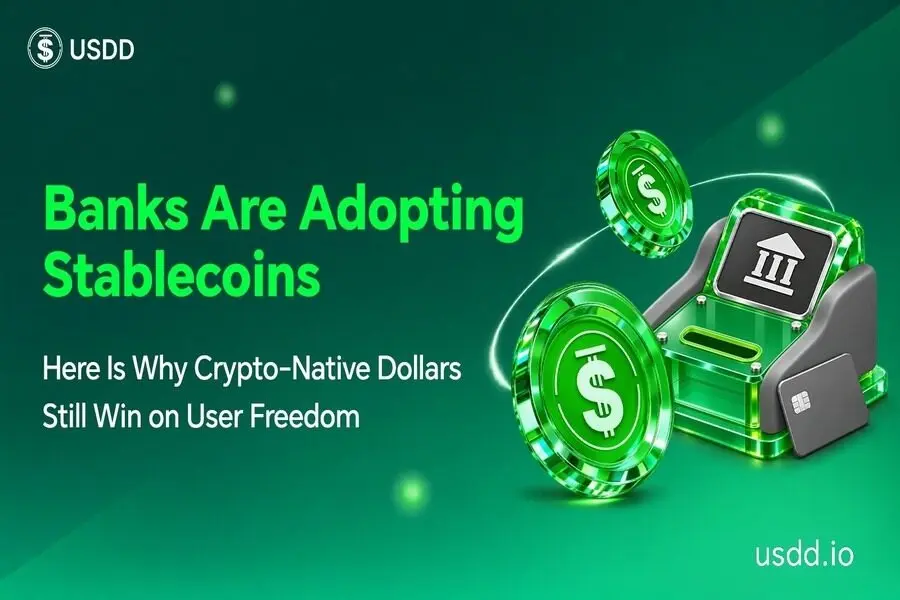
ROAD TOWN, TORTOLA, BRITISH VIRGIN ISLANDS — As traditional financial institutions increasingly race to adopt digital dollars and modern back-end payment rails, decentralized stablecoin protocol USDD is expanding its multichain footprint across TRON, Ethereum, and BNB Chain. Combining automated sUSDD yield generation via its proprietary Smart Allocator with GasFree, zero-TRX transfer mechanisms, the project is positioning itself at the forefront of a shifting financial landscape.
In a recent industry interview with instant exchange partner ChangeNOW, USDD Head of Communications Yvonne Chia outlined why elements such as self-custody, 24/7 global settlement, and transparent onchain reserves give decentralized digital dollars a structural advantage that traditional, bank-issued alternatives simply cannot replicate.
The commentary arrives at a pivotal moment for global finance. While traditional banking giants attempt to bridge the gap between legacy systems and blockchain technology, crypto-native protocols are rewriting the rules of access, ownership, and value distribution. According to Chia, the fundamental differences between centralized banking and decentralized protocols go far beyond simple technical upgrades; they represent an entirely new paradigm of financial autonomy.
Permissionless Access Versus Gatekept Accounts
For billions of people across the globe, opening and maintaining a traditional bank account remains a cumbersome process. It often involves navigating extensive paperwork, meeting strict minimum balance requirements, confronting geographic restrictions, and enduring frustrating approval delays. Even in instances where traditional financial institutions integrate stablecoin rails behind the scenes, those services are almost invariably locked behind legacy compliance walls and intermediary control.
Crypto-native stablecoins effectively flip this restrictive model on its head. During her discussion with ChangeNOW, Chia emphasized the stark contrast in barrier-to-entry between the two systems. Pointing to the ease of decentralized onboarding, she noted that compared to traditional banking, utilizing a stablecoin like USDD requires little more than a smartphone and a working internet connection. Users can immediately establish a digital wallet and gain instant access to their funds without needing institutional permission.
With USDD, individuals can access and manage their digital dollars directly through their own self-custody wallets, entirely bypassing the need for traditional financial intermediaries. This dynamic represents a fundamental shift in global financial access. Users are no longer bound by the operating hours, arbitrary geographical limitations, or restrictive account structures dictated by a single financial institution. Instead, they gain the absolute freedom to hold, manage, and transfer their digital assets completely on their own terms.
Furthermore, self-custody provides users with a much higher degree of autonomy over their day-to-day financial decisions. Account holders retain the sole ability to choose which wallet applications they prefer to use, where they wish to transfer their capital, and which decentralized applications they choose to interact with. They are never forced to route every routine transaction or investment decision through a centralized bureaucratic institution.
Through USDD, a user’s digital dollars travel natively with them across an open, borderless blockchain ecosystem, rather than remaining trapped within the proprietary ledger of a single bank or service provider.
24/7 Global Settlement Versus Legacy Banking Hours
Legacy payment networks and traditional banking systems still operate heavily on decades-old schedules. Weekend cutoffs, public bank holidays, and multi-day cross-border settlement delays continue to plague traditional wire transfers, often accompanied by exorbitant fees.
In sharp contrast, decentralized blockchain networks operate continuously, never closing for weekends or holidays. Whether a transaction is initiated on a Sunday night or during a global public holiday, USDD moves effortlessly across the globe without depending on traditional banking operating hours or arbitrary settlement windows.
Chia highlighted this around-the-clock utility during her interview, pointing out that the ability to execute transfers 24/7 without traditional banking limitations means that stablecoins are not merely catching up to traditional banks, but in many ways exceeding what those legacy institutions can offer to modern users.
To make everyday transfers even smoother and more frictionless than traditional fintech applications, USDD introduced a GasFree integration on the TRON network. This capability allows users operating on compatible wallets to pay network transaction fees directly in USDD, eliminating the traditional requirement to hold a separate native token—such as TRX—just to move digital dollars.
This integration successfully removes one of the most persistent practical barriers to mainstream stablecoin adoption: the friction of acquiring and maintaining a separate gas token solely to facilitate transfers. With the GasFree mechanism, eligible users can execute transactions at a fraction of standard network costs, making digital dollars far more practical for everyday payments and international value transfers. Ultimately, the true utility of a stablecoin extends far beyond maintaining a strict dollar peg; low-cost transfers, intuitive wallet experiences, and constant availability are what transform digital currency into viable everyday financial infrastructure.
Passing Yield Back to Users Versus Bank Spreads
Perhaps the sharpest and most consequential contrast between traditional banking and decentralized stablecoins lies in how financial yield is generated and distributed.
In the traditional banking model, institutions collect customer deposits, deploy that pooled capital into various yield-generating markets, and retain a vast majority of the financial returns. Everyday depositors receive relatively negligible interest rates on their savings accounts, while higher-yielding financial products usually come attached with restrictive eligibility requirements, steep minimum deposit thresholds, or long-term fixed maturity periods that lock up capital.
Stablecoins introduce an entirely different model for participating in digital-dollar opportunities. Rather than locking capital within a traditional, low-yield deposit account, users can tap directly into onchain yield opportunities through decentralized protocols and transparent investment mechanisms.
USDD was architected specifically to return that value directly to asset holders. Through the USDD Earn program, users can deposit USDD to receive sUSDD, thereby earning automated, competitive yields powered by the protocol’s Smart Allocator system. Crucially, this mechanism operates without imposing fixed lock-up periods that unnecessarily restrict users’ access to their own capital.
For everyday participants, this distinction is vital. USDD Earn provides access to a productive, yield-generating stablecoin while maintaining financial flexibility, sparing users from having to commit their funds to conventional, inflexible fixed-term banking products.
Onchain Verification Versus Institutional Trust
Traditional banking models ultimately require customers to place blind trust in closed-door balance sheets, opaque internal risk management, and periodic regulatory filings—an arrangement that often remains unchallenged until a systemic financial crisis proves its fragility.
USDD adopts a radically different philosophy rooted in the cryptographic ethos of independent verification. By emphasizing publicly accessible onchain information, the protocol relies on data that can be independently audited and examined by anyone, at any time.
While absolute transparency does not entirely eliminate inherent financial or technological risks, it fundamentally transforms how users evaluate those risks. Instead of relying exclusively on corporate assurances and marketing statements from a single institution, participants have direct access to immutable onchain metrics that can be independently inspected and verified.
Beyond a Single Network: An Open, Multichain Financial Ecosystem
True financial freedom encompasses more than merely holding digital dollars in a static wallet. It requires the ability to deploy those assets wherever valuable opportunities and decentralized applications exist. A stablecoin that is rigidly confined to a single blockchain network or restricted to a narrow use case can never fully realize the expansive potential of open blockchain finance.
Following a major protocol upgrade, USDD successfully expanded natively from its foundational home on TRON onto both Ethereum and BNB Chain, significantly broadening its reach across multiple leading blockchain ecosystems.
This multichain presence allows USDD to seamlessly connect with diverse user communities, varying liquidity pools, and a wide array of decentralized applications. Furthermore, the sUSDD product has expanded into prominent decentralized finance integrations, including platforms like Pendle and Morpho, providing users with advanced avenues to access diversified yield strategies across supported ecosystems.
The broader vision is an interconnected financial architecture where users can fluidly transition between holding, transferring, exchanging, and deploying their stablecoins according to their individual needs. These functions are deeply complementary, working together to elevate stablecoins into robust, everyday financial infrastructure.
As traditional financial institutions continue to experiment with stablecoin rails to modernize their internal back-end settlement systems, crypto-native protocols continue to demonstrate the expansive possibilities of open, permissionless finance. For USDD, the mission extends far beyond issuing a reliable, dollar-pegged asset. It is about ensuring that digital dollars remain accessible, highly transferable, and productive across an interconnected global economy.
From self-custody and 24/7 global transfers to flexible yield generation and multichain DeFi accessibility, these capabilities provide users with powerful tools to manage and grow their wealth. While traditional banks bring stablecoins into the legacy financial fold, crypto-native protocols are actively proving what digital currency can achieve well beyond its borders.
The full interview detailing these developments can be viewed on official social channels, and further information regarding the USDD ecosystem is available through its official web portal.