
Global cryptocurrency markets faced intense downward pressure this week, with Bitcoin plunging more than $10,000 and settling near the $65,000 threshold. The sharp market correction has drawn immediate parallels to historical mid-term election cycles in 2018 and 2022, both of which saw major corrections before finding a definitive bottom. While the short-term landscape remains dominated by extreme fear and heavy liquidations, analysts and market observers are closely parsing the macro economic shifts, shifting institutional flows, and adjacent technology sector turbulence that triggered the latest wave of volatility.

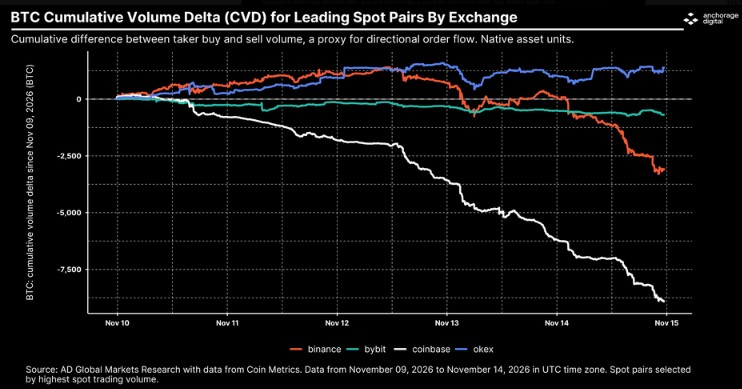
According to data from Anchorage Digital researcher David Lawant, the primary sell pressure driving the current correction is originating domestically within the United States. Lawant highlighted order-book data showing persistent net taker sell flows concentrated heavily on Coinbase compared to overseas trading venues. This domestic sell-off has been sharply magnified by a massive wave of capital flight from United States spot Bitcoin exchange-traded funds. Over the past two weeks, these investment vehicles have experienced a staggering $2.35 billion in net outflows. Farside Investors data indicates that redemptions topped $1.07 billion during the most recent week, following an even larger $1.28 billion exit the week prior—marking the largest weekly redemptions seen since late June. Furthermore, market influencer Axel Bitblaze pointed out a persistent intraday trend, noting that Bitcoin prices fell in the hour leading up to the opening of traditional U.S. markets on all but two of the past fifteen trading sessions.
The broader market downturn has also coincided with mounting macroeconomic pressures and external market events. Binance founder Changpeng Zhao forcefully addressed market rumors, taking to social media to rebuff allegations that his exchange was orchestrating or fueling the sell-off. Clarifying his stance, Zhao stated that he had actually purchased crypto assets over the preceding few days. Instead of platform manipulation, Zhao attributed the broader market slide to a combination of capital shifting toward high-profile traditional equity offerings like the Anthropic IPO, ongoing spot Bitcoin ETF redemptions, lingering security concerns following the recent Binance exploit, and stubbornly hot U.S. inflation data. The latest inflation prints have rapidly shifted investor expectations, with interest rate markets now fully pricing in a quarter-point Federal Reserve rate hike at the upcoming December meeting.
Despite briefly touching a four-month low near $62,000 over the weekend, Bitcoin managed a modest technical rebound above $65,000. Nevertheless, sentiment has deteriorated rapidly, pushing the Crypto Fear and Greed Index down to a reading of 10, entering deep into "Extreme Fear" territory. Long-term market participants, however, continue to look toward historical precedence for comfort, noting that following the mid-term election corrections of both 2018 and 2022, Bitcoin managed to more than double in price over the subsequent twelve-month period. Adding to the bullish long-term outlook, Bitcoin Opportunity Fund co-founder Mark Moss suggested that Wall Street’s deeper integration and the broader accessibility provided by traditional financial institutions have ultimately created what he describes as the best buying opportunity in the asset’s history, projecting a new record high by 2027.
Compounding the atmosphere of risk aversion across financial markets, traditional tech equities and index structures have also experienced significant disruption. The Financial Times recently reported that former Nvidia CEO Jensen Huang is actively plotting a high-stakes corporate comeback alongside a network of Silicon Valley allies and supporters. Huang stunned the technology sector on November 12 when he abruptly resigned as CEO and board member following revelations regarding a series of personal relationships, including an independent board probe investigating an alleged affair with a subordinate who reportedly had ties to a Chinese intelligence operative.

The abrupt departure sent Nvidia shares tumbling and sent immediate shockwaves through artificial intelligence stocks and correlated risk assets, including cryptocurrency. Despite the severity of the allegations—with reports indicating that U.S. intelligence officials had briefed President Trump about the situation a year prior without taking immediate action—Huang’s supporters have rapidly mobilized. A dedicated petition calling for his reinstatement has already garnered more than 100,000 signatures, including backing from prominent tech leaders such as SpaceX CEO Elon Musk and Epic Games CEO Tim Sweeney, alongside thousands of current Nvidia employees. The political fallout from the scandal is also extending into legislative halls, with the U.S. Congress advancing three distinct bills aimed at severely tightening AI chip export restrictions to China.
The regulatory and index landscape is simultaneously shifting beneath digital asset treasury companies and infrastructure providers. Index provider MSCI confirmed that Bitcoin treasury pioneer Strategy will be officially removed from its global equity indexes following months of intense debate regarding whether corporate entities holding massive digital asset reserves truly qualify as operating businesses. The removal, scheduled to take effect after the market close on November 30, will also impact Japan-based Metaplanet and crypto treasury firm Upexi, while Ether treasury firm Sharplink has been placed on an active watchlist. Market commentators noted that the inclusion of such firms in major indexes had previously exposed passive investors, such as those holding pension funds, to leveraged cryptocurrency exposure without their explicit consent. Following the announcement, Strategy shares fell 6.49%, deepening a monthly decline of more than 25%.

Metaplanet itself reported a severe financial blow for the first nine months of the year, swinging to a net loss of 27.16 billion yen, equivalent to approximately $170 million. The Japanese corporate holder cited a substantial 19.17 billion yen loss stemming from a deliberate Bitcoin sale designed to demonstrate liquidity-raising capabilities, alongside an 8.04 billion yen impairment loss from declining asset valuations. Meanwhile, infrastructure and protocol developers are being forced to adapt to evolving technical and structural demands. Ethereum research collective Ethlabs announced the withdrawal of its Quick Slots proposal from the upcoming Hegoté network upgrade, urging core developers to accelerate post-quantum security preparations. The group introduced a roadmap titled "pqai27," emphasizing the urgent need to shield the Ethereum network against the looming threat of quantum computing capabilities by 2027, aligning closely with researcher Justin Drake’s target timeline presented at Devcon.
At the infrastructural level, corporate restructuring continues to reshape the Web3 landscape. MEGA, the parent organization behind the Ethereum layer-2 network MegaETH, executed a 20% workforce reduction as part of an ongoing restructuring process. The firm is reallocating $30 million toward the expansion of artificial intelligence products built directly on top of the MegaETH network. These developments occurred alongside broader digital infrastructure turbulence, highlighted by a massive global Microsoft 365 outage that disrupted Outlook, Teams, and enterprise applications for over 24 hours. Microsoft swiftly ruled out any cyberattack or artificial intelligence agent involvement, attributing the disruption entirely to an unpredicted technical glitch introduced during a routine network capacity upgrade.

Across the wider digital asset economy, weekly performance metrics reflected the pervasive risk-off sentiment. Bitcoin finished the week down 12.4% at $65,116, Ethereum fell 14.4% to trade at $1,822, and XRP declined 13.3% to $0.96, bringing the total cryptocurrency market capitalization down to approximately $2.2 trillion. Despite the macro correction, select altcoins managed to decouple from the broader market downturn; among the top 100 digital assets, Kite, Pieverse, and Midnight posted weekly gains ranging between 28% and 35%. Conversely, Zcash, Uniswap, and Aero bore the brunt of the selling pressure, registering double-digit losses exceeding 23% over the same period.