
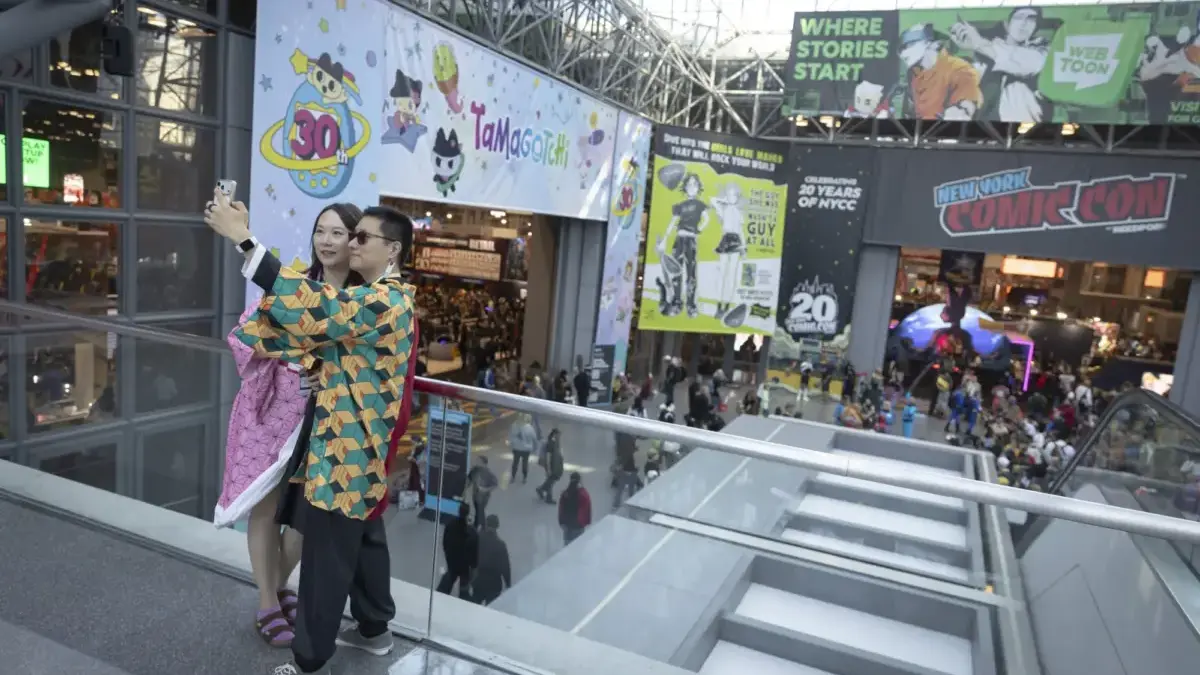
From the dedicated creator lounge perched high above the main entrance of the Javits Center, the view of New York Comic Con offers a striking glimpse into the modern entertainment landscape. Below, thousands of passionate fans stream through the doors in a vibrant, colorful procession of elaborate cosplays, oversized prop weapons, and instantly recognizable pop culture icons brought to life. Towering banners celebrating everything from legacy properties to upcoming television premieres hang overhead, creating a visual spectacle that serves as a massive gathering space for fandom. It is also an ideal backdrop for a viral TikTok video.
That dual reality is entirely intentional. For this year’s convention, organizers deliberately designed the lower portions of the massive entrance banners in the venue’s Crystal Palace with photo and video capture in mind, anticipating precisely how modern attendees document and share their live experiences online.
The creator lounge itself offers a strategic vantage point overlooking the bustling crowds below, equipped with high-speed Wi-Fi, ample workspace for filming and editing, and quiet corners to recharge amidst the sensory overload of the convention floor. It represents just one of the ways New York Comic Con is adapting to accommodate a rapidly growing contingent of digital content creators who arrive at the venue each year equipped with professional cameras, high-end microphones, and massive built-in audiences.
On the bustling show floor below, cosplayers pause for impromptu photo shoots, fans capture spontaneous moments for their personal feeds, and digital creators stop passersby for quick interviews. The convention has effectively transformed into a place as much about manufacturing digital content as it is about experiencing the physical fandoms that brought everyone together in the first place. For some attendees, sharing that excitement online is purely a hobby; for others, it is a full-time profession. Increasingly, however, it is both at once.
Conventions have traditionally functioned as physical sanctuaries where fans gather to celebrate the books, movies, games, and characters they love. But as pop culture fandom continues to flourish across platforms like TikTok, YouTube, Instagram, and other digital spaces, massive pop culture events are evolving right alongside it. Major conventions are morphing into sprawling, temporary content studios where nearly every corner offers a visually distinct moment worth capturing, prompting organizers to completely rethink how they design and manage their physical spaces.
From Convention Floor to Content Feed
For New York Comic Con, this structural shift began in earnest in 2021, when live events returned following pandemic-era lockdowns and short-form video was rapidly transforming how everyday consumers discovered and engaged with entertainment media. That year, event organizers took a calculated risk by hiring two independent content creators to take total control of the convention’s official TikTok account during the four-day event. According to marketing director Fallon Prinzivalli, that single experiment proved wildly successful, reaching more than 8 million unique viewers in just four days.

"We started engaging with them very intentionally following the pandemic when live events were coming back," Prinzivalli explained.
What followed that initial success was a much more formal, structured approach to working with digital influencers and independent creators, including the introduction of dedicated badges and, eventually, a specialized lounge built around their unique operational needs. In earlier years, many influencers had been forced to apply for traditional press credentials despite not strictly qualifying as editorial journalists or print media. NYCC recognized that these independent digital personalities offered a fundamentally different, yet undeniably valuable, type of engagement for the convention and its corporate exhibitors.
Today, New York Comic Con offers a strictly limited number of complimentary creator badges to qualified applicants. Although the official submission guidelines specify a benchmark of at least 200,000 followers across major social platforms, Prinzivalli noted that the convention also evaluates smaller, emerging creators based on the strength of their niche communities, creative originality, and overall cultural impact.
The demand for these credentials has proven immense. Organizers received thousands of applications for this year’s event and were forced to close the submission window early in August after reaching maximum capacity, though Prinzivalli declined to disclose the exact number of badges ultimately issued.
The physical creator lounge itself evolved directly out of the practical realization that modern digital creators require far more than just a standard table and an internet connection to do their jobs effectively. Organizers wanted to provide dedicated, reliable Wi-Fi situated right in the middle of the convention’s energetic ecosystem—a space where creators could seamlessly film segments, edit video files on the fly, and network with peers. Above all, it provides a quiet sanctuary to catch their breath before diving back into the overwhelming chaos of the show floor.
When Fandom Becomes a Production Schedule
For Kallen Zborovsky-Fenster, a New York City-based digital creator who publishes content under the handle @king_kallen on TikTok, New York Comic Con stands as one of the absolute highest priorities on his annual production calendar. He routinely spends weeks preparing for the event long before doors open, carefully developing interview topics, gathering portable technical equipment, and transforming his standard at-home recording setup into a mobile production rig. This year, his packed schedule included interviewing fellow creators and convention attendees about everything from upcoming cinematic releases to the shifting landscape of the comic book universe.

"This is one of my highest priority events," he said.
The creator lounge provides him with an essential, controlled environment to conduct sit-down interviews, recharge his gear, and converse with other professionals working within the entertainment sphere. Even so, he prefers not to spend his entire weekend sequestered upstairs away from the action. "I want to go where the people are," he noted.
For Caroline Martini, who shares dedicated cosplay and convention vlogs with her online audience as @newyorkcaroline, the preparation process looks distinctly different. Before arriving at the Javits Center, she maintains a meticulously organized running list of specific video concepts and visual shots she wants to capture using her smartphone notes app. She also designs and constructs many of her own intricate costumes, including an elaborate Éowyn cosplay from The Lord of the Rings that she proudly wore to this year’s convention floor.
Between filming detailed cosplay showcases and producing daily convention vlogs for TikTok, Instagram Reels, and YouTube Shorts, Martini maintains a relentlessly busy schedule. The pace of convention days can frequently become so overwhelming that her daily vlogs occasionally fail to make it online until the following morning. When an individual’s livelihood and personal passion revolve around creating content about the things they love, drawing a hard line between genuinely enjoying the moment and the constant urge to document it can prove remarkably difficult.
While Martini acknowledges the functional benefits of the creator lounge’s professional lighting and curated photo backdrops, she rarely spends extended periods of time inside it. Not all of her personal friends hold official creator badges, and her primary goal remains experiencing the convention alongside them. After all, even as conventions increasingly formalize creators as industry professionals, the individuals operating the cameras remain passionate fans at heart.
A New Kind of Convention Community
The tangible benefits of dedicated creator access extend far beyond simply securing a comfortable place to film and edit footage. Zborovsky-Fenster, a Columbia University student with professional aspirations in entertainment law and media production, views New York Comic Con as an invaluable networking opportunity to build lasting industry relationships. Having secured a creator badge for his second consecutive year, he was determined to earn his return by submitting multiple detailed applications complete with analytics and examples from his previous year’s coverage.

While the complimentary badge makes attending the massive convention financially manageable, the interpersonal connections forged on-site hold equal weight. Through professional collaborations and shared spaces, creators rapidly expand their networks, frequently joining forces to attend industry events and support one another’s digital channels.
For Dominique Little, who regularly publishes vlogs and energetic dance videos to her 1.8 million TikTok followers under the handle @nojill, the dedicated lounge removes the logistical friction of collaborating with peers. Rather than wandering endlessly across a massive, crowded convention floor trying to coordinate meetups, creators have a designated physical hub to coordinate schedules, film joint content, and make guest appearances in each other’s videos, complete with shared equipment like tripods.
Furthermore, the practical demands of a digital production schedule are rarely glamorous. Between recording hours of footage, rendering heavy video files, and uploading content to tight deadlines, reliable high-speed internet access, accessible charging outlets, and a simple place to sit down can dramatically alter a creator’s daily workflow.
For Brandon Bullock, who covers breaking anime developments under the moniker Anime News Guy, the lounge serves yet another vital operational purpose. His digital coverage is heavily dictated by fast-moving news announcements breaking live from convention panels, requiring him to capture, edit, and publish video packages almost instantaneously while public interest remains at its peak. He records his initial reporting directly on the show floor before retreating upstairs to the creator lounge to quickly edit and push the content live.
Bullock openly identifies as a reporter, even while participating directly in the convention’s official creator ecosystem. It highlights a professional distinction that has grown increasingly difficult to define in modern media. Today’s digital creators are actively conducting press interviews, breaking entertainment news, hosting live broadcasts, and constructing powerful, independent media brands from the ground up.
Prinzivalli has witnessed this shifting paradigm firsthand. Many prominent creators are now treated with the kind of reverence traditionally reserved for mainstream celebrities within the fandoms they cover, frequently mobbed on the convention floor by admirers requesting selfies and autographs. At modern pop culture conventions, a single individual can effortlessly embody the roles of dedicated fan, working journalist, and viral celebrity—sometimes all at the exact same time.

Built to Be Shared
The undeniable, expanding influence of digital creators is ultimately reflected in the physical architecture and spatial design of modern conventions, down to the smallest decorative details. Organizers acknowledge that virtually every element constructed for an event must function as a shareable digital moment.
That deliberate philosophy extends across corporate sponsor activations, directional signage, and the overall layout of the sprawling exhibition floor. To celebrate New York Comic Con’s 20th anniversary, organizers purposely engineered the lower sections of the grand entrance banners inside the Crystal Palace to double as pristine photo and video backdrops. Even the physical halls are conceptualized through the precise lens of a camera, with careful consideration given to how those environmental aesthetics will translate across social media feeds.
Concurrently, the convention has significantly expanded its internal livestream production capabilities, broadcasting panels from major stages, deploying roaming camera crews onto the active show floor, and operating a dedicated media studio in the River Pavilion to interview visiting film casts and creative talent between panels. This year’s official broadcast featured a rotating lineup of hosts combining experienced entertainment journalists with digital personalities boasting massive established online followings, such as creator and podcast host Brandon Davis.
Together, these multi-channel broadcasting efforts successfully extend the convention’s cultural reach far beyond the physical walls of the Javits Center, ensuring that fans unable to make the trip to New York City can still experience the excitement as it happens in real time.
Prinzivalli views the fundamental relationship between online fandom and physical events as a continuous, circular ecosystem. Vibrant digital communities successfully rally fans together in physical spaces, where their collective enthusiasm transforms into the exact photos, videos, interviews, and conversations that ultimately feed back into those very same digital feeds.
So much of modern fandom inherently exists online—embedded within group chats, comment sections, and the endless scroll of social media algorithms. Major conventions offer a rare, powerful opportunity to translate those intangible digital connections into the physical world, turning online usernames into familiar faces and shared digital interests into tangible community. As those experiences inevitably find their way back onto the internet, the individuals documenting them continue to cement their growing influence over modern entertainment culture.
Leave a Reply