
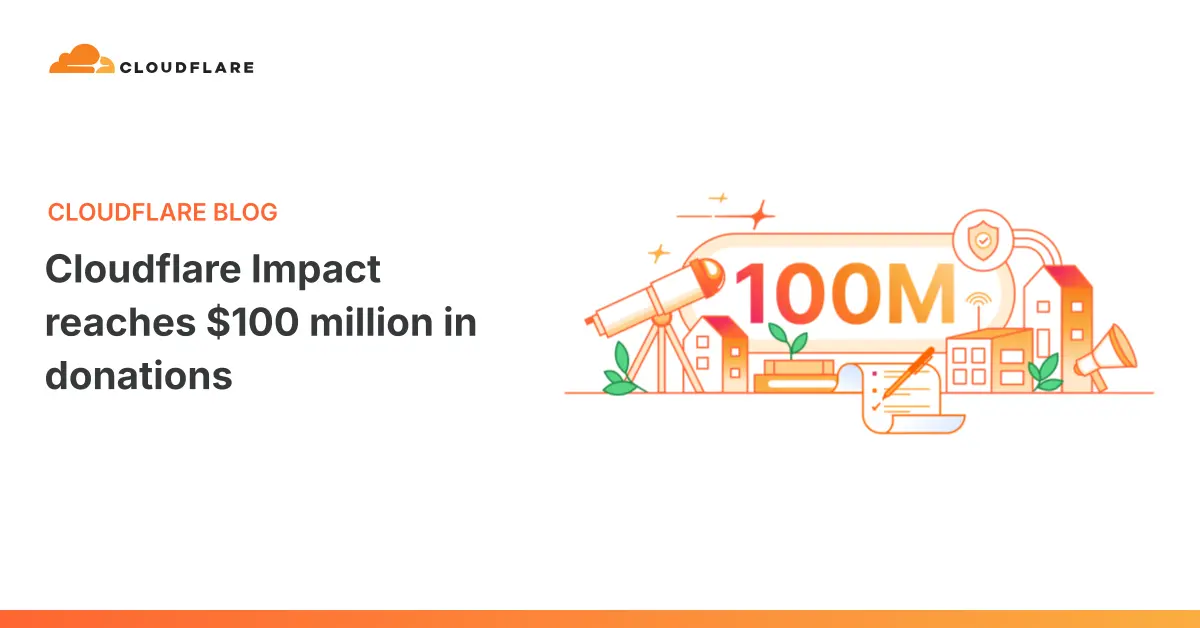
Cloudflare has announced a major milestone for its Impact programs, revealing that the total value of donated cybersecurity services provided to vulnerable organizations worldwide will reach $100 million this week. The achievement underscores the company’s ongoing commitment to safeguarding thousands of independent journalism outlets, civil society groups, human rights defenders, state and local governments, election management bodies, and public schools from escalating cyber threats.
While the scale of the milestone reflects significant philanthropic impact, executives at Cloudflare emphasize that these initiatives have never been treated as mere corporate charity. Instead, they are framed as a fundamental pillar of the company’s core business model and overarching mission—shaping nearly every operational and strategic decision the firm makes.
As Cloudflare celebrates this financial and operational milestone alongside its 16th Birthday Week, company leadership is taking the opportunity to look back on the evolution of its public interest initiatives. The retrospective highlights not only the journey that brought the platform to this juncture, but also how these programs are continuously adapting to meet the complex technological challenges faced by public interest workers today.
The Origins of Free Protection and the Birth of Project Galileo
Cloudflare originally launched as a free service with a pragmatic economic model. The initial concept was to provide a basic, accessible tier of infrastructure to developers and small businesses at no cost. By observing and analyzing the cyberattacks directed at these smaller websites, the company gathered vital threat intelligence to build and refine more sophisticated commercial products.
However, this strategy yielded an unexpected realization. Platform administrators quickly discovered that a substantial portion of their free tier users were operating organizations engaged in essential, high-risk public service work—such as journalists reporting on government corruption in Africa or documenting the Russian invasion of Crimea. At the same time, these vital public interest entities were frequently targeted by some of the most sophisticated and largest distributed denial-of-service (DDoS) attacks traversing the global network.
That revelation profoundly shifted Cloudflare’s perspective on its free services. The company formalized a dual commitment: keeping essential tools freely available for all users while establishing dedicated, advanced defenses tailored specifically for organizations targeted by powerful adversaries simply because they served the public interest.
This commitment led to the creation of Project Galileo in 2014, an initiative designed to provide robust enterprise-grade security services to vulnerable, high-risk organizations online. Over the past twelve years, the scope of these safety nets has expanded significantly. Today, Project Galileo provides specialized digital defense to more than 3,500 domains spread across over 120 countries.
The threat landscape facing these participants remains severe. In 2025 alone, Cloudflare successfully blocked more than 38.5 billion cyberattacks directed at Project Galileo participants, encompassing sophisticated DDoS attempts, website vulnerability exploits, and email phishing campaigns. This translates to an average of nearly 105.4 million blocked attacks every single day.
Data Highlights Escalating Threats Against Civil Society
Over the past dozen years, Cloudflare has steadily broadened its portfolio of Impact programs. Although each program addresses unique operational security needs, the overarching objective remains unified: to support organizations and public institutions that would otherwise lack the financial resources or technical capacity to access critical cybersecurity infrastructure.
To better understand the distinct threat dynamics faced by these groups, Cloudflare released its inaugural annual report on cyberattacks against civil society in early 2026. The findings revealed that civil society organizations are targeted with a frequency and intensity that far surpasses the average commercial customer.
According to the report, Project Galileo participants faced attempts to exploit security vulnerabilities in their websites at a rate more than seven times higher than an average user on the network. Furthermore, application volumes for Project Galileo are currently on pace to more than double compared to the previous year, highlighting a growing global demand for robust digital protection among vulnerable public interest institutions.
Adapting to the Era of Artificial Intelligence
As technology and global threat environments shift, Cloudflare’s Impact programs are evolving beyond traditional cybersecurity defense. Increasingly, the mandate for supporting public interest organizations involves empowering them to adapt, navigate, and thrive in an increasingly complex digital landscape defined by artificial intelligence.
This forward-looking approach was on display in early September 2026 during a rainy afternoon in Barcelona, where Cloudflare co-hosted a specialized hackathon. While the company frequently organizes developer events to showcase its core platform, this gathering marked a significant departure from standard practice. Rather than filling a room with traditional software engineers or venture-backed startup founders, the event brought together a specialized cohort of working journalists.
The hackathon formed part of a comprehensive three-day conference organized by Media Party, a nonprofit organization dedicated to fostering media innovation through emerging digital tools. Designed to bridge the gap between journalism and software development, the event challenged journalists, developers, and media strategists to address a pressing, industry-wide question: how newsrooms can successfully adapt to an AI-driven, post-search information landscape.
The collaborative sprint concentrated on four core themes: workflow automation, agentic journalism, synthetic-content verification, and broader information integrity. Throughout the day, participating teams were granted free access to Cloudflare’s advanced developer platform, supplemented by hands-on technical assistance from volunteer Cloudflare engineers.
Following intense development sessions, four teams advanced to the final evaluation round. The ultimate winning project, developed by a team under the name AIdas, produced an innovative tool designed to help researchers and journalists study potential algorithmic bias across politically contested topics. The application works by systematically comparing how different large language models respond to identical prompts, subsequently archiving those responses as transparent, open data for public analysis.
Building a Culture Centered on Public Interest
The Barcelona hackathon represents just one facet of a broader organizational push to extend Cloudflare’s Impact framework beyond defensive cybersecurity, helping public interest institutions navigate systemic technological shifts. Across all of these diverse initiatives, the underlying objective remains unchanged: ensuring that organizations performing vital societal work retain unhindered access to the tools, security, and technical support necessary to advance their missions.
Reflecting on the human element behind these programs, company leadership points to the deep alignment between Cloudflare’s internal culture and its external public commitments. Staff members frequently cite these initiatives as a primary driver for joining the firm.
During the Barcelona event, organizers noted that several participating Cloudflare engineers who volunteered their time specifically highlighted Project Galileo as a key factor in their decision to pursue a career at the company, drawing them to an environment where technical skills could be directly applied to protecting communities and supporting the public good.
For the company, these programs serve as an enduring reminder that its mission extends far beyond commercial operations—actively shaping its identity and attracting talent dedicated to preserving a safer, more resilient internet for institutions serving the public interest.
Leave a Reply