

A year ago, as widespread cost-cutting and shifting industry attitudes led many major technology companies to pull back on intern and new-graduate hiring, Cloudflare chose a radically different path. Moving counter to prevailing trends, the web infrastructure and security giant announced an ambitious, highly visible goal: to hire a staggering 1,111 interns in 2026—a numeric nod to 1.1.1.1, the company’s widely used public DNS resolver.
At the heart of this unconventional recruitment drive was a distinct hypothesis. Cloudflare’s leadership bet that the integration of modern artificial intelligence tools would make early-career talent far more valuable, enabling them to make meaningful impacts on complex systems much faster than previously possible. While industry skeptics worried about the viability of entry-level coding roles in an automated landscape, Cloudflare argued that the best AI utilities help individuals learn massive, unfamiliar architectures faster, experiment with a higher volume of creative ideas, and tackle tougher engineering challenges. Crucially, the company reasoned that AI could never replace the fundamental human energy, raw curiosity, and fresh perspectives that new professionals bring to established teams.
One year into this massive experiment, the results are reshaping how the company builds its products. Cloudflare’s interns are not sitting on the sidelines or working on isolated, throwaway sandbox projects; they are actively writing, testing, and shipping code directly to internal teams and millions of external customers worldwide. In fact, anyone reading this report on the Cloudflare Blog is already interacting with the tangible fruits of their labor. The platform itself runs on EmDash, a custom content management system, and EmDash’s second-ever maintainer began their tenure at Cloudflare as a summer intern.
A New Generation of Builders Across Global Offices
Cloudflare’s sweeping initiative is well on its way toward its numerical namesake. To date, the company has successfully hosted 750 internships distributed across 48 distinct operational teams spanning nine global offices. These hubs include Austin, San Francisco, London, Lisbon, New York, Singapore, Bengaluru, Washington D.C., and Sydney, with recruitment efforts remaining ongoing as the company looks to round out its cohorts.
From their very first day on the job, these interns were embedded directly into active teams to tackle live, production-level problems. Rather than operating under loose oversight, each participant was expected to leave a definitive mark before their tenure concluded—whether that meant shipping a tangible product improvement, streamlining an internal operational process, building a new piece of infrastructure, or uncovering a critical insight that fundamentally alters how a team approaches its daily workflow.
Importantly, this impact extended far beyond traditional software engineering divisions. The scope of intern contributions touched nearly every corner of the enterprise, highlighting the versatility of early-career talent equipped with modern technological leverage. For instance, an internal audit intern designed and implemented an AI-assisted pipeline dedicated to automating ISO compliance control testing and documentation. Meanwhile, a product manager intern took ownership of building an application programming interface, user dashboard, and comprehensive migration tooling designed to modernize credit management systems for the company’s Startup Program.
In the human resources domain, a people team software engineering intern significantly improved background-verification workflows for incoming personnel. On the front lines of customer service, a customer support intern explored innovative ways to leverage artificial intelligence to automatically trigger complex troubleshooting commands directly from raw support case descriptions. These diverse projects underscored the reality that early-career talent, when empowered with the right tools and institutional backing, can drive efficiency and modernization across non-technical and technical departments alike.
AI-Native Interns and Real-World Results
While artificial intelligence served as a central, recurring theme throughout the entirety of the internship program, it was never treated as a shortcut around rigorous learning, foundational accountability, or high engineering standards. Instead, interns utilized advanced AI tools as force multipliers—leveraging them to comprehend unfamiliar codebases and sprawling systems, compare intricate product requirements against actual implementations, rapidly prototype fresh ideas, and automate repetitive administrative chores. By doing so, they drastically accelerated the trajectory from initial question to working, scalable solution.
Even with these advanced capabilities, managers and mentors remained fundamentally indispensable. They provided crucial direction, reviewed high-stakes architectural decisions, and ensured that everything making its way to production met Cloudflare’s rigorous standards for safety, performance, and reliability.
For many participants, the presence of AI essentially moved the starting line of their projects forward by weeks. Where previous generations of engineers might have spent the better part of a month simply mapping out a new project’s architecture, this cohort could create functional scaffolds in a matter of days. This shift allowed them to dedicate a much greater portion of their time to grappling with the difficult, high-level questions that truly define great software engineering: What should we build? Who will actually use it? How do we mathematically verify that it is correct? And what happens when this code finally hits a live production environment serving global traffic?

The transformative impact of these tools led one intern to express a sentiment that neatly captured the shift in perspective: "How did previous interns ship anything in 12 weeks without AI?"
Interns Ship at Cloudflare
When Cloudflare first announced its massive hiring initiative last year, one of the central promises was that interns would immediately begin shipping production-level code. True to that vision, this year’s cohort contributed directly to some of the company’s most high-profile technology releases, with several key projects developed and engineered entirely by interns.
Faced with a sharp climb in global RAM and disk prices over the past year, an intern named Aashi investigated whether Cloudflare could extract greater cache capacity out of its existing hardware infrastructure. Aashi successfully developed Cache Transcoding, a system that compresses eligible digital assets using Zstandard within the primary proxy before those assets are ever written to disk. Initial testing revealed that the tool shrinks assets to an average of one-third of their original on-disk size. This breakthrough points toward petabytes of effective future cache capacity and a notable reduction in redundant data movement across data centers.
In another major software contribution, Noah joined the company as an intern and quickly evolved into EmDash’s second maintainer. Noah contributed sweeping changes across the platform’s media library, content editor, and administrative interface, culminating in the official release of EmDash 1.0 during Cloudflare’s prominent Birthday Week announcements.
Other interns focused on preparing the broader internet infrastructure for a post-quantum future, with Cloudflare targeting 2029 as a milestone for complete post-quantum security. Recognizing that an organization cannot migrate what it cannot visualize, an intern named Tiago helped build CryptoLabe, an internal AI-driven tool that scans the codebase to discover cryptographic implementations and map dependent systems. Simultaneously, an intern named Sophie helped bring per-connection post-quantum visibility directly to Logpush, Log Explorer, and HTTP Traffic Analytics, empowering external customers to audit and verify their own cryptographic migration progress.
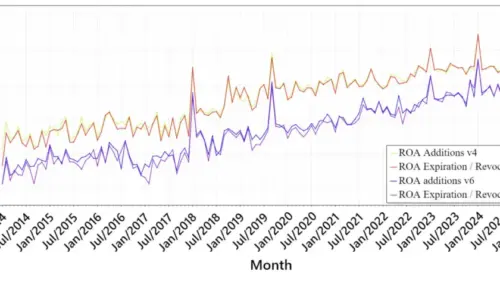
Other intern projects reached far beyond Cloudflare’s proprietary products to tackle foundational issues in the plumbing of the global internet. Iliana measured the frequency with which network operators rewrite BGP’s ORIGIN attribute to redirect traffic toward their own systems, discovering the practice on roughly 70 percent of all observed paths. Iliana subsequently published this data and publicly advocated for the complete removal of the ORIGIN attribute from route selection processes. Additionally, Iliana tracked the adoption rates of RFC 9234, an internet standard that enables routers to autonomously reject dangerous route leaks. By measuring systemic problems, publishing transparent data, and proposing concrete structural fixes, these interns participated in the core mission of building a better, more resilient internet.
Building Community and Connections Together
Beyond the technical deliverables and code repositories, the internship program maintained a strong focus on community, mentorship, and professional networking. Across Cloudflare’s global offices, participants engaged in regular communal meals, collaborative volunteer initiatives, and social events designed to foster peer connections.
In a demonstration of executive engagement, Cloudflare CEO Matthew Prince hosted informal dinners with interns across multiple international offices, taking direct feedback on what the participants were building, what challenges they were facing, and what lessons they were absorbing. These intimate gatherings were supplemented by regular executive Q&A sessions, where interns could ask candid questions concerning company strategy, technological trajectories, and long-term career development. These touchpoints complemented the day-to-day guidance provided by direct managers and mentors, offering interns a comprehensive view of how a large-scale technology enterprise operates and where it is heading in the future.
Looking ahead, Cloudflare intends to expand the program further in the coming year, welcoming a fresh cohort of students, incorporating additional internal teams into the initiative, and continuing to study how early-career technologists achieve their highest potential when backed by advanced AI and collaborative human support.
For Cloudflare, a successful summer internship is viewed merely as an initial milestone; the ultimate goal is cultivating long-term careers and empowering a new generation of builders dedicated to improving the digital landscape.

Leave a Reply