
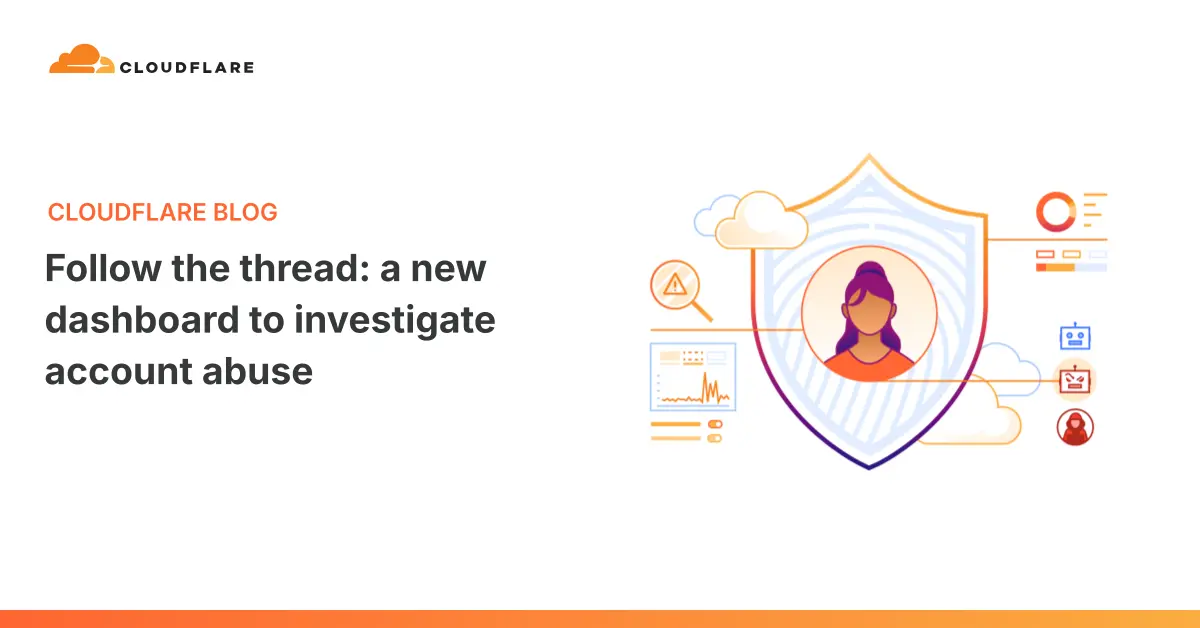
As artificial intelligence tools become more widespread, malicious actors are increasingly leveraging advanced technology to fabricate or imitate legitimate user identities. By combining exposed credentials with synthetic media designed specifically to evade traditional identity verification checks, fraudsters can scale attacks with unprecedented ease. In response to this evolving threat landscape, Cloudflare has announced the rollout of a dedicated fraud dashboard for Account Abuse Protection, debuting first for Early Access customers. The new workspace bridges the gap between aggregate security monitoring and granular account investigations, offering a stateful trust model designed to outpace modern cyber threats.
Traditionally, securing online platforms against unauthorized access relied heavily on point-in-time proof of identity. Users would enter a correct password, complete a biometric verification, or pass a liveness check to gain entry. Defeating these checkpoints required fraudsters to steal actual credentials and other identity evidence from genuine users, a process that was difficult to execute and scale efficiently. Today, however, widespread access to AI has fundamentally altered that dynamic.
Because a single, convincing interaction can be easily faked by automated systems, static identity checks are no longer sufficient. Even when an interaction successfully passes a momentary check, it provides no guarantee that the account itself can be trusted over its lifecycle. While faking a single event is simple, maintaining a consistent, long-term pattern of legitimate behavior is significantly more difficult. Modern fraud prevention must therefore shift away from stateless decisions toward a stateful trust model.
Where traditional verification asks whether a person can pass a check right now, a stateful approach continually asks whether an action fits the established behavioral history known about the account. At Cloudflare, trust is continually earned and reassessed at each interaction, measuring current requests against historical behavioral, network, and device patterns observed across the network.
Cloudflare’s Account Abuse Protection, known as AAP, forms the foundation of this stateful approach by creating comprehensive account overviews that help website owners detect and investigate abuse across login and signup activities. Customers begin by configuring an identifier from their existing authentication flows, such as an email address, username, or phone number. Cloudflare then cryptographically hashes that value to establish a privacy-preserving, per-domain Hashed User ID.
Within the AAP framework, this Hashed User ID acts as a stable anchor representing an account and its associated activity. With every subsequent login or signup attempt, the system appends the new event alongside relevant network and device signals observed at Cloudflare’s edge. Over time, this accumulated history builds a robust context for typical account behavior, making meaningful deviations much easier to spot and giving security teams a solid foundation for deeper investigations.
The newly introduced fraud dashboard brings these capabilities together into a centralized workspace for security intelligence, investigations, trust and safety, and risk and compliance personnel. Designed first for Early Access customers, the dashboard aggregates account overviews derived from observed activity across configured login and signup flows. It enables fraud analysts to survey their entire user population, spot emerging suspicious trends, and seamlessly transition from macro-level activity patterns down to targeted individual account investigations.
Dashboard Overview: From Population Visibility to Individual Account Depth
The architecture of the new dashboard functions as an investigative funnel. When an anomalous or suspicious event is flagged, fraud teams can review a high-level account population overview to understand the true scale and shape of the suspicious pattern without getting bogged down by examining every single account individually.
Security professionals can review total login and signup volumes, track how many distinct accounts generated those events, and analyze the unique IP addresses and devices observed across that user base. Granular country and Autonomous System Number breakdowns provide vital geographical and network context, helping analysts pinpoint exactly where and how activity originates.
This macro-level population overview equips fraud teams to evaluate the broader scope of an active campaign, prioritize specific accounts for manual review, reconstruct the timeline of what transpired, and formulate an effective operational response.

Consider a typical scenario where a fraud or security operations team investigates a sudden surge in unusual login activity. By opening the Account Abuse Protection dashboard, analysts can immediately assess how broadly a credential stuffing attack has impacted their user population. The interface allows them to drill down from total event traffic directly to individual accounts requiring urgent review, leveraging historical context to reconstruct the incident.
The investigative workflow begins by spotting anomalies within the account population overview. An unexpected spike in failed login activity naturally prompts the team to examine the results of leaked credential checks integrated directly into login events. In a typical attack pattern, a summary might show thousands of events producing a leaked username or password result, contrasted against a larger number of events where credentials were classified as clean. This discrepancy serves as an investigative lead rather than immediate confirmation that every flagged account has been successfully compromised.
Armed with this data, analysts can focus intensely on accounts associated with leaked credential matches. They can investigate whether multiple accounts share connections to identical IP addresses or ASNs, or if a single account suddenly appears across an unusually high number of unique IP addresses. These relational insights help define the scope of a credential stuffing campaign and highlight high-risk accounts that demand immediate manual scrutiny.
To handle large datasets efficiently, the dashboard features robust filtering tools that narrow the broader account population down to specific subsets exhibiting the most concerning combinations of risk signals. Analysts can easily apply filters to isolate accounts that feature multiple failed logins, repeated leaked credential matches, and activity spanning numerous unique IP addresses. From this refined cohort, security personnel can pinpoint the exact Hashed User IDs requiring urgent intervention.
Investigating Individual Accounts and Determining Responses
Once a specific account is selected for deep review, the individual account view provides a rich layer of investigative depth. Analysts can examine individual login attempts, identify newly introduced devices or unfamiliar geographic locations, and reconstruct the chronological sequence of events. Using an integrated event table, security teams can compare earlier clean events against subsequent suspicious activity to determine precisely when an anomalous pattern began and whether it manifested as a single incident or a series of repeated attempts.
Every logged event includes a unique Cloudflare Ray ID, a persistent identifier attached to every request traversing Cloudflare’s network. Analysts can readily use these Ray IDs to cross-reference associated telemetry within the broader Security Events logs. This detailed visibility helps answer critical operational questions regarding account health and compromise status, empowering fraud teams to determine whether an affected account requires forced recovery, temporary access restriction, or other tailored interventions.
When an investigation yields sufficient evidence of compromise, analysts can take decisive action. They can initiate established internal account recovery protocols to protect the end user. Simultaneously, they can leverage the account’s Hashed User ID directly within Web Application Firewall rules to challenge or block any future requests originating from or associated with that specific identifier.
To ensure robust internal security and governance, Cloudflare has designed the dashboard to minimize unnecessary data exposure through role-based access control. The launch introduces two distinct access levels: the Account Abuse Protection role, which governs general access to the dashboard interface, and the Account Abuse Protection PII role, which controls visibility into sensitive account-level personally identifiable information such as email addresses.
Customer administrators are encouraged to assign these permissions strictly on a need-to-know basis aligned with each team member’s specific investigative responsibilities. Furthermore, the Account Abuse Protection PII role is explicitly required to create or update Logpush jobs that handle data containing PII, ensuring that organizations can easily enforce the principle of least privilege across both interactive dashboard workflows and automated data export pipelines.
The new fraud dashboard is currently rolling out to Account Abuse Protection Early Access customers. Enterprise customers utilizing Bot Management who wish to integrate these advanced stateful trust capabilities can sign up for Early Access through Cloudflare’s portal, while prospective customers can contact the sales team to learn more. By pairing automated bot detection with stateful account overviews, website owners gain a comprehensive toolkit designed to combat both automated scripts and sophisticated human-driven abuse across every stage of the user journey.

Leave a Reply