
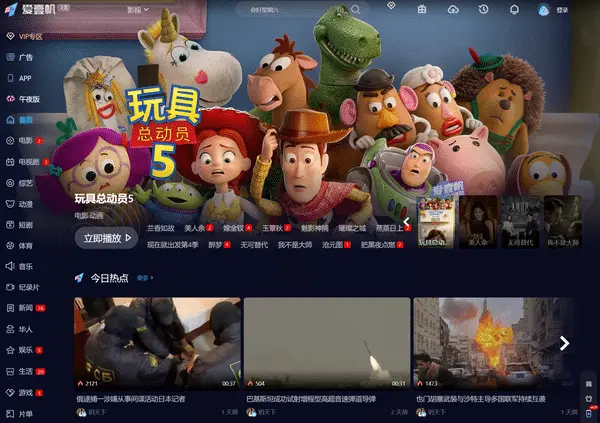
Chinese streaming giant iQIYI has secured a significant legal victory in a United States federal court against Aiyifan, a prominent pirate streaming network catering to Chinese-speaking audiences residing outside of China. While the U.S. court ruled in favor of the streaming platform and issued a multimillion-dollar judgment, the outcome fell drastically short of the staggering financial penalties iQIYI originally demanded, and the presiding judge notably declined to hand over the platform’s valuable domain names.
The legal battle in the United States mirrors a broader, multi-jurisdictional crackdown on online piracy originating from Chinese platforms. Last month, rival streaming behemoth Tencent successfully won the initial phase of its own U.S. legal battle against another pirate platform, Olevod, proving that major Asian media companies are increasingly willing to cross international borders to protect their intellectual property. iQIYI utilized the same Florida court and legal representation to pursue Aiyifan, which operates across multiple domains and alternative titles including YFSP and IYF.
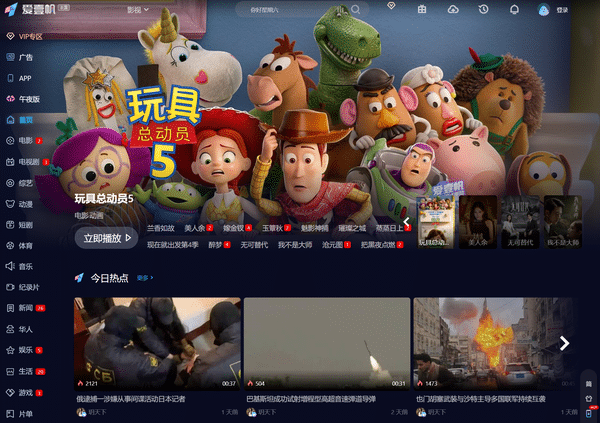
Aiyifan maintains a sprawling digital footprint across various domains such as aiyifan.tv, yfsp.tv, and iyf.tv, drawing substantial web traffic from overseas viewers. According to data from analytics platform Similarweb, the yfsp.tv domain alone pulled in roughly 14 million visits during the month prior to the court proceedings. Despite the massive scale of the operation, Aiyifan chose not to appear in the U.S. court, and the operators behind the network were not formally named as individual defendants in the Florida civil complaint.
However, the civil lawsuit in the United States is only one front in a much larger legal onslaught against the architects of the pirate enterprise. While the platform’s operators managed to ignore the proceedings across the Pacific, they could not escape local authorities in China, where criminal prosecution has already resulted in significant prison sentences.

Operator Jailed in China
In August, iQIYI updated the Florida federal court regarding parallel criminal proceedings taking place overseas. The Shanghai Third Intermediate People’s Court officially upheld the criminal conviction of Wang Jianyang, whom court documents identify as one of the principal masterminds behind the Aiyifan network.
According to the official Shanghai court ruling, Wang managed a company located in Chongqing that was specifically established to provide the underlying technical infrastructure and app support for Aiyifan. Beyond technical operations, Wang was also heavily involved in managing advertising and promotional campaigns for the illegal streaming platform, having worked on the project since 2022.
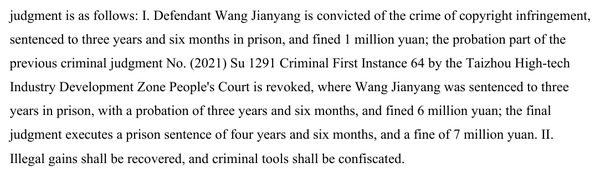
Chinese law enforcement detained Wang in March 2024, more than a year before iQIYI ultimately filed its civil copyright infringement lawsuit in Florida. Wang was no stranger to law enforcement scrutiny. Back in 2021, a court in Jiangsu province previously convicted him for setting up an entirely separate pirate streaming website, handing down a three-year suspended prison sentence alongside a hefty fine of 6 million yuan.
The Aiyifan platform was launched while Wang was still serving his probationary period. Consequently, in March of this year, a district court in Shanghai officially revoked the suspension of his earlier sentence and imposed an additional three-and-a-half-year prison term, accompanied by a 1 million yuan fine. Combined together, Wang now faces a total of four and a half years behind bars and a financial penalty totaling 7 million yuan.

Wang attempted to challenge the verdict on appeal, arguing that the presented evidence was fundamentally insufficient and asserting that his involvement was strictly limited to providing technical support services. The appellate court firmly rejected these arguments, concluding that his role was central and indispensable to the ongoing operation of the piracy syndicate. That criminal ruling is now final and unappealable.
Florida: $1.96 Million Instead of $196 Million
Back in the United States, iQIYI initiated its civil lawsuit in the U.S. District Court for the Southern District of Florida with the primary objective of shutting down the network’s operations. Because Aiyifan failed to mount a legal defense or respond to the formal complaint, the court entered a default judgment against the operators in July 2025.
Seizing upon the default status, iQIYI initially requested a colossal $196.55 million in statutory damages. The vast majority of this massive sum was calculated by applying the maximum statutory penalty of $150,000 per violation across 776 formally registered copyrighted works. Furthermore, the platform sought an additional $78.55 million in proposed damages tied to thousands of other unregistered works hosted on the site.
In January, U.S. District Judge Melissa Damian ruled that Aiyifan was indeed legally liable for copyright infringement. However, she sharply rejected the astronomical damages request, noting that the figures lacked adequate legal and evidentiary support. In response, iQIYI submitted a revised, lowered request seeking $54.4 million, but the court deemed this figure excessive as well.
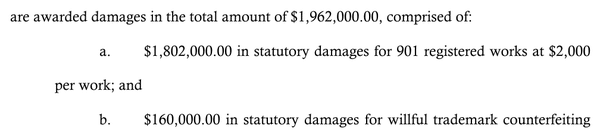
In her final order, Judge Damian awarded $1,000 for each registered work, which was subsequently doubled due to the willful nature of the infringement, resulting in a baseline total of $1.8 million. This calculation ultimately covered 901 works, as iQIYI had managed to process additional copyright registrations as the litigation progressed over time.
Trademark infringement claims added another $160,000 to the total, while the court declined to award any statutory damages for the roughly 5,000 unregistered works included in the complaint. Ultimately, the final judgment awarded iQIYI approximately $1.96 million—roughly one percent of the streaming company’s original financial demand.
Judge Won’t Transfer Domains
The reduced monetary award was not the only procedural hurdle iQIYI encountered. The streaming giant’s aggressive efforts to secure a sweeping injunction were also substantially scaled back by the court.
In its initial filings, iQIYI specifically targeted the infrastructure of the pirate network, requesting that the court force registrars to hand over the domain names entirely and redirect internet traffic straight to iQIYI’s official platform. Additionally, the company sought broad mandatory orders compelling internet service providers, web hosting companies, content delivery networks, payment processors, and messaging platform WeChat to completely cut off services to Aiyifan.
Although the amended motion for default judgment eventually dropped most of the third-party service providers, iQIYI continued to press for full domain name takeovers to effectively force the sites permanently offline.
Judge Damian remained unconvinced that such a broad remedy was appropriate under the circumstances. During the proceedings, iQIYI acknowledged that it could not definitively quantify how much of the content hosted across the domains was actively infringing versus whether any of the remaining library was properly licensed.
Because Aiyifan streams a considerable amount of media content not directly owned or licensed by iQIYI, executing a total domain takeover would overreach the scope of appropriate legal remediation, the judge concluded. The official order explicitly recognized that while some judges within the same judicial district have historically adopted a more liberal approach to granting injunctive relief, Judge Damian chose to strictly adhere to the Eleventh Circuit’s established requirement that injunctions must be narrowly tailored to the specific harm proven.
Partial Domain Registrar Suspensions?
Rather than ordering a complete transfer of domain ownership, the final judgment directs domain name registrars to cancel specific web pages and subdomains that prominently feature iQIYI’s copyrighted television shows or registered trademarks, provided that iQIYI supplies an itemized list.
The judgment further dictates that if a registrar fails or refuses to comply with these specific takedown directives, the applicable domain registry must transfer the management of the domain to a registrar chosen explicitly by iQIYI. While this mechanism alters the administrative registrar, it still falls short of transferring actual ownership of the digital property to the copyright holder.
Whether domain registrars possess the technical capability to comply with these orders remains highly questionable. Standard domain registrars manage the overarching registration and contact data of a web address rather than the individual web pages hosted on a server, meaning their primary tools are limited to suspending or redirecting an entire domain as a single unit.
Such a broad suspension is precisely the outcome the court explicitly sought to avoid. Furthermore, handling individual subdomains presents distinct technical challenges. Platforms such as m.yfsp.tv and www.yfsp.tv share a foundational domain name, and a registrar can typically only disable an individual subdomain if it directly controls the domain’s underlying Domain Name System (DNS) configurations.
For the time being, the various Aiyifan domains remain fully operational online. Given that the site’s anonymous operators have continuously refused to participate in the U.S. legal proceedings, it remains unclear whether iQIYI will ever be able to successfully recover any portion of the multi-million-dollar judgment awarded by the court.


Leave a Reply