
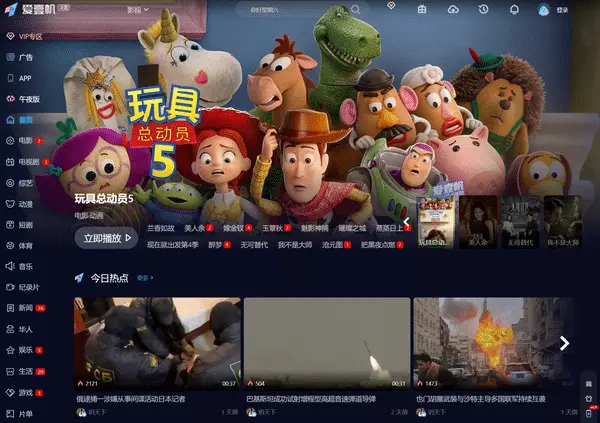
Chinese streaming giant iQIYI has secured a $1.96 million default judgment in a United States federal court against Aiyifan, a prominent pirate streaming network that caters to Chinese-speaking audiences residing outside of China. While the ruling marks a significant legal milestone in the ongoing cross-border crackdown on digital piracy, the final financial award represents just a tiny fraction of the staggering sum initially requested by the plaintiff, highlighting the complex evidentiary hurdles streaming platforms face when taking legal action in foreign jurisdictions.
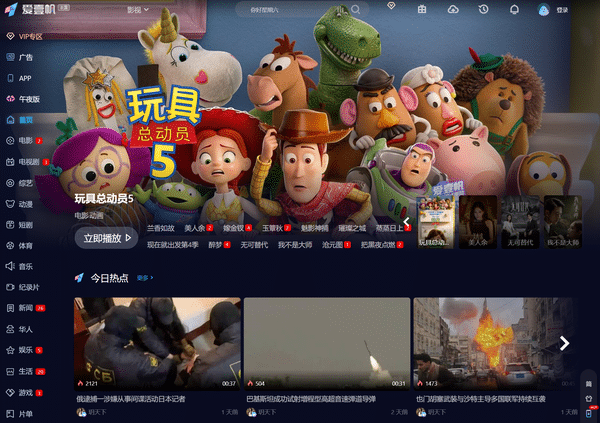
The case in Florida mirrors a similar legal strategy deployed by rival Chinese streaming platform Tencent, which recently won the initial phase of its own U.S. courtroom battle against the pirate service Olevod. Both companies have increasingly turned to American courts to disrupt platforms that siphon international viewership away from authorized channels. Aiyifan—which operates extensively under alternative brand names such as YFSP and IYF across multiple domains including aiyifan.tv, yfsp.tv, and iyf.tv—draws substantial global traffic. According to web analytics from Similarweb, the single domain yfsp.tv alone pulled in approximately 14 million visits in a single month, demonstrating the vast scale of the unauthorized distribution network.
Unlike Olevod, which faced the court directly, Aiyifan chose not to participate in the U.S. proceedings, and its primary operators were never formally named as individual defendants in the Florida lawsuit. Even so, the site’s anonymous operators have not escaped legal consequences altogether. In a parallel development that underscores the international scope of the enforcement efforts, one of the platform’s key operational figures has recently been sentenced to prison time in China.
Operator Jailed in China

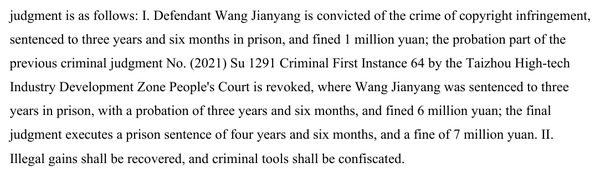
In August, legal representatives for iQIYI submitted documentation to the Florida federal court revealing that the Shanghai Third Intermediate People’s Court had formally upheld the criminal conviction of Wang Jianyang, whom prosecutors identified as a principal operator behind the Aiyifan network.
According to the translated Shanghai court ruling submitted into the U.S. record, Wang managed a business entity based in Chongqing that was responsible for delivering the critical technical support required to keep Aiyifan’s website and mobile applications functional. In addition to his technical contributions, Wang oversaw advertising and promotional strategies for the illicit platform, maintaining active involvement with the network since 2022.
Chinese law enforcement authorities detained Wang in March 2024, more than a year before iQIYI initiated its civil lawsuit across the Pacific Ocean in Florida. Wang’s criminal history regarding intellectual property theft dates back even further. In 2021, a court in Jiangsu province handed down a three-year suspended prison sentence alongside a 6 million yuan fine after finding him guilty of establishing and operating an entirely separate pirate streaming website.
The illicit launch of Aiyifan occurred while Wang was still serving his probationary period. Consequently, in March of this year, a Shanghai district court revoked the suspension of his previous sentence, appending an additional three-and-a-half-year prison term and a 1 million yuan fine. Combined, Wang now faces a total of four and a half years behind bars and a heavy financial penalty of 7 million yuan.
Wang attempted to challenge the verdict on appeal, arguing that the presented evidence was fundamentally insufficient to justify the severity of the charges and claiming that his contributions were strictly limited to basic technical support. The appeals court firmly rejected these arguments, concluding that Wang had indeed maintained a vital, leadership-level role in the execution of the enterprise. That appellate decision is now final.

Florida: $1.96 Million Instead of $196 Million
In the United States, iQIYI’s civil litigation was designed primarily to force the complete shutdown of the sprawling pirate infrastructure. Because Aiyifan’s operators completely ignored the U.S. federal complaint, the court entered a default against them in July 2025.
Seizing upon the default status, iQIYI initially petitioned the court for an extraordinary $196.55 million in statutory damages. The vast majority of this massive figure was calculated by applying the statutory maximum of $150,000 per violation across 776 formally registered works, with thousands of additional unregistered works contributing another $78.55 million to the proposed total.
In January, U.S. District Judge Melissa Damian ruled that Aiyifan was indeed legally liable for copyright infringement. However, she flatly rejected the initial damages calculation, noting that it lacked adequate evidentiary support. Although iQIYI quickly responded with a revised request totaling $54.4 million, the court determined that even this adjusted figure remained excessive.
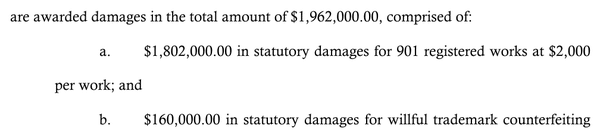
In a final order issued by Judge Damian, the court awarded $1,000 per registered work, which was subsequently doubled on the grounds of willful infringement, resulting in a baseline of $1.8 million. This calculation covered a total of 901 works, as iQIYI managed to process additional copyright registrations while the litigation slowly progressed.
Additional trademark infringement claims added another $160,000 to the total, while the court declined to award any statutory damages for the approximately 5,000 unregistered works included in the complaint. Ultimately, the final judgment settled at $1.96 million—roughly one percent of the streaming company’s original financial demand.
The reduced financial award is not the only hurdle iQIYI has encountered in its quest for comprehensive relief, as the presiding judge also placed strict limitations on the scope of the requested injunction.
Judge Won’t Transfer Domains
iQIYI’s legal strategy relied heavily on targeting the pirate network’s domain names, requesting a court order that would force registrars to hand over the domains and redirect internet traffic directly to iQIYI’s own official platform. Furthermore, the streaming company sought broad injunctions compelling internet service providers, hosting companies, content delivery networks, payment processors, and WeChat to completely sever all ties and stop providing services to Aiyifan.
Although iQIYI eventually dropped most of the third-party service providers from its amended motion for a default judgment, it maintained its core demand for mandatory domain takeovers to drive the pirate sites permanently offline.
Judge Damian remained unconvinced that such broad measures were legally appropriate. Crucially, iQIYI candidly admitted during the proceedings that it could not definitively prove what precise percentage of the massive content library hosted on the pirate domains was actually infringing, nor could it guarantee that all other hosted material lacked proper licensing agreements.
Because Aiyifan consistently streams a wide variety of audiovisual content that is not exclusively owned by iQIYI, executing a total domain takeover would overreach the boundaries of fair legal remedies, the judge concluded.
The court’s written order explicitly acknowledged that while some judges within the same judicial district have historically favored a more liberal approach to issuing sweeping injunctive relief, Judge Damian felt bound to adhere strictly to the Eleventh Circuit’s established legal requirement that all injunctions must be narrowly tailored to the specific violations proven in court.
Partial Domain Registrar Suspensions?
Rather than ordering a complete transfer of ownership, the final judgment directs domain registrars to cancel specific webpages and subdomains that prominently feature iQIYI’s copyrighted television shows or registered trademarks, provided that the streaming company supplies an exact list of offending URLs.
The order further specifies that if a registrar refuses or fails to comply with this directive, the overarching registry must forcibly transfer the management of the domain to a registrar selected directly by iQIYI. While this mechanism alters the administrative registrar handling the domain, it deliberately avoids transferring actual ownership of the underlying web property.
Practical implementation of this remedy remains highly questionable. Domain registrars traditionally control the overarching registration of a domain name rather than the specific, granular webpages housed on a live server. Consequently, the only enforcement tools realistically at a registrar’s disposal involve suspending or redirecting an entire domain as a single unit—precisely the broad, indiscriminate outcome the court explicitly sought to avoid.
Even targeting specific subdomains presents technical obstacles. Popular subdomains like m.yfsp.tv and www.yfsp.tv share the exact same root domain, and a registrar is generally incapable of disabling one without simultaneously controlling the domain’s underlying Domain Name System configuration.
For the time being, the various web portals associated with Aiyifan remain fully operational online. Given the complete absence of a defense or appearance from the platform’s anonymous operators, it remains entirely uncertain whether iQIYI will ever successfully recover any portion of the multi-million-dollar judgment awarded by the court.


Leave a Reply