
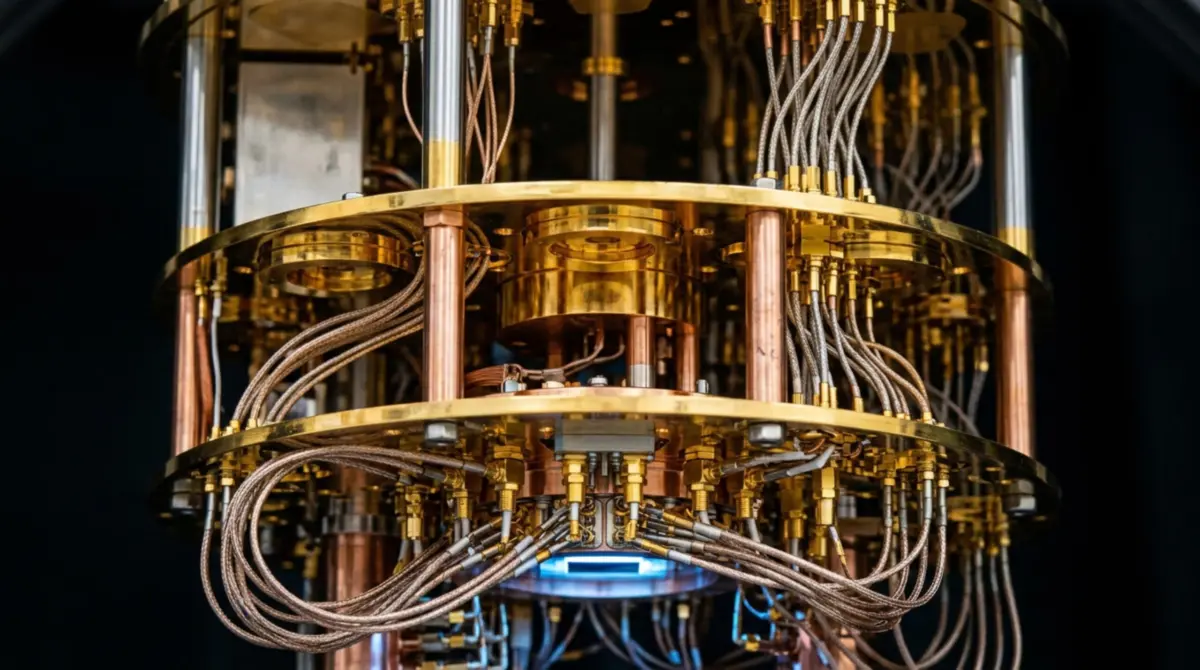
For years, the quantum computing industry has been locked in a seemingly singular debate centered on qubits. Stakeholders, researchers, and engineers have endlessly discussed how many physical or logical qubits a system can support, how quickly errors can be corrected, and when fully fault-tolerant systems will finally arrive. Conferences and boardrooms are routinely dominated by questions over which qubit modality—whether superconducting circuits, trapped ions, or neutral atoms—will ultimately win the race and scale the fastest.
While these remain critical hardware questions for the physics community, a growing faction within the industry argues they may not be the most pressing inquiries regarding the ultimate utility of quantum computing. Throughout 2026, IBM has championed a fundamentally different perspective. Rather than treating the quantum computer as an isolated, standalone box operating in a vacuum, IBM is advancing an architecture where quantum processors function as specialized computing resources sitting alongside central processing units (CPUs), graphics processing units (GPUs), and other accelerators.
IBM calls this overarching architecture quantum-centric supercomputing.
Though the name carries a touch of corporate marketing, the underlying systems concept is profound. Instead of forcing a quantum computer to handle an entire end-to-end task alone, a complex workload is dynamically divided among different computing resources. Each resource performs the specific portion of the problem it handles best. CPUs take charge of general-purpose processing and overall system orchestration. GPUs accelerate highly parallelized classical computations. Quantum processing units, or QPUs, execute those specific sub-problems where quantum algorithms provide a demonstrable advantage. Meanwhile, artificial intelligence steps in to help manage, optimize, and orchestrate these multi-layered workflows.
This paradigm shift frames the evolution of quantum systems not as a story of quantum computers eventually replacing classical computers, but rather as the integration of quantum mechanics into the broader fabric of enterprise and scientific computing.
IBM formalized this philosophy earlier in the year by publishing a comprehensive reference architecture for quantum-centric supercomputing. The model outlines QPUs operating in tandem with CPUs and GPUs across high-performance computing (HPC) centers, national research laboratories, and expansive cloud environments. Crucially, the framework treats the combined workflow—not any single processor—as the actual computing system.

In the months following the publication of this reference architecture, IBM and its global research partners have provided increasingly compelling evidence supporting the viability of this collaborative approach.
In July, IBM and researchers at the University of Chicago announced a breakthrough demonstration of quantum advantage. The team utilized logical quantum circuits to execute a computation that lay entirely beyond the practical reach of leading classical simulation methods, while simultaneously establishing a rigorous protocol to verify and trust the resulting data. Additional collaborations involving IBM alongside technology firms like Qedma and Algorithmiq reported separate quantum advantage outcomes, focusing specifically on problem spaces where conventional classical approximations could no longer generate consistent or reliable answers.
Quantum advantage has long served as one of the most anticipated and fiercely contested milestones in the technology sector. However, a close look reveals a vital architectural detail behind IBM’s methodology. IBM’s own 2026 development roadmap deliberately frames quantum advantage not as a solitary achievement of a QPU, but in the context of a quantum processor tightly coupled with high-performance classical infrastructure. The company is actively building an integrated software and hardware environment where quantum code and classical subroutines can be deployed as unified components of a single workload.
This evolution mirrors the historical trajectory of other computing paradigms. When GPUs first emerged as graphics engines, they did not completely replace CPUs. When specialized AI accelerators arrived, they did not render GPUs obsolete. Instead, each technology evolved into a specialized resource within an increasingly heterogeneous computing architecture, seamlessly coexisting to solve larger problems.
The rapid rise of AI inference is already accelerating this architectural transition across modern data centers. Contemporary inference infrastructure distributes different stages of a massive workload across CPUs, GPUs, specialized networking processors, and custom accelerators. Data preparation, model execution, vector retrieval, memory management, orchestration, and complex agentic workflows rarely run on a single processor type. Instead, what an end user experiences as a unified AI application is actually an orchestrated workflow spanning numerous disparate, specialized computing resources.
Quantum computing is now firmly tracking along the same architectural path. A prime example of this reality emerged from joint research conducted by IBM, Oak Ridge National Laboratory, and the Cleveland Clinic. In July, the research team reported the first-known quantum computer calculations targeting molecular configurations for a material critical to producing tritium fuel for fusion energy.

The significance of the breakthrough lay less in the fact that a quantum computer was used, but rather how it was used. Researchers relied on quantum-centric supercomputing techniques to divide the massive scientific problem between quantum and classical resources. Quantum systems calculated specific segments of the complex electronic structure problem, while classical supercomputers supported the broader, sprawling scientific workflow. IBM characterized this milestone as a fusion of quantum computing, AI, and exascale computing, deployed to tackle a problem that remains intractable for classical systems working in isolation. In this operational model, the quantum computer was not the entire computer; it was a powerful, specialized component of a much larger system.
The exact same operational pattern has become increasingly apparent in IBM’s ongoing work with the Cleveland Clinic and RIKEN. Previous research from the collaborative group utilized IBM Quantum Heron processors alongside classical supercomputing resources to accurately simulate biologically relevant molecular systems containing upwards of 12,635 atoms. That groundbreaking research was subsequently named a finalist for the prestigious 2026 ACM Gordon Bell Prize, one of the highest accolades in the global high-performance computing community.
Even more significant developments followed as the group engineered a fully automated, end-to-end workflow capable of executing smoothly across quantum and classical resources simultaneously. Tasks that previously demanded heavy manual coordination, custom scripting, and deliberate data transfers between disparate systems could instead be automated as native steps within a larger, unified workflow.
For the long-term trajectory of the industry, this software automation may ultimately prove far more significant than simply scaling up the size of modeled molecules. The transition from manually stitching together quantum and classical experiments to fully automated workflow execution makes the QPU look less like an esoteric physics experiment and more like a dependable accelerator embedded within a standard computing environment.
This mirrors the history of graphics processing. Very few modern application developers think about the low-level mechanics of physically moving workloads back and forth between a CPU and a GPU. Sophisticated software frameworks, runtimes, and low-level schedulers abstract away the vast majority of that operational complexity. While the underlying processor remains critically important, the surrounding infrastructure ultimately determines whether its raw capabilities can be practically and efficiently harnessed. Quantum computing is now confronting this exact architectural challenge.
At the hardware level, IBM continues to push the boundaries of QPU performance. The company’s recently introduced Nighthawk r2 processor is capable of executing more than 100,000 circuits per second, a performance metric IBM notes represents up to a 25-fold increase in circuit throughput compared to its prior Heron systems. Furthermore, the Nighthawk r2 has successfully demonstrated highly accurate computations running on circuits containing more than 7,500 gates.

Simultaneously, IBM is investing heavily in the underlying manufacturing infrastructure required to scale the global quantum ecosystem. In September, IBM subsidiary Anderon finalized a $1 billion award under the U.S. CHIPS and Science Act to develop a state-of-the-art 300-millimeter pure-play quantum foundry. Backed by an additional $1 billion matching investment from IBM, the facility will manufacture advanced quantum wafers for IBM and other commercial quantum developers. This foundry model is designed to eventually allow quantum innovators to focus their capital and talent on architectural design, systems engineering, and software development, rather than getting bogged down in the immense costs of building proprietary wafer manufacturing lines.
While these hardware milestones are vital, faster quantum processors inherently increase the importance of everything surrounding them. Useful, high-throughput quantum computation drives surging demand for classical preprocessing, post-processing, advanced error mitigation, precise job scheduling, rapid data movement, and intelligent workflow orchestration.
This systemic reality helps explain why technology companies traditionally outside the quantum hardware market are increasingly investing in quantum software and systems. Nvidia, for instance, does not manufacture a QPU. Instead, the company designed its CUDA-Q platform specifically around heterogeneous quantum-classical computing, allowing CPUs, GPUs, and third-party QPUs to participate natively within the same software application. For anyone tracking the evolution of AI infrastructure over the past decade, this architectural playbook looks remarkably familiar.
The processor matters deeply, but deciding which processor should perform which specific operation is becoming the defining engineering challenge of the era. As these computing environments grow increasingly intricate, artificial intelligence is poised to assume a primary role within the orchestration layer. IBM’s existing quantum roadmap explicitly anticipates opportunities for AI-driven automation to assist in combining, scheduling, and managing hybrid quantum-classical computing resources.
This dynamic is driving an intriguing technological convergence. Artificial intelligence increasingly demands heterogeneous computing to manage sprawling workloads. Quantum computing inherently requires heterogeneous computing to bridge the gap between fragile qubits and classical data processing. High-performance computing has relied on heterogeneous models for years. Rather than developing in isolation as independent computing silos, all three domains are rapidly overlapping.
Consequently, the most significant terminology in the future of quantum computing may turn out to be neither "qubit" nor even "quantum advantage." It may simply be "workflow."

Practical quantum applications will ultimately require enterprise-grade systems capable of intelligently deciding where workloads execute, how data moves securely between disparate resources, which specific processor is best suited to each operation, and how individual results are synthesized into actionable insights. While continuous advancements in QPUs remain an absolute prerequisite, the true utility of quantum computing will increasingly depend on the robust classical infrastructure that surrounds it.
For many years, the technology sector has treated quantum computing primarily as a race to build a better quantum computer in isolation. However, IBM’s quantum-centric approach points toward a fundamentally different reality. In the end, the quantum computer may not exist as a separate, standalone category of computing infrastructure at all. Instead, the QPU could quietly become just another specialized processor operating within a much larger, highly unified heterogeneous computing system.
When that transition is complete, the most profound milestone in the history of quantum computing will not be the day quantum computers finally replace classical computers. It will be the day we stop thinking of them as separate computers altogether.


Leave a Reply