
Belgium has rapidly accelerated its standing in the European anti-piracy landscape since establishing its dedicated enforcement department. Having initially lagged behind other European jurisdictions in implementing aggressive site-blocking regimes, the country has quickly closed the gap through swift legal maneuvers spearheaded by major rightsholders. The latest chapter in this evolving legal saga centers on a groundbreaking enforcement action initiated by sports rightsholder DAZN, which has successfully defended a contested court ruling requiring major public Domain Name System (DNS) resolver operators to block access to pirate streaming domains.
The controversial legal battle began in April 2025 under Belgium’s newly minted anti-piracy framework. Seeking to curb rampant unauthorized streams of live sports content, DAZN secured an aggressive blocking order that extended far beyond traditional Internet Service Providers (ISPs). Alongside major domestic telecom operators, the injunction uniquely targeted foundational global DNS infrastructure providers, specifically requiring Cloudflare, Google, and Cisco to stop resolving pirate domains through their public services. Non-compliance carried the threat of severe financial penalties, mounting up to €100,000 per day.
The directive prompted immediate and divergent reactions from the tech giants. Cisco took an aggressive stance by pulling its popular OpenDNS service out of Belgium entirely to avoid the liability. Google and Cloudflare chose alternative paths to compliance, but all three companies collectively challenged the legality and proportionality of the order in court.
By July 2025, the legal pressure eased temporarily when a Belgian court suspended the DNS blocking requirements against Cisco pending a definitive ruling. This temporary reprieve allowed OpenDNS to resume normal operations in the country and temporarily put similar blocking actions on hold. However, that fragile stability has now evaporated with the arrival of the court’s final decision.
Court Upholds DNS Blocking
The definitive legal ruling arrived on August 20, when the President of the French-speaking Business Court of Brussels delivered a major setback to the DNS providers by rejecting the core arguments of their challenge. Consequently, the controversial DNS blocking mandate remains legally binding.

Although the complete judicial text of the order has not been publicly released, a newly issued implementation decision from Belgium’s anti-piracy department outlines the outcome and details how the blockades will be enforced in practice. According to this documentation, the court determined that modern alternative DNS resolvers possess the technical capability to block designated domains and that the responding companies failed to sufficiently demonstrate that compliance costs would be disproportionately burdensome. Furthermore, concerns raised regarding potential geolocation overblocking errors affecting users near national borders failed to sway the court’s perspective.
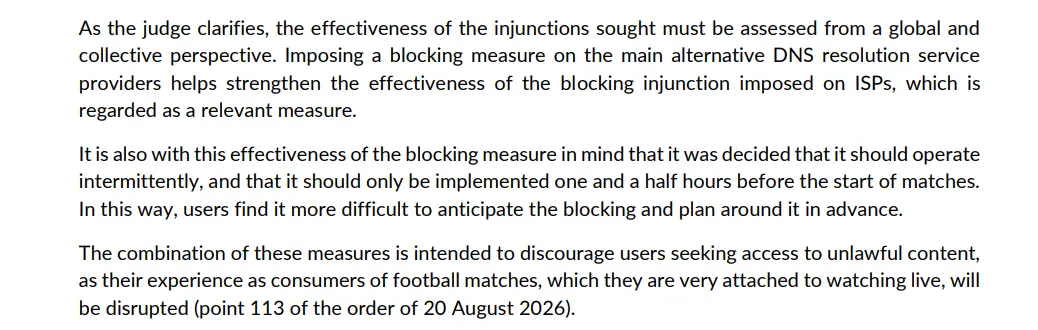
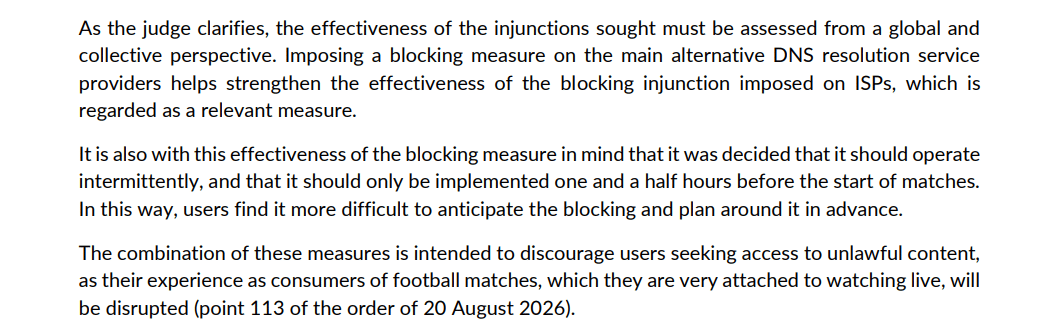
The implementation order underscores the strategic rationale behind targeting alternative DNS services. "Imposing a blocking measure on the main alternative DNS resolution service providers helps strengthen the effectiveness of the blocking injunction imposed on ISPs, which is regarded as a relevant measure," the decision explains.
The directive explicitly notes the consumer-facing impact intended by the regulation. "The combination of these measures is intended to discourage users seeking access to unlawful content, as their experience as consumers of football matches, which they are very attached to watching live, will be disrupted," it adds.
Despite ruling against the fundamental challenge, the court granted several concessions to the DNS providers. Notably, the requirement to redirect blocked users to an explanatory warning page was scrapped, with the court recognizing that such a measure cannot reasonably be imposed on network-level DNS resolvers.
Additionally, the severe non-compliance penalties were softened. While the looming €100,000 daily fine remains intact, it will now only accrue on days when DAZN broadcasts live matches. The framework also establishes a €20 million maximum liability cap per company and ensures that penalties will not apply in cases of under-blocking caused by exceptional geolocation errors.

Evolving Blocklist with a 90-minute Clock
The implementation framework details the operational mechanics of the blocking measures, which specifically target matches from premier Belgian football competitions, including the Jupiler Pro League. To adapt to ongoing sporting schedules, DAZN is authorized to submit one blocklist update per week containing a maximum of 100 new domains.
Rather than following a rigid calendar, DAZN selects the specific matchday for a blocklist update by providing at least seven working days of advance notice to the anti-piracy department. Once notified, the affected DNS resolvers are granted five working days to implement the requested alterations.
To maximize operational effectiveness and catch illicit streaming operators off guard, the actual blockades must go live precisely 90 minutes before the kickoff of a scheduled match.
"It is also with this effectiveness of the blocking measure in mind that it was decided that it should operate intermittently, and that it should only be implemented one and a half hours before the start of matches," the implementation order states. "In this way, users find it more difficult to anticipate the blocking and plan around it in advance."
The dynamic nature of this evolving blocklist is already evident in official data. Publicly shared records indicate that the number of domains blocked under the regulatory order has rapidly expanded from an initial 58 to 258.
OpenDNS Exit Looms
While Google and Cloudflare successfully integrated compliance mechanisms following the initial ruling last year and will maintain their current posture under the new decision, Cisco faces an entirely different set of operational challenges.
During the court hearings, Cisco firmly reiterated to the anti-piracy department that it intends to withdraw OpenDNS from Belgium once again. The networking giant argued that its public DNS architecture "does not allow for the implementation of selective, geolocated and dynamic blocking as required by the order." Furthermore, the company asserted that attempting to engineer such bespoke modifications "would compromise the performance, stability and security of that service."
Cisco maintained that withdrawing from the Belgian market is the only technically feasible measure available to comply with the legal constraints. The Belgian anti-piracy department has accepted this drastic operational withdrawal as a valid form of compliance.
The affected DNS resolvers have been granted a grace period of three months to fully implement the required technical blocking measures. For the time being, OpenDNS remains operational within Belgium, and Cisco has indicated its intention to pursue an appeal against the ruling. While a formal corporate statement was still being finalized at the time of publication, a Cisco spokesperson briefly confirmed that "OpenDNS currently remains available in Belgium."
Unless an upcoming appeal successfully alters the legal landscape, Belgian users of the OpenDNS service face the prospect of the platform going dark for a second time later this year.



Leave a Reply