
Belgium’s aggressive new anti-piracy enforcement regime has scored a major legal victory, with a Brussels court upholding a sweeping site-blocking order that targets major public Domain Name System (DNS) service providers. While the decision solidifies a powerful new weapon for rightsholders targeting unauthorized live sports streaming, it has already forced Cisco to announce the complete withdrawal of its OpenDNS service from the country for a second time.
The legal battle stems from an enforcement mechanism launched after Belgium established its dedicated anti-piracy department. Although the country was initially considered a laggard in the European site-blocking landscape, it has rapidly caught up to its neighbors through aggressive litigation and enforcement strategies.
The first blocking order under this modern framework was secured in April 2025 by sports rightsholder DAZN. The injunction was notable for its broad reach, extending far beyond traditional Internet Service Providers (ISPs) to encompass major public DNS operators. Under the threat of €100,000 in daily fines, the order required Cloudflare, Google, and Cisco to actively prevent their public DNS resolvers from resolving pirate streaming domains.
The initial response from the targeted tech companies varied significantly. Cisco reacted swiftly and aggressively, pulling its OpenDNS service out of Belgium entirely to avoid the severe penalties. Google and Cloudflare chose to comply with the demands in their own distinct ways while simultaneously launching legal challenges alongside Cisco.
In July 2025, the French-speaking Business Court of Brussels offered temporary relief to the DNS providers by suspending the blocking requirements against Cisco pending a final ruling. That suspension also put several secondary DNS blocking orders on hold, allowing OpenDNS to briefly return to the Belgian market. However, that fragile reprieve has now come to an end.
Court Upholds DNS Blocking
The final ruling, delivered on August 20 by the President of the French-speaking Business Court of Brussels, dismissed the core arguments brought forward by the DNS providers. The court firmly upheld the requirement for alternative DNS resolvers to block designated pirate domains, cementing the controversial legal precedent.
Although the full text of the court order has not yet been published, a newly issued implementation decision from Belgium’s anti-piracy department outlines the final outcome and details the practical execution of the blockades. According to the decision, the court concluded that it is technically feasible for alternative DNS resolvers to implement domain blocking. Furthermore, the judges found that the companies failed to adequately demonstrate that compliance costs would be disproportionate to their operations.

The court also dismissed concerns raised by the providers regarding potential geolocation overblocking errors affecting users residing near national borders, ruling that these risks did not outweigh the necessity of the measure.
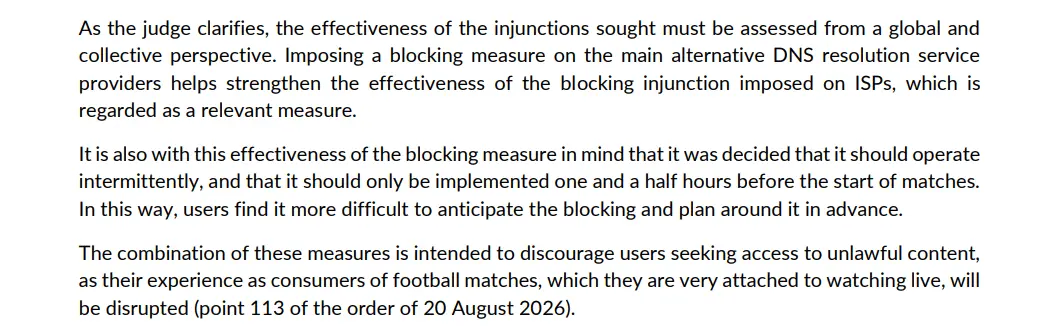
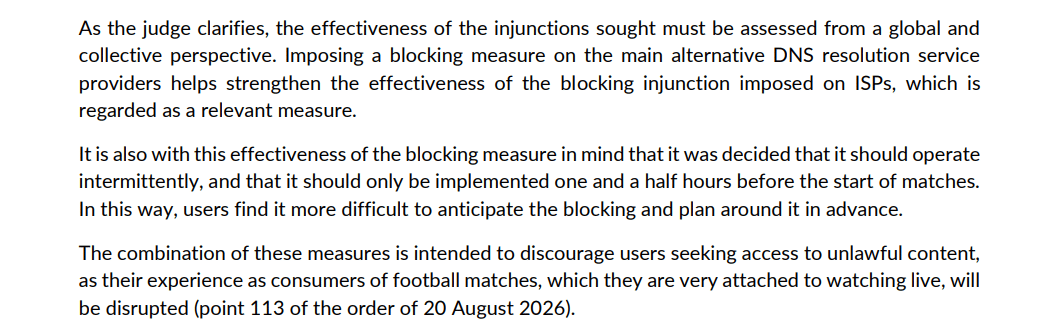
"Imposing a blocking measure on the main alternative DNS resolution service providers helps strengthen the effectiveness of the blocking injunction imposed on ISPs, which is regarded as a relevant measure," the implementation decision explains.
"The combination of these measures is intended to discourage users seeking access to unlawful content, as their experience as consumers of football matches, which they are very attached to watching live, will be disrupted," it adds.
The ruling was not an absolute defeat for the tech companies, as the court did grant a few concessions. Most notably, the judges scrapped a requirement that would have forced DNS resolvers to redirect blocked users to an informational warning page, noting that such measures cannot be reasonably imposed on basic DNS resolution infrastructure.
The financial penalties for non-compliance were also softened. While the steep €100,000 daily fine remains intact, the court specified that penalties will only accrue on days when DAZN matches are actively broadcast live. Additionally, a maximum cap of €20 million per company was established, and fines will not be applied in cases of under-blocking caused by exceptional geolocation errors.
Evolving Blocklist with a 90-minute Clock
The newly detailed implementation decision sheds light on the operational mechanics of the blocking framework, which primarily covers matches from major Belgian football competitions, including the Jupiler Pro League. Under the rules of the order, DAZN is permitted to submit one blocklist update per week, with a hard cap of 100 new domains per submission.
Rather than adhering to a rigid weekly schedule, DAZN specifies which matchday requires a blocklist update by providing at least seven working days of advance notice to the anti-piracy department. Once notified, the DNS resolvers are given five working days to integrate the changes into their systems.

To maximize disruption against unauthorized streaming operations, the actual blockades are timed to go live precisely 90 minutes before the kickoff of a scheduled match.
"It is also with this effectiveness of the blocking measure in mind that it was decided that it should operate intermittently, and that it should only be implemented one and a half hours before the start of matches," the implementation decision notes.
"In this way, users find it more difficult to anticipate the blocking and plan around it in advance," the document adds.
Publicly available data demonstrates the rapidly expanding nature of these blocklists. Since the initial issuance of the order, the number of domains targeted by the dynamic blocking mechanism has grown significantly, rising from 58 to 258 entries as the football season progresses.
OpenDNS Exit Looms
While Google and Cloudflare successfully navigated the compliance landscape following the initial injunction, the definitive ruling spells a very different outcome for Cisco and its OpenDNS service.
During the court proceedings, Cisco reiterated its position that its public DNS architecture "does not allow for the implementation of selective, geolocated and dynamic blocking as required by the order." The company argued that attempting to modify the infrastructure to support these demands "would compromise the performance, stability and security of that service."
Faced with these technical limitations, Cisco informed authorities that withdrawing OpenDNS from Belgium remains the only viable course of action to comply with the legal reality of the situation without compromising its global network integrity. The Belgian anti-piracy department has formally accepted this withdrawal as an acceptable form of compliance.
The affected DNS resolvers have been given a three-month window to fully implement the mandated blocking measures. Although OpenDNS remains operational in Belgium for the time being, Cisco has indicated its intention to challenge the ruling through an appeal.
When contacted by reporters regarding the timeline of the withdrawal, Cisco representatives did not directly answer specific operational questions, instead pointing to a brief official statement.
"OpenDNS currently remains available in Belgium," a company spokesperson confirmed.
Unless subsequent legal challenges succeed in altering the judicial stance, Belgian users relying on Cisco’s public DNS infrastructure can anticipate the service to go dark across the country for a second time later this year.

Leave a Reply