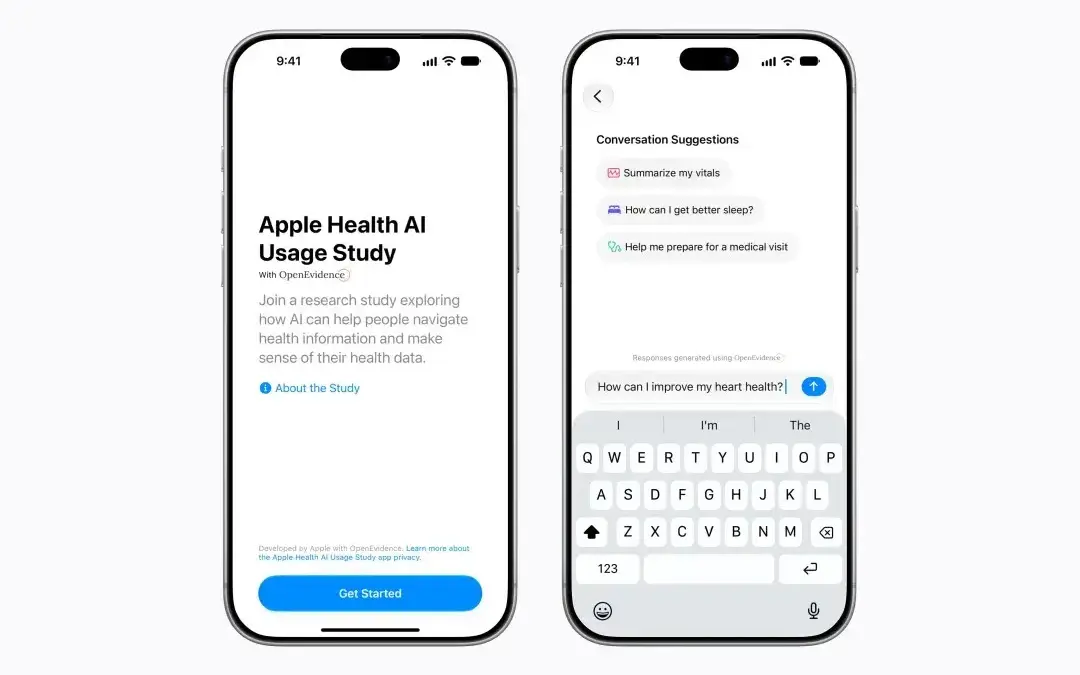
As major technology companies race to integrate artificial intelligence into everyday healthcare, Apple is taking a distinctly methodical route. While industry rivals like OpenAI and Anthropic have rapidly deployed specialized chatbots designed to answer health-related queries directly for consumers, Apple is stepping back to study the impact of clinically grounded AI before making any broad consumer product rollouts.
The iPhone maker has announced a major new research initiative in partnership with OpenEvidence, a prominent healthcare-focused artificial intelligence company. Through a dedicated study app launched recently in the United States, Apple aims to understand how everyday users interact with, comprehend, and evaluate clinically grounded medical information delivered via AI systems.
Rather than immediately introducing general health-answering capabilities into Siri or the default iOS Health app, Apple is prioritizing scientific rigor. The study is designed to run for more than 12 months, with the company aiming to recruit up to 200,000 participants. To qualify, users must be at least 21 years old, located in the United States, and operating an iPhone 15 or later running iOS 26 or subsequent software versions with Apple Intelligence enabled.

The newly introduced research application allows participants to ask everyday medical questions much like they would interact with consumer chat assistants such as ChatGPT or Claude. However, the architecture behind Apple’s study app relies strictly on clinical data sourced from highly respected medical literature, including publications like The New England Journal of Medicine, the Journal of the American Medical Association (JAMA), and Nature.
According to Apple, the software is engineered to translate complex medical literature into simplified, accessible answers for everyday medical questions. Participants in the study are encouraged to actively engage with the system by rating the AI-generated responses and providing feedback. In addition to rating specific queries, study participants are asked to complete regular monthly surveys to track their ongoing experience and comprehension over the course of the year-long research period.
To make the AI-generated suggestions more relevant, participants have the option to integrate data from Apple’s HealthKit ecosystem. By sharing information such as resting heart rate, daily physical activity metrics, sleep patterns, and laboratory results, users can receive more personalized and pointed suggestions from the study app. Furthermore, Apple highlights that the application is designed to help patients better prepare for upcoming visits with their doctors, while also guiding users toward specific qualified medical providers when dealing with concerning or urgent health issues.
Privacy and data security remain central pillars of Apple’s approach, particularly given the sensitive nature of health information. The company has specified that all participant data is fully anonymized before being transmitted to a secure third-party cloud provider. Crucially, Apple has explicitly stated that the data collected through the study app will not be used to train any artificial intelligence models. Additionally, OpenEvidence is bound by protocols ensuring that query and response data is deleted entirely within 24 hours.

The decision to launch a dedicated research study underscores Apple’s philosophy regarding responsible innovation in the medical sector. Sumbul Desai, M.D., Apple’s vice president of Health and Fitness, emphasized the necessity of a cautious, evidence-based approach in a public statement regarding the initiative.
"At Apple, we believe responsible innovation starts with scientific rigor and clinical grounding," Desai said. "Health is deeply personal, and conducting a dedicated research study is the most thoughtful way to understand how people engage with, comprehend, and evaluate health AI in everyday life."
She added that the insights gathered from the 12-month study will play a vital role in advancing the broader scientific conversation surrounding artificial intelligence in medicine. As technology continues to evolve rapidly, Apple intends to use these findings to ensure that any future digital tools genuinely support people wherever they happen to be on their personal health journeys.
The Apple Health AI Study app is available for download starting today for eligible U.S. users through the App Store. While Apple has not yet confirmed whether the insights gained from this study will eventually lead to AI-powered medical query features within Siri or the iOS Health app, the potential market demand is undeniable. Earlier this year, OpenAI reported that consumer interest in digital health tools has surged significantly, with users submitting over 300 million health-related queries to ChatGPT each week across the United States. As consumer reliance on AI for medical information continues to grow, Apple’s empirical study may well set a new benchmark for how technology companies balance innovation with clinical validation and user safety.