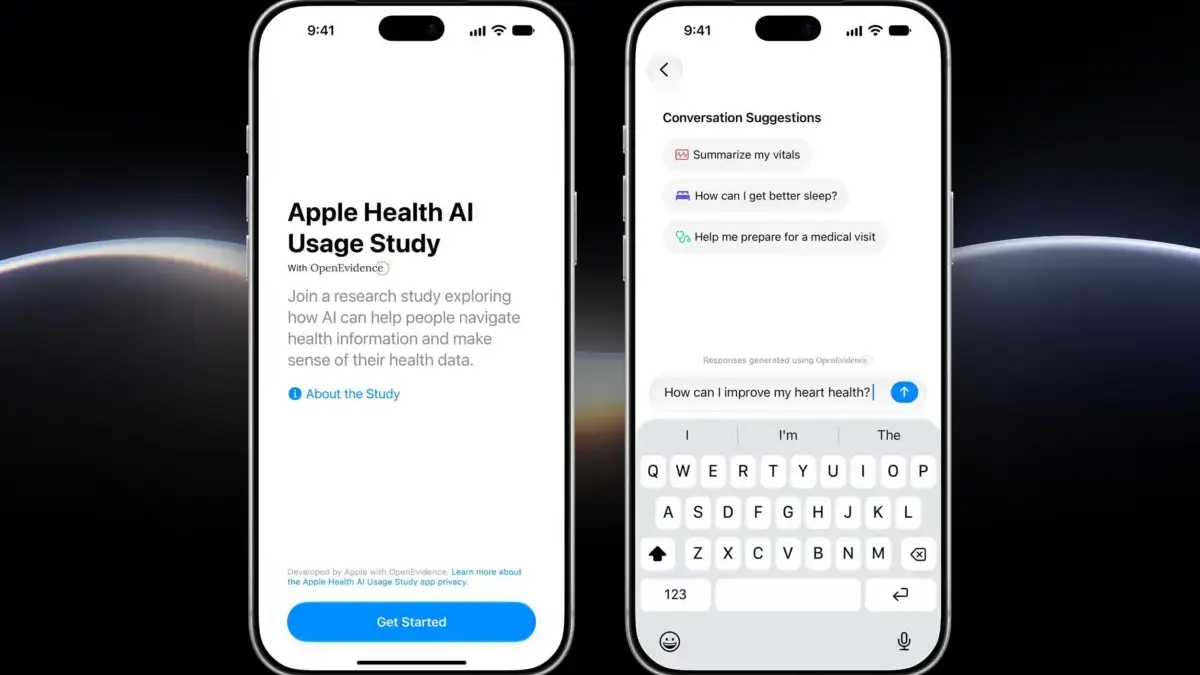
Apple has announced the launch of a significant new research initiative aimed at better understanding how everyday users interact with conversational artificial intelligence tools designed for health and medicine. The company is spearheading the Apple Health AI Usage Study in collaboration with OpenEvidence, an established clinical AI platform frequently utilized by healthcare professionals to generate medical insights derived from rigorous, peer-reviewed literature and authoritative sources such as The New England Journal of Medicine. Through this initiative, Apple hopes to gain deeper insights into the practical utility, accuracy, and comprehensiveness of conversational medical AI when deployed among the general public.
To facilitate the research, Apple has released a dedicated iOS application designed specifically for the study. Enrollment for the project officially opens today, with the tech giant casting a wide net to recruit up to 200,000 participants across the United States. To be eligible for participation, individuals must be at least 21 years of age and reside in the US. Furthermore, while the study’s application does not rely on Apple’s broader suite of Apple Intelligence features, it does carry specific hardware requirements, necessitating an iPhone 15 Pro or a later model running iOS 26 or a subsequent version of the operating system.

Once enrolled, participants are granted access to the study app, where they can type in health-related questions and receive clear, easily digestible responses accompanied by direct links to peer-reviewed clinical sources. The current iteration of the app relies strictly on text-based prompts for interaction. While users have the option to utilize dictation via the standard iOS keyboard to input their queries, the tool operates independently and is not directly integrated with Siri or other built-in Apple Intelligence systems, ensuring a controlled environment for the research objectives.
A key component of the study involves evaluating how personalized data influences the relevance of AI-generated medical responses. During the onboarding and enrollment process, participants are presented with the option to voluntarily share select data from the Apple HealthKit ecosystem, including metrics regarding their daily physical activity, sleep patterns, or clinical laboratory results. By granting access to these parameters, the conversational tool can contextualize its responses around the user’s specific health profile.
At the same time, Apple has placed a heavy emphasis on data privacy and user confidentiality. The company has explicitly stated that robust measures have been implemented to ensure all information collected during the study remains strictly confidential. Furthermore, Apple has confirmed that the personal data gathered through the application will not be utilized to train its commercial artificial intelligence models. The overarching objective of the research is strictly focused on refining the design, user experience, and overall functionality of AI-powered health technologies, ultimately paving the way for tools that can deliver complex medical information in a manner that is both accurate and genuinely actionable for everyday consumers.

The initiative comes at a time when conversational AI is increasingly intersecting with personal wellness and healthcare, raising critical questions about accuracy, reliability, and how non-medical professionals interpret algorithmic output. By relying on a structured framework where users rate AI responses based on specific criteria such as accuracy, level of detail, and contextual relevance, Apple and OpenEvidence aim to establish a clearer baseline for how these technologies perform in real-world scenarios.
Sumbul Desai, MD, Apple’s vice president of Health and Fitness, emphasized the company’s deliberate and scientifically grounded approach to exploring this emerging technological frontier. In a statement regarding the launch of the study, Desai highlighted the sensitive nature of personal health and the necessity of rigorous clinical backing.
"At Apple, we believe responsible innovation starts with scientific rigor and clinical grounding," said Dr. Desai. "Health is deeply personal, and conducting a dedicated research study is the most thoughtful way to understand how people engage with, comprehend, and evaluate health AI in everyday life. Insights from this study will help advance the broader scientific conversation and ensure that as technology evolves, we continue building trusted tools that genuinely support people wherever they are on their health journey."