Your alarm goes off at 6:10 a.m. You are upright by 6:12, moving through the kitchen by 6:15, and yet you still could not recite your own phone number if asked. You stand blankly in front of the open refrigerator, unable to make a single decision. You read the same text message three separate times without processing it. Around 6:40 a.m., the mental fog finally thins, and you begin to feel like a functioning person—which happens to be precisely when you need to walk out the door.
For the rest of the day, you carry the lingering assumption that you must have a chronic sleep problem. Perhaps you do. But the frustrating cognitive paralysis happening between 6:10 and 6:40 has a formal scientific name, an extensive research literature, and a remedy list that bears no resemblance to the standard advice you have been handed over the years. Most of those supposed morning hacks are not clever tricks you can perform at 6:12 to instantly jolt your brain awake. Instead, they are the result of decisions you either made the night before or when you first set your alarm clock.
Sleep Inertia Is a Measured State, Not a Character Flaw
In clinical and scientific terms, this transition period immediately following waking is known as sleep inertia. During this phase, both mental alertness and physical performance are significantly degraded, as documented in recent reviews by researchers like Hilditch and McHill in 2019. In clinical literature, it manifests as heavy grogginess, spatial and temporal disorientation, and persistent difficulty achieving full wakefulness, a phenomenon detailed by Trotti in 2017. Crucially, sleep inertia is temporary, entirely ordinary, and routinely experienced even by individuals who get exemplary sleep. Nobody is cognitively sharp the absolute second their eyelids snap open.
Faced with this daily handicap, most people cycle through the standard array of recommended fixes. They place the alarm clock across the room to force themselves out of bed. They splash freezing water onto their faces, banish their phones to the hallway, pour a larger cup of coffee, or attempt an earlier bedtime, only to abandon it after three days when it fails to yield immediate results. Some of these strategies are perfectly reasonable components of general hygiene, but none of them fundamentally alter the texture of those initial twenty minutes. The reason for this failure is not poor execution; rather, it is that almost every intervention with genuine scientific backing must take place before you open your eyes.
The Honest Answer to Grogginess Is Disappointing First, Useful Second
When people search for ways to eliminate morning grogginess, they often look for immediate reactive measures, yet the evidence supporting post-alarm tricks is thin and mixed. The factors that exert the most consistent influence over sleep inertia are decided much earlier: the total amount of sleep you actually obtained and where your alarm lands relative to your internal body clock. Consequently, the more productive question is not how to magically clear the mental fog at 6:12 a.m., but rather why that fog is rendering you immobile in the first place.
Three primary physiological variables dictate the severity of sleep inertia. The first is sleep debt. Clinical studies demonstrate that people perform significantly worse after partial sleep deprivation compared to a full, uninterrupted eight-hour sleep opportunity. Furthermore, an excessively long stretch of wakefulness preceding sleep can exacerbate the difficulty of the subsequent wake-up process. Of the three major factors, sleep debt is typically the one individuals have the most control over, yet none of that control is exercised during the morning hours.
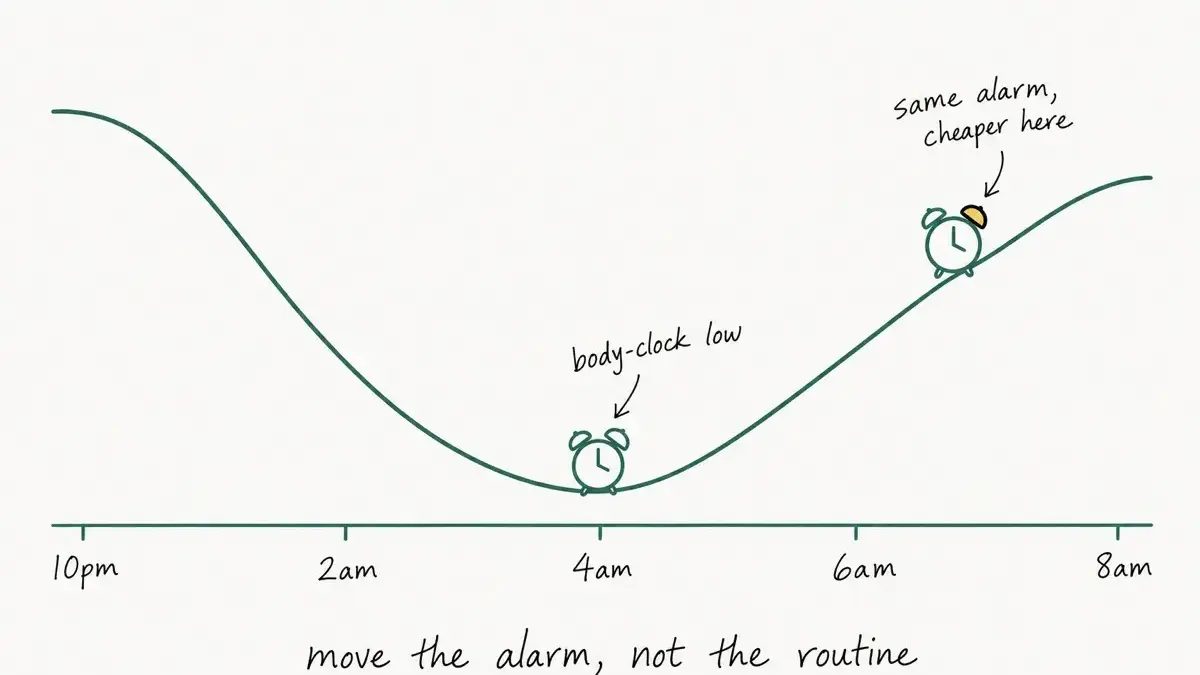
The second variable is body-clock timing. Waking up during the circadian trough—the biological low point of your internal night—substantially intensifies sleep inertia. For an individual maintaining a standard schedule of roughly 11:00 p.m. to 7:00 p.m., researchers place this biological trough between 3:00 a.m. and 5:00 a.m., according to a 2023 review by Kovac and colleagues. However, these exact clock numbers are not universal; they shift dynamically depending on an individual’s unique daily schedule and chronotype. Translated into practical terms, an alarm set directly inside your biological low point carries a much higher cognitive cost than the exact same alarm scheduled thirty minutes later.
The third factor involves the specific sleep stage from which you are abruptly pulled. Being startled awake from deep, slow-wave sleep has been linked in multiple studies to stronger sleep inertia, although findings occasionally conflict as sleep pressure and overall timing can confound the apparent stage effect. While this is useful context to understand, it also provides ample reason to remain skeptical of commercial sleep-tracking applications that promise to time your alarm to a light sleep stage and completely spare you from the morning fog.
What Helps, Ranked by Scientific Evidence
When reviewing scientific literature, two distinct interventions carry the most robust empirical support, and both occur well before you wake up: securing adequate sleep duration and moving your alarm out of your body-clock low point. Caffeine and morning light exposure sit firmly in a secondary tier, where the evidence is real but limited, and where much of the benefit improves how waking feels rather than how sharply you perform. The familiar reactive morning tricks sit at the very bottom. While several have been tested in laboratory settings, their effects are consistently weak.
Protecting your overall sleep opportunity must be the primary objective. Because chronic sleep loss directly worsens how you transition into wakefulness, the most honest initial move is remarkably unglamorous: getting more sleep on a consistent basis rather than searching for a sharper morning ritual. If your nights are persistently broken rather than simply short, that points to an underlying issue requiring a different corrective approach.
The second highly effective move is to adjust the timing of your alarm rather than your morning routine. If you find yourself consistently waking up inside your biological trough, the cheapest available modification is to set a later alarm, even if it is only pushed back by twenty or thirty minutes, with the lost time recovered elsewhere in your schedule. Individuals who feel permanently incapable of functioning early in the morning frequently suffer from a biological timing conflict rather than a lack of personal discipline.
Beyond timing and duration, caffeine can be utilized effectively when understood as a delayed tool. Limited experimental evidence indicates that caffeine can reduce sleep-inertia impairments, highlighted by a small study involving caffeinated gum where post-nap vigilance improved roughly twelve to eighteen minutes after waking. However, the timing lag is where many people miscalculate. Direct crossover comparisons show that the median time to peak blood caffeine concentration is approximately forty minutes for caffeinated gum and thirty-eight minutes for a beverage, with no statistically significant difference between the two delivery methods. While caffeine enters the bloodstream before that ultimate peak, the pharmacological switch is not instantaneous. Consequently, treating your first morning mouthful of coffee as the start of a twenty-minute waiting period, rather than an immediate fix, aligns better with biology.

Morning light exposure also offers psychological benefits regarding how waking feels. In home studies, artificial dawn simulators ramping up to moderate lux levels before waking successfully reduced reported sleep-inertia complaints over testing periods. A subsequent crossover study investigating light-emitting glasses found a distinct split: while the light devices improved self-rated alertness and subjective energy among adults, objective psychomotor vigilance performance did not significantly improve. Morning light may make the process of waking feel substantially better without rendering you measurably sharper right away, a trade-off that remains worthwhile as long as expectations are managed appropriately.
Meanwhile, popular reactive tricks—such as splashing cold water on the face, drinking a massive glass of water, consuming breakfast specifically as a grogginess cure, or launching into a high-intensity workout to shock the system—lack strong backing. Major reviews covering these non-pharmacological countermeasures describe the evidence as mixed or limited, indicating small or short-lived effects rather than a true physiological reset. Hydrate because you are thirsty, eat because you are hungry, and exercise because physical movement is beneficial for overall health, but do not expect any of these habits to prematurely terminate sleep inertia.
Designing a Morning That Accommodates the Fog
Because the physiological fog of sleep inertia is largely predetermined by the time consciousness returns, the remaining challenge is determining how to navigate a twenty-minute window where you simply cannot make smart decisions. The key is to stop fighting the state and intentionally remove any tasks from that timeframe that could punish a poor decision.
Consider the contrast in routines. One individual might historically spend the first twenty minutes of the day tackling high-stakes mental tasks: answering overnight work messages, resolving complicated administrative quotes, or debating between demanding gym classes. Recognizing that these are complex decisions, shifting them to a later point in the day—such as a commute where the brain is an hour past waking—transforms the morning entirely. Allocating the immediate post-wake window to mindless, automatic tasks—such as showering, dressing in clothes laid out the night before, starting a cup of coffee, and sitting by a window for ten minutes of natural light—removes friction. None of these activities are inherently impressive, which is precisely the point. By removing high-stakes decisions from the foggy window, mornings cease to feel like daily failures, even if the biological fog itself takes its normal course to lift.
For shift workers or those who nap during the day, the challenges of sleep inertia can replicate themselves outside of the morning hours. Laboratory protocols examining naps following simulated night work show that brief ten-minute naps produce minimal post-nap impairment, whereas thirty-minute naps frequently plunge individuals into slow-wave sleep, resulting in measurable performance deterioration that can persist for nearly an hour after waking. For those who need to function immediately upon standing, shorter rest intervals often prove safer.
When Morning Grogginess Requires Clinical Attention
While standard sleep inertia is a normal physiological hurdle, persistent morning difficulty is not always a simple scheduling issue. Severe, prolonged trouble waking—frequently referred to in clinical contexts as sleep drunkenness—is strongly associated with conditions like idiopathic hypersomnia. Similarly, unrefreshing sleep and profound daytime sleepiness can serve as hallmark indicators of underlying obstructive sleep apnea.
Individuals experiencing extreme, unyielding morning impairment should discuss the pattern thoroughly with a qualified clinician, detailing the exact duration of their unusable state, the frequency of the occurrences, and the broader impact on daily functioning. Bringing information regarding the mismatch between natural circadian timing and required professional schedules can further assist medical professionals in evaluating whether formal diagnostic intervention is warranted.
Ultimately, the most effective approach to managing morning grogginess requires abandoning ineffective reactive tricks and focusing instead on foundational biological inputs. Protecting adequate sleep duration and aligning wake times with natural circadian rhythms offer the most reliable pathways forward. By structuring the earliest moments of the day to bypass complex decision-making, the unavoidable transition of sleep inertia can pass safely on its own schedule without exacting a daily toll.
Frequently Asked Questions
How long does sleep inertia last?
There is no single universal timeline, and estimates vary widely across clinical literature. While some studies observe cognitive performance returning to baseline within minutes, others report lingering effects lasting up to two hours, with common estimates clustering around twenty to thirty minutes. Planning for a brief period of reduced cognitive sharpness prevents unnecessary panic if the fog lingers slightly longer on certain days.
Why is sleep inertia often worse after a nap than in the morning?
The severity of sleep inertia is heavily influenced by the specific sleep stage from which you are awakened. Naps that are long enough to push an individual into deep, slow-wave sleep frequently result in a much heavier, more disorienting wake-up experience compared to shorter rest periods. Shortening daytime naps or budgeting a buffer period afterward helps mitigate this effect.
Does hitting the snooze button make sleep inertia worse?
While direct research on the physical act of snoozing is sparse, a frequent snooze habit can inadvertently disrupt overall sleep architecture. If alarms are set artificially early simply to accommodate a snooze cycle, it often results in fragmented sleep loss and shifts the final wake-up time into an unfavorable slot within the circadian cycle. The core issue is less about the button itself and more about whether the habit compromises total sleep quality or timing.
Is severe morning grogginess always indicative of a sleep disorder?
Not inherently, as mild to moderate sleep inertia is a universal human experience. However, prolonged, debilitating difficulty waking that persistently impairs daily functioning is a recognized clinical feature of disorders such as idiopathic hypersomnia. When morning grogginess extends far beyond normal limits and severely disrupts life, it warrants professional medical evaluation rather than simple lifestyle adjustments.