The underlying legal battle originated in May when sports broadcaster beIN Sports secured a judicial injunction targeting an initial batch of six domains. While such orders are frequently deployed in European jurisdictions to combat intellectual property infringement, the scope of the restriction has expanded dramatically over the subsequent months. By late October, the blocklist had grown to encompass 118 distinct domain names, transforming a targeted enforcement action into a sweeping digital dragnet.

Because official regulatory bodies in France, such as Arcom, do not publicly publish real-time updates regarding these expanding blocklists, tracking the exact parameters of the injunction requires diligent oversight. Researchers and digital rights advocates must rely heavily on transparency reports filed by tech giants like Google with the Lumen Database. These public notices reveal that the blocklist grew in incremental waves, with twenty-two domains added in June, followed by three separate batches of thirty domains each in September and October.
This steady accumulation of restricted sites has brought critical oversight challenges to light, particularly regarding the handling of domain lifecycles and administrative accountability. Digital networks and internet service providers are legally compelled to maintain these blocks regardless of whether a domain continues to host infringing content. Consequently, various entities find themselves caught in the crosshairs of automated and static filtering systems even after their underlying circumstances have radically shifted.

An analysis of the 118 domains on the blocklist reveals several anomalies that underscore the blunt-force nature of modern DNS filtering. While the vast majority of the listed addresses continue to resolve to active infrastructure—with many pointing toward specific server blocks based in Hong Kong associated with unauthorized streaming operations—a notable subset of domains no longer serves any infringing purpose.
Several addresses have completely expired and are no longer registered, while others have faced registrar suspensions or have been formally seized by international law enforcement agencies, such as domains previously targeted by United States authorities in global anti-piracy sweeps. Despite these domains being defunct, seized, or repurposed, French DNS resolvers frequently maintain the blocks, treating dead infrastructure with the same hostility as active pirate portals.

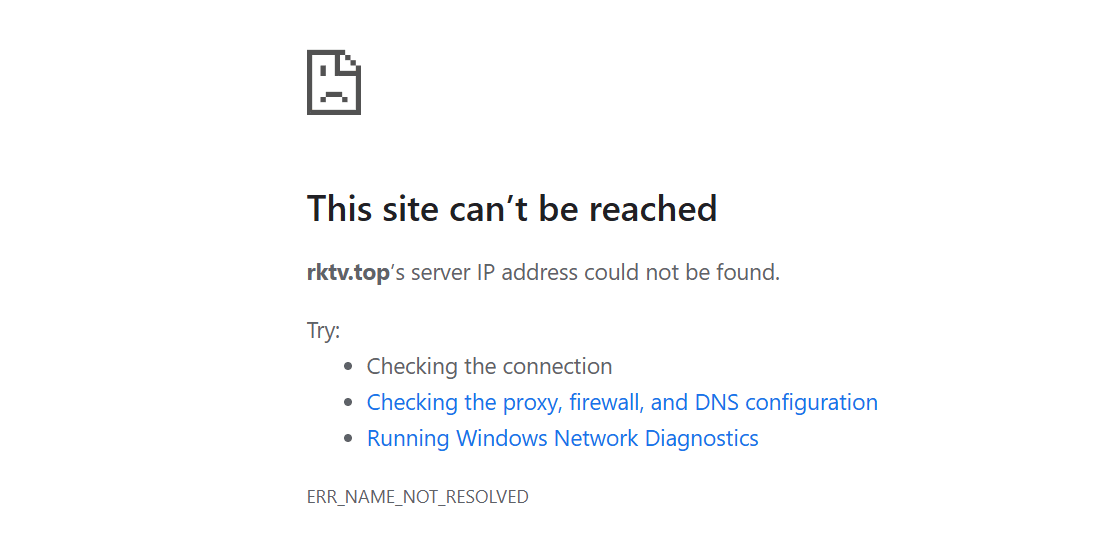
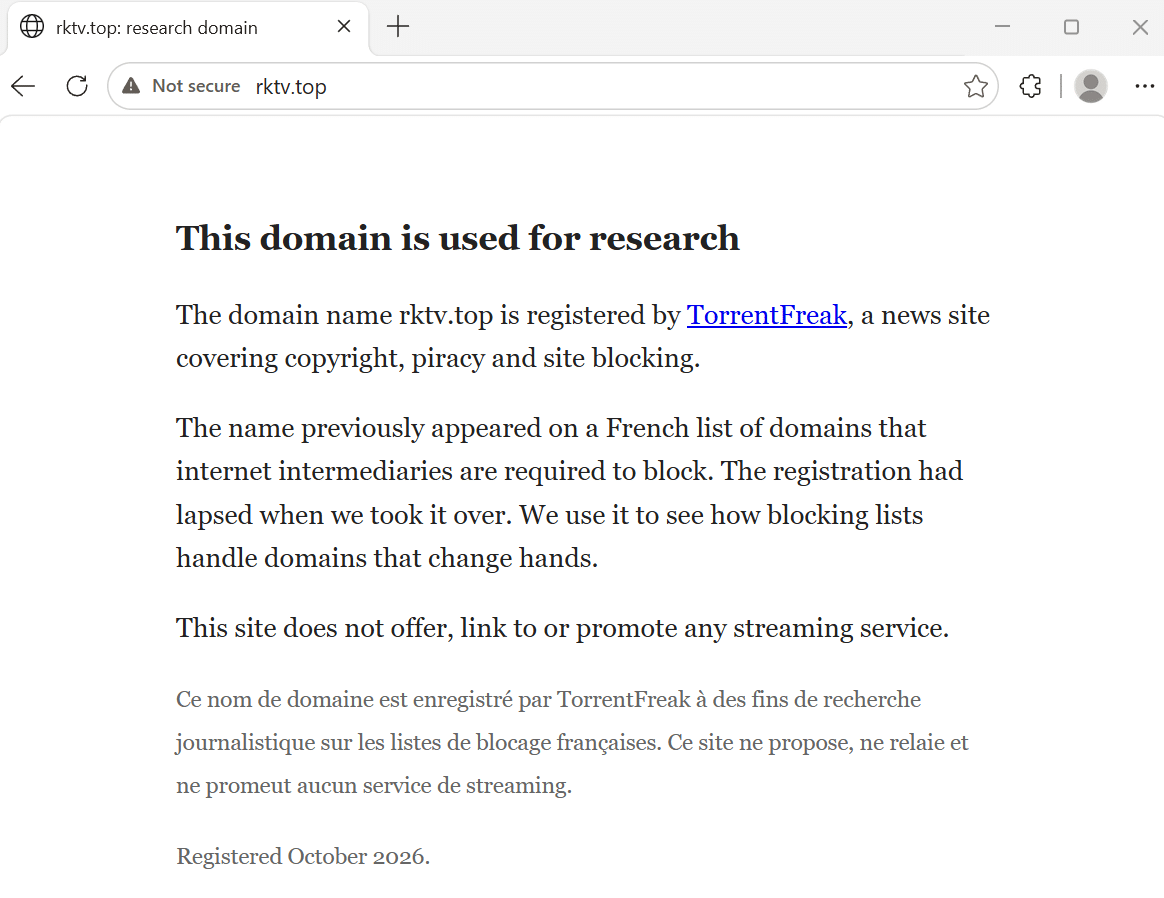
The disconnect between legal injunctions and technical reality became starkly apparent when digital publication TorrentFreak registered two expired domains that had previously appeared on the French court’s blocklist: rktv.top and ap-live.top. Seeking to test the practical mechanics of the enforcement regime, the publishers established basic, informational landing pages explicitly clarifying that the sites were under new ownership for research purposes and contained no links to or promotions of streaming services.
Despite the benign nature of the new content, the reaction from French digital infrastructure was swift and automated. Google’s DNS resolver in France refused to resolve the research domain, returning an extended error code that explicitly denotes censorship under judicial injunction. Meanwhile, major French internet service providers, including Bouygues Telecom, Free, and SFR, redirected user queries entirely. Instead of encountering the neutral research page, visitors attempting to access the domain were forcefully routed to an official government-backed portal designed to promote licensed sports broadcasts.
This automated redirection highlights a systemic vulnerability in how judicial blocking orders are implemented across national telecommunications networks. Domain names change hands frequently, and internet infrastructure is fluid. When static blocklists are enforced indefinitely without provisions for appeals, corrections, or independent reviews, legitimate actors and researchers can easily find their properties mischaracterized and blocked from public view. Furthermore, the absence of an accessible administrative grievance process leaves domain owners with few avenues to challenge erroneous restrictions.
The technical approaches to compliance also vary significantly among major technology firms operating within the French market. While Google’s DNS resolver and consumer-focused VPN providers quickly implemented broad blocks encompassing the vast majority of the listed domains, alternative services adopted different strategies. Cloudflare, for instance, maintains that its primary 1.1.1.1 DNS resolver does not actively block the domains under this specific order, choosing instead to comply with French judicial mandates through its Content Delivery Network infrastructure, an approach a Paris court accepted as a reasonable compliance effort earlier in the autumn.
As the debate over proportionality and effectiveness continues among lawmakers, intermediaries, and rightsholders, France’s regulatory framework is poised to expand further. Legislation passed by the French Parliament in July establishes mechanisms for automated, real-time blocking of unauthorized sports streams during live events, with regulatory review occurring after the fact. Critics point out that such systems operate with minimal public transparency, compounding the difficulties independent observers face when attempting to audit the scope of government-mandated internet censorship.
The court order underpinning the current wave of restrictions is scheduled to expire alongside the conclusion of the tennis season in mid-November. Whether authorities will lift the restrictions on the existing batch of domains—including the research properties swept up in the enforcement process—remains uncertain as the broader debate over digital governance and network filtering persists.