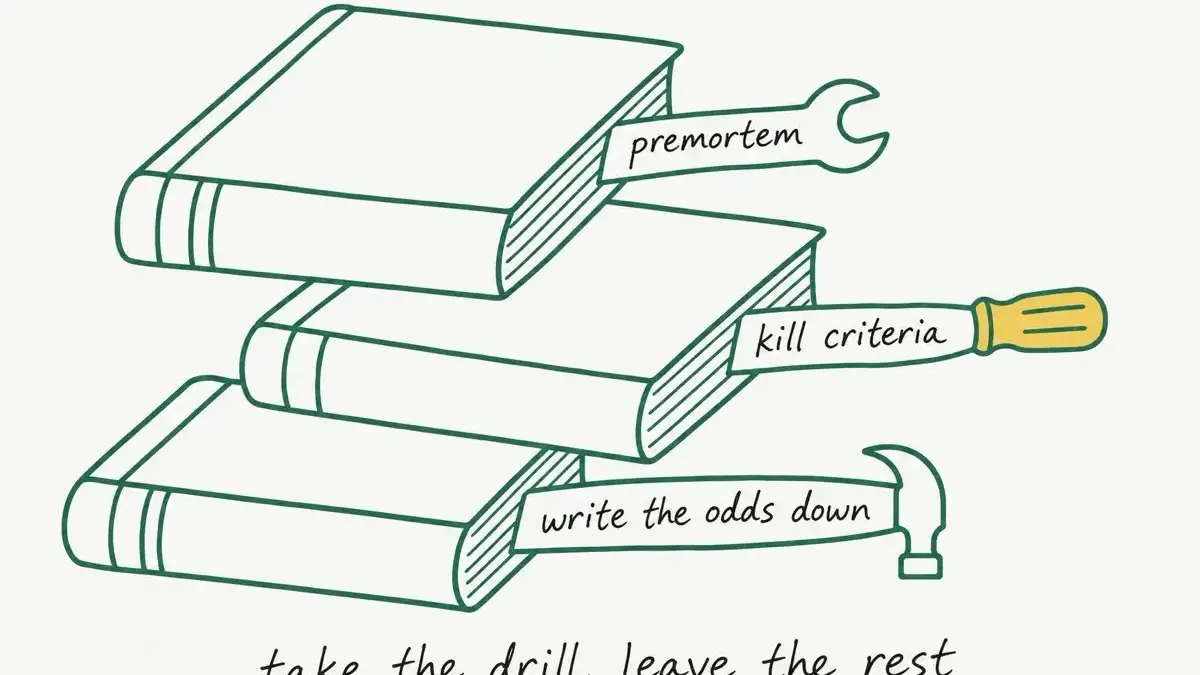
To cut through this noise, experts have evaluated the landscape of decision-making literature not by sales metrics, but by how each title addresses distinct real-world situations. Rather than serving as an abstract review, this assessment focuses on what each book actually does to a reader’s cognitive process, the single practical drill worth running from its pages, and where its utility ultimately breaks down. Furthermore, the analysis scrutinizes prominent titles that fail to equip someone grappling with an active choice, shedding light on the limitations of popular literature.
The criteria used to evaluate these texts center around specific operational questions rather than established academic rubrics. The primary weight is given to whether a book provides actionable practice. Research highlights the tangible value of structured drills. Across four extensive years of geopolitical forecasting tournaments sponsored by the United States intelligence community, a training module lasting under an hour improved forecasters’ accuracy—measured objectively by the Brier score—by six to eleven percent compared to a control group, according to research published by Chang, Chen, Mellers, and Tetlock in the journal Judgment and Decision Making. This demonstrated that under an hour of structured, numerical drills yields measurable improvements. Conversely, standard book reading rarely tracks such concrete behavioral metrics. Consequently, each book was scored based on whether readers could pull a functional drill from its pages. Finishing a text without executing a practical exercise amounts to little more than observing a nature documentary about one’s own mind.
Among the titles deemed worth a reader’s time is Chip and Dan Heath’s Decisive: How to Make Better Choices in Life and Work. The authors argue that most people mistakenly deliberate inside a frame constructed by someone else, asking narrow questions like whether to accept a specific job rather than broadening the scope to consider the best alternatives for the next two years. This tunnel vision mirrors organizational tendencies documented by Paul Nutt, whose profile of 78 decision case studies revealed that most corporate processes are solution-centered, favoring a pre-selected answer that stifles both innovation and the consideration of alternative paths. The Heaths’ WRAP sequence—widening options, reality-testing assumptions, attaining distance, and preparing to be wrong—directly combats this habit. The final step, preparing to be wrong through a prospective premortem where one assumes failure and lists the causes in advance, draws on the work of Gary Klein. Klein’s research indicates that prospective hindsight raises an individual’s ability to identify future failure points by roughly thirty percent. While the book’s corporate examples can feel distant, its core framework remains powerful.
Another critical dimension of decision-making often overlooked is the art of stopping, which is explored in Annie Duke’s Quit: The Power of Knowing When to Walk Away. While most literature focuses exclusively on choosing, Duke emphasizes that knowing when to exit a failing venture is equally vital and rarely scheduled. Her primary utility lies in establishing strict exit conditions while calm—such as closing a business if it fails to clear two thousand dollars a month by a specific date. These pre-written boundaries prevent individuals from negotiating with themselves when quitting starts to feel indistinguishably like losing. However, the poker framing utilized by the author does not always translate seamlessly to personal life, where walking away from a career or a marriage carries costs for others that are not fully accounted for in her logic.
Duke’s earlier work, Thinking in Bets: Making Smarter Decisions When You Don’t Have All the Facts, pairs naturally with her later insights by tackling the trap of "resulting"—the psychological error of judging a past decision solely by its outcome. If a properly vetted job prospect leads to a company folding, individuals often incorrectly conclude they made a poor choice, ignoring the reality that they acted rationally given the information and odds available at the time. Separating the quality of the decision from the randomness of the outcome prevents bad years from imparting false lessons, though maintaining a written decision record remains a personal habit rather than a universally validated scientific intervention.

For those seeking to understand the foundational mechanics of cognitive error, Daniel Kahneman’s Thinking, Fast and Slow remains a generation-defining text. By introducing the vocabulary of a fast, automatic system and a slow, effortful one, Kahneman illuminates concepts like anchoring, availability, loss aversion, and overconfidence better than almost anyone else. Yet, the book is deliberately constructed as an account of how human judgment functions rather than a practical manual, leaving the question of intervention largely open. Furthermore, certain elements of the text have faced rigorous academic scrutiny, notably regarding social-priming research that Kahneman himself later acknowledged relied on underpowered studies. Readers are encouraged to approach the book as an exceptional chronicle of cognitive pitfalls rather than an infallible operational guide.
Expanding on systemic errors, Kahneman’s later collaboration with Olivier Sibony and Cass Sunstein in Noise: A Flaw in Human Judgment addresses the invisible scatter that plagues evaluations. While bias pushes judgments in a specific direction, noise represents the erratic variability seen when two professionals evaluate the same risk or candidate differently under identical conditions. The book’s practical contribution centers on decision hygiene, particularly the practice of breaking complex judgments into independent parts assessed separately before combining them, rather than letting a single initial impression overpower the entire process. Nevertheless, this institutional focus limits its direct application for individuals navigating personal choices, such as selecting between two apartments.
For individuals seeking a procedural, methodical approach, Smart Choices: A Practical Guide to Making Better Choices offers a structured sequence addressing the problem, objectives, alternatives, consequences, and tradeoffs. By forcing decision-makers to confront their competing objectives through a comparative table, the framework frequently exposes inferior options that can be safely discarded. Although the text is dry and its examples show their age, its reliance on the assumption that individuals can accurately articulate their own preferences can be limiting, requiring readers to pair it with newer psychological insights.
Finally, Philip Tetlock and Dan Gardner’s Superforecasting: The Art and Science of Prediction highlights the reality that most difficult choices inherently conceal a forecast about the future viability of a role or the long-term value of an investment. Tetlock’s top forecasters succeeded by quantifying beliefs, fragmenting questions into manageable components, and iteratively updating their views as new evidence emerged. While personal decisions rarely resolve with the clean parameters of a geopolitical tournament, the discipline of assigning probabilities to outcomes instills valuable intellectual rigor.
Beyond these recommended texts, certain popular titles warrant caution. Rolf Dobelli’s The Art of Thinking Clearly offers a useful encyclopedic glossary of cognitive biases, but cataloging survivorship bias does not translate into a functional method for choosing between conflicting career paths. Similarly, Dan Ariely’s Predictably Irrational provides an engaging tour of human self-sabotage without supplying a concrete procedure for resolving immediate dilemmas, a limitation compounded by subsequent academic retractions involving data validity in related behavioral studies.
Ultimately, evaluating the utility of decision-making literature reveals a fundamental truth supported by available research: reading a book in isolation does not reliably alter human behavior. True cognitive improvement stems from structured practice and active drills rather than passive reading. Whether an individual is facing an immediate deadline, struggling to abandon a failing project, or untangling complex organizational choices, the most effective approach is to anchor theory in immediate, hands-on application. Books remain affordable tools, but the real-world consequences of a poorly made choice far outweigh the cost of the volumes on the shelf.