While record labels and major rightsholders in the United States continue to absorb the shockwaves of a monumental legal defeat, lawmakers south of the border have charted a distinctly different course regarding internet service provider liability. For years, the global entertainment industry pursued U.S. internet service providers through aggressive litigation, arguing that companies should be held legally responsible for repeatedly continuing to serve subscribers who were accused of digital piracy. However, that primary enforcement strategy suffered a severe blow when the U.S. Supreme Court completely wiped out a massive one-billion-dollar copyright infringement verdict against provider Cox Communications.
According to the high-profile U.S. ruling, simply possessing knowledge of ongoing copyright infringement among a subscriber base and failing to take decisive action against those individuals is legally insufficient to render an ISP liable for contributing to secondary copyright infringement. Yet, as American rightsholders find themselves grappling with a narrowing scope of secondary liability under U.S. jurisprudence, the legislative and executive branches in Mexico have moved swiftly in the opposite direction.
In a significant legislative development, Mexico’s Senate officially approved a sweeping reform of the country’s Federal Copyright Law. The newly enacted amendments tie the legal liability of internet service providers directly to whether or not they maintain and enforce an explicit corporate policy aimed at terminating the accounts and internet connections of repeat copyright infringers.
Senate Backs ISP Liability Rules
The Mexican Senate successfully approved the legislative amendments with roughly two-thirds of the total vote, overcoming coordinated opposition from dissenting lawmakers who voted against the measure. Because the Chamber of Deputies had already approved the identical legislative text back in October, the official decree now heads directly to the desk of President Claudia Sheinbaum for final enactment. Her administration initially proposed these legislative changes in May, with the explicit objective of bringing domestic Mexican copyright law into strict alignment with the United States-Mexico-Canada Agreement, commonly referred to as the USMCA trade pact.

International pressure played a substantial role in shaping Mexico’s legislative agenda. For years, powerful U.S. rightsholder coalitions aggressively lobbied Mexican authorities to establish stringent ISP liability rules. Earlier in the year, the International Intellectual Property Alliance filed a formal critical complaint arguing that Mexico’s previous copyright reforms implemented in 2020 failed to establish a sufficiently clear legal principle of secondary liability for entities that actively induce or promote digital copyright infringement.
The pressure from Washington has already yielded tangible diplomatic results. Earlier in the year, the Office of the United States Trade Representative formally moved Mexico to a more favorable, lower tier of its annual Special 301 piracy watch list, explicitly citing the pending draft amendments as a primary justification for the upgrade.
Disconnect Repeat Infringers
The newly approved trade agreement between the North American neighbors also catalyzed an earlier round of legislative updates in 2020, during which Mexico introduced Digital Millennium Copyright Act-style safe harbor protections into its domestic copyright framework. Under those established rules, online hosting platforms and search engine operators were granted legal immunity only if they maintained an active, functioning policy to terminate the accounts of repeat copyright infringers. However, those earlier safe harbor requirements notoriously failed to encompass regular consumer internet service providers, leaving a substantial loophole for broadband companies.
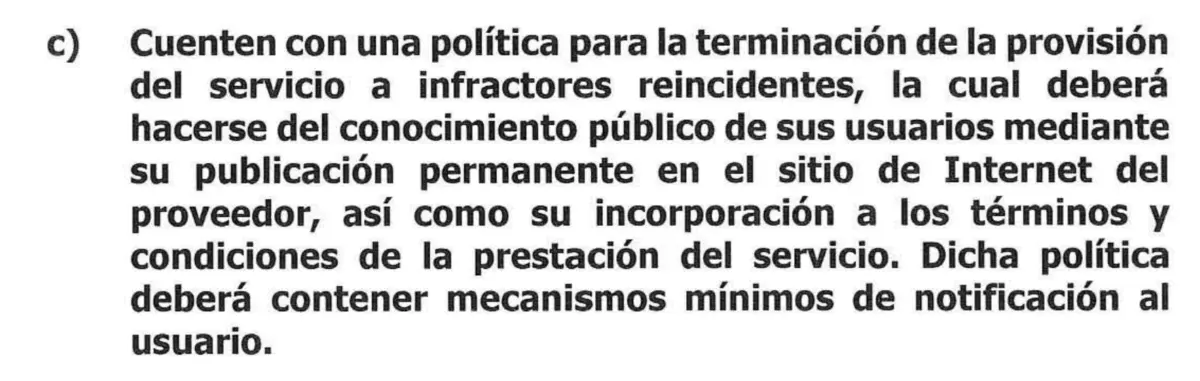
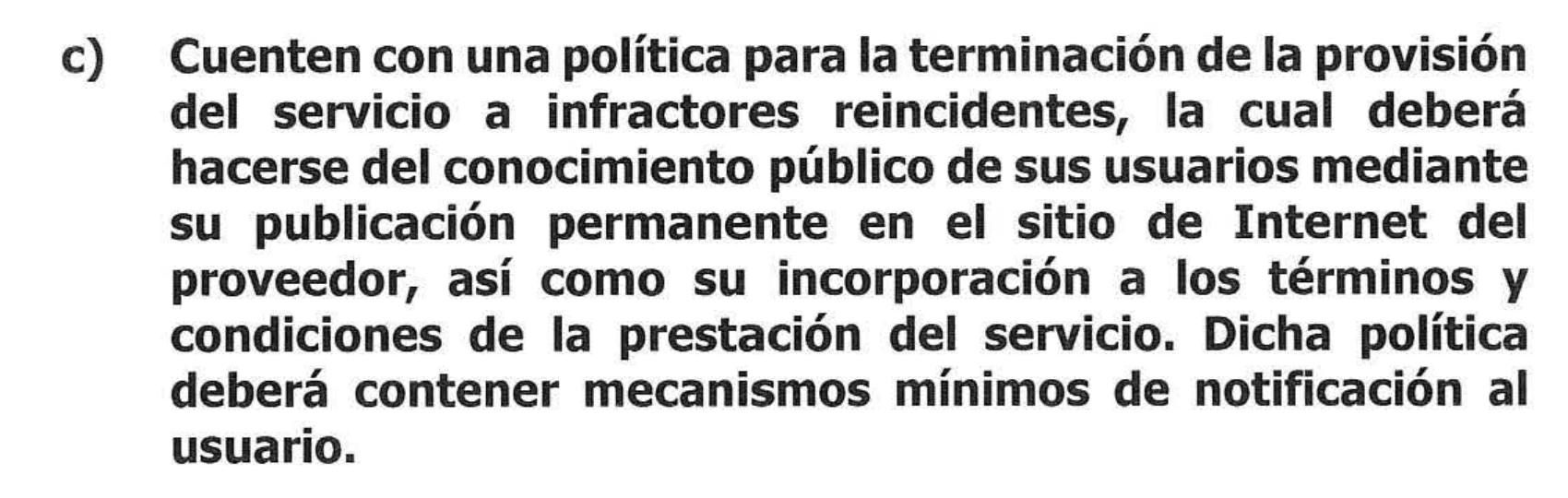
The newly passed amendments systematically close that gap by legally obligating internet access providers to establish, implement, and maintain a formal corporate policy dedicated to terminating the internet service of repeat copyright infringers. Under the statutory requirements, this policy cannot remain hidden or obscure; it must be published permanently on the provider’s official website as well as within their standard consumer terms of service. Furthermore, the framework mandates that providers must incorporate a basic, accessible mechanism allowing rightsholders and affected parties to properly notify users of alleged infringements.
Crucially, the legislation specifies that what faces termination is the physical internet connection itself, rather than merely a secondary streaming or service account. According to analysis from prominent Mexican business publications, major domestic access providers such as Telmex and Izzi will now be legally compelled to draft and enforce these termination protocols to protect themselves from severe regulatory penalties.
Internet service providers that fail to comply with these statutory mandates face immediate exposure to liability. Under the updated regulatory structure, any ISP that fails to satisfy the mandatory safe harbor conditions becomes legally liable for the copyright infringements committed by its users, provided the company knowingly contributes to, induces, or otherwise causes the infringement to occur.
The same strict standard applies to any internet provider that retains the practical technical capability to control the infringing user and simultaneously profits directly from the unauthorized activity. In either scenario of non-compliance, the Mexican Institute of Industrial Property is empowered to levy substantial administrative fines against the offending provider, with penalties reaching up to roughly 4.7 million pesos, equivalent to approximately $250,000, depending on the severity and scale of the underlying infringement.
Who Is a Repeat Infringer?
Despite establishing strict compliance mandates, the newly approved law conspicuously omits an explicit definition of the term "repeat infringer." Furthermore, the legislation fails to establish a specific numerical threshold regarding how many distinct piracy accusations or formal notices must accumulate before a subscriber’s internet connection is legally required to be cut off.
Legal experts have noted that this ambiguity leaves significant implementation challenges for the industry. According to legal specialists, individual providers will essentially be forced to determine their own operational thresholds for repeat infringement. Industry analysts have advised that providers should also implement internal verification procedures to assess whether incoming infringement accusations actually hold legal merit, while simultaneously providing accused subscribers with a fair opportunity to respond and defend their usage, even though the statute itself does not explicitly mandate such procedural safeguards.
Similar anxieties were prominently voiced by opposition lawmakers during the intense Senate debate. Legislators warned that modern households frequently share a single broadband connection among multiple family members, meaning that the unauthorized downloading or sharing activities of a single individual could effectively sever internet access for an entire household, impacting remote workers, students, and families alike. Prior to the final vote, opposition members had formally proposed introducing a mandatory requirement that would necessitate a formal judicial order before any consumer internet service could be suspended, but that protective amendment was ultimately rejected by the majority.
Not Like Cox
The legal structure adopted by Mexico bears a superficial resemblance to the framework established decades ago in the United States under the Digital Millennium Copyright Act. In the U.S., internet service providers seeking safe harbor protection must similarly implement a policy that provides for the termination of repeat infringers in appropriate circumstances. However, as the U.S. Supreme Court explicitly underscored in its landmark ruling earlier this year regarding Cox Communications, a provider’s failure to maintain a perfect repeat infringer policy does not automatically strip away its broader defense if the company can successfully argue it did not directly infringe on copyrights.
In the U.S. high court’s majority opinion, justices emphasized that merely operating a public utility network knowing that a minority of users might misuse it for piracy does not constitute contributory copyright infringement. Justice Thomas wrote that companies cannot be held liable as direct copyright infringers simply for providing a general-purpose telecommunications service to the public.
Mexico’s legislative framework, however, establishes an entirely different legal pathway. In the Mexican jurisdiction, failing to satisfy the mandatory safe harbor conditions—including the explicit requirement to maintain and enforce a repeat infringer policy—serves as a primary legal prerequisite for establishing provider liability. If an internet provider subsequently contributes to an infringement with documented knowledge, or retains the technical capacity to control the infringing subscriber while deriving direct financial profit from the activity, the enterprise can be held fully responsible under the law.
The newly enacted repeat infringer rules are scheduled to take formal effect 180 days following their official publication in Mexico’s official gazette. As the countdown to implementation begins, both the telecommunications industry and copyright holders wait to see how Mexican internet service providers will ultimately define the parameters of a repeat infringer, how many formal accusations will trigger enforcement actions, and how regulatory authorities will police compliance in the evolving digital landscape.