The development cycle for Linux 7.4 has officially entered the history books as one of the most prolific and massive merge windows the open-source operating system has ever experienced. The story began when Linus Torvalds opened the Linux 7.4 merge window just over two weeks ago. Timing presented an immediate hurdle, as the opening coincided with his annual family vacation, leading to some temporary disruptions to his regular workflow and schedule.
Warning the kernel development community in advance, Torvalds noted that his schedule would be entirely unconventional and that merging contributions might require an extra week to process thoroughly. Despite these initial logistical warnings and travel constraints, the first release candidate, or RC1, still arrived right on schedule according to the traditional two-week timeline that kernel maintainers and developers have relied on for years.

However, the adherence to the timeline did not make the window any smaller or less intense. By Torvalds’s own official count, the merge window brought in a staggering total of nearly 20,000 commits. To put that figure into proper perspective, an average kernel merge window typically hovers around 15,000 commits. The sheer volume of incoming code was so vast that the shortlog alone extended to an astonishing 24,000 lines, reflecting an unprecedented level of activity across the global Linux contributor ecosystem.
How big is it?
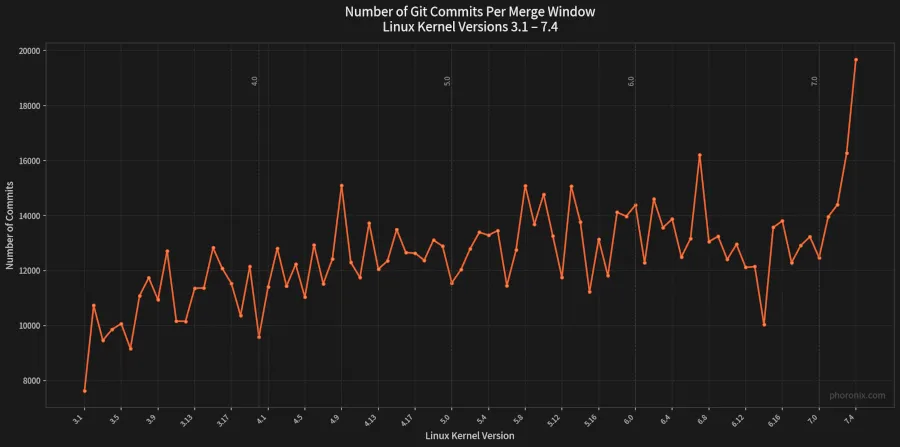
To understand just how extraordinary the Linux 7.4 merge window truly is, industry analysts and publications like Phoronix went back through every single merge window recorded since the release of Linux 3.1 back in 2011, meticulously counting the commits submitted during each cycle. The historical analysis revealed that Linux 7.4 easily captured the top spot with 19,671 commits, overshadowing the previous high-water mark set by Linux 7.3, which had held the record at 16,267 commits.

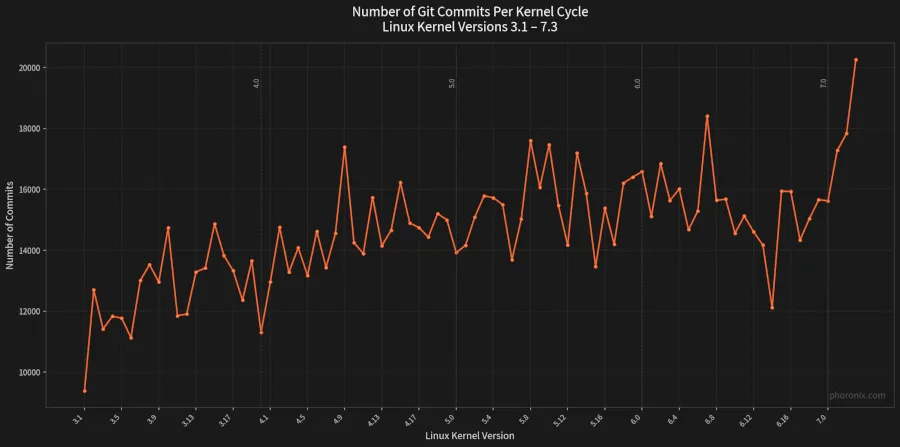
This surge did not materialize out of thin air. In fact, a clear, upward trajectory has been visible across recent release cycles, with every single merge window following Linux 7.0 consistently topping the one that came before it. The 7.4 window notably beat the 7.3 window by a margin of more than 3,400 commits. Broader development cycles across kernel releases show a parallel trend of expansion, with Linux 7.3 having been the first to cross the milestone of 20,000 total commits within a cycle at 20,260, while the incoming 7.4 window came remarkably close to matching that monumental milestone.
Why?
When looking for the root causes behind this unprecedented explosion of code contributions, Linus Torvalds pointed directly to the rapid evolution and adoption of artificial intelligence. He highlighted a significant surge of development work kicked off by modern AI tools. This influx includes a wide variety of bug fixes alongside a steadily growing number of patches and code modifications suggested by AI assistants, though he noted that these machine-generated suggestions frequently undergo extensive rewriting by human maintainers before being accepted into the codebase.
Rather than viewing this trend with skepticism, Torvalds expressed a preference for receiving these AI-assisted contributions upfront during the initial merge window rather than having to deal with them as chaotic, late-stage fixes during the subsequent release candidate testing phase. Furthermore, he voiced optimism that this exceptionally large window signals a broader cultural shift where AI-assisted bug fixes and contributions are successfully transitioning into an ordinary, standardized part of the everyday Linux kernel development pipeline.
Artificial intelligence is not the sole explanation offered for the record-breaking numbers, however. Torvalds also observed that the widespread industry expectation surrounding Linux 7.4—specifically the anticipation that it will be designated as the next long-term support release—likely played a contributing, albeit minor, role in driving developers and corporate contributors to accelerate their submissions. This strategic anticipation acts as a separate driving factor encouraging maintainers to land their features and subsystems into what will inevitably become a heavily relied-upon enterprise kernel branch.
What’s included?
A significant portion of the massive patch collection consists of hardware definitions and low-level specifications. AMD GPU header files, which contain critical register definitions for upcoming graphics hardware, account for roughly one-third of the entire patch set. Torvalds has playfully advised observers to ignore these massive header additions when analyzing the functional code changes, as they primarily represent sprawling data structures rather than active logic.
When looking at the functional components of the kernel, hardware drivers make up about half of the total patch volume, a figure that climbs to roughly two-thirds of the overall submission size when the AMD GPU header files are factored into the equation. The remaining portion of the merge window covers core kernel subsystems. These essential areas include networking, the continued integration of the Rust programming language, BPF infrastructure, memory management, and filesystems. Additionally, the window absorbed critical tooling updates such as perf and selftests, alongside a wide array of architecture-specific updates.

As a direct consequence of this immense influx of contributions, the overall Linux source tree grew substantially in tandem. According to lines-of-code counts conducted ahead of the RC1 release on November 1, the total source tree stood at an immense 41,605,120 lines, marking a noticeable expansion from the 41,019,555 lines recorded when Linux 7.3 made its debut. Out of that massive total count, actual functional code accounts for roughly 455,000 lines, with the vast majority of the remaining line count consisting of necessary blank lines, documentation, and code comments.