

The community centered around Opensource.com is currently hard at work on something entirely new. Visitors to the platform may have noticed a distinct quietness settling over the site recently, and there is a very good reason for this atmospheric shift. Behind the scenes, a brand-new project is actively in the works. While specific, granular details regarding the initiative are not yet ready for public announcement, there is already an abundance of foundational topics to discuss. And what better way to kick off a new era for a global network than by looking at the very concept that connects the entire internet?
The Internet, and Top-Level Domains
To understand the magnitude of building networks and communities in the digital space, it helps to look back at how the underlying infrastructure of the internet came to be. Most internet users know that the internet is, fundamentally, a network. By definition, a network is simply a group of interconnected connections. In fact, the very word "internet" is a portmanteau derived from "interconnected" and "network."
Historically, the internet began as a network of interconnected networks that originally consisted of only two primary nodes: the military network and the academic network. These early days of digital communication were tightly controlled and limited to specific institutional users. However, once the internet began to surge in popularity and expand far beyond those initial, specialized groups, it quickly became apparent that different designations were desperately needed.
Administrators and pioneers needed a way to instantly differentiate a commercial entity from a charitable organization, a university from a governmental department, or a personal page from an institutional hub. These crucial designations eventually became known as top-level domains, commonly abbreviated as TLDs.

Today, a vast and complex marketplace of TLDs is available to anyone registering a web address, but for a very long time, there were only a handful of options guiding traffic across the web. Those original top-level domains remain remarkably popular and culturally embedded in the architecture of the internet to this day. Most web users instinctively recognize that when they navigate to an address ending in the .com suffix, they are visiting a commercial site. Conversely, when a user visits an address ending in .org, they understand they are accessing the digital home of a non-profit organization. These suffixes do more than just route traffic; they tell a story about the nature and intent of the entity behind the screen.
Open Source Is a Network
Just as the internet relies on a web of connections to function, open source can be many things, but at its core, it is always a network. The open-source model can take on a multitude of forms across modern society. It can be commercial, serving enterprise markets and driving economic innovation. It can be non-profit, empowering grassroots organizations and public-interest initiatives. It can be academic, fostering research and collaborative learning, or it can be cultural, shaping how creators share art, literature, and knowledge.
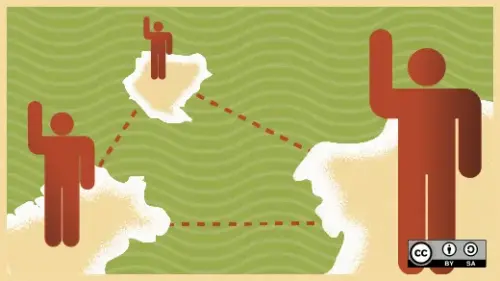
No matter what form open source ultimately takes, it remains a network. Sometimes—though certainly not always—that network is literally made of computers, servers, and repositories of source code. But most importantly, and far more powerfully, it is a network of people.
Whether community members are gathering in person at a bustling international conference, sharing ideas over drinks at a local pub, or collaborating asynchronously in an online chat room, the open-source movement is, above all else, a community of human beings.

For the past twelve years, the website Opensource.com has been supported by a commercial entity. That institutional backing provided the platform with stability and resources to grow into a prominent voice in the technology sector. However, the people—referring directly to the readers, contributors, advocates, and creators who constitute the very heart of the Opensource.com community—are not commercial entities. They are individuals, united by a shared passion for openness, collaboration, and the belief that software and knowledge should be shared freely.
The upcoming transition represents a significant milestone for this collective of individuals. In exactly one month, Opensource.com is going to resolve that lingering structural disconnect. The community-driven project currently in development aims to bridge the gap between institutional support and the people-powered nature of the movement.
As the countdown begins, the community is encouraged to stay tuned for further updates as the details of this new chapter come to light. Opensource.com continues its long-standing tradition of publishing stories about creating, adopting, and sharing open source solutions, maintaining its presence across digital channels for those eager to follow the latest developments in the open-source world.


Leave a Reply