

The vibrant global community behind Opensource.com is hard at work on something entirely new. Visitors to the platform may have noticed a distinct quietness settling over the site recently, but this lull is far from a sign of inactivity. Instead, it marks a period of transition and intensive behind-the-scenes development as a brand-new project takes shape. While specific details regarding the upcoming initiative are still tightly under wraps and not yet ready for a public announcement, there is already plenty to discuss about the future of the platform, the philosophy of open source, and the enduring power of human connection across the digital landscape.
To understand the weight of this upcoming transition, it is helpful to look back at the fundamental architecture of the internet and how digital spaces have historically organized themselves. What better way to start exploring a new digital horizon than by examining the very fabric of the entire internet?
The Internet, and Top-Level Domains
Most users navigate the web every day without giving much thought to the underlying infrastructure that makes global communication possible. As the name implies, the internet is fundamentally a network. By definition, a network is a group of interconnected connections and systems. In fact, the term "internet" is a portmanteau born from the combination of "interconnected" and "network."
At its inception, the internet was a much smaller, more specialized web of interconnected networks. Historically, it consisted primarily of two main entities: a military network designed for resilient communication, and an academic network meant for research institutions to share computational resources and data. As long as the network remained confined to these specialized groups, its organizational needs were relatively straightforward.

However, once the internet began to catch on and gain widespread popularity outside of military and academic circles, the landscape shifted dramatically. It quickly became apparent that different designations were urgently needed to differentiate various types of entities inhabiting the digital space. Society needed a way to instantly distinguish a commercial enterprise from a charitable organization, a university from a governmental department, or an individual enthusiast from a corporate body.
These vital designations ultimately became known as top-level domains, or TLDs. Today, internet users can choose from a vast and diverse marketplace of available TLD extensions. Yet, for a very long time, the digital world operated with only a handful of foundational extensions. These original TLDs remain remarkably popular and culturally embedded in the architecture of the web. Most internet users intuitively understand that visiting a website ending in a .com address typically means browsing a commercial site, whereas landing on a .org address signals a journey to a non-profit organization dedicated to a cause, community, or public service. These suffixes carry meaning, signaling intent, governance, and organizational structure before a user even reads a single word on the page.
Open Source Is a Network
Just as the internet relies on interconnected networks to function, open source as a movement can manifest in many different forms, yet it always remains a network at its core. Open source can be commercial, driving enterprise software and global economic growth. It can be non-profit, sustaining public-interest software and digital rights advocacy. It can be academic, fostering foundational research and educational tools. It can also be cultural, shaping how artists, writers, and creators share their work with the world.
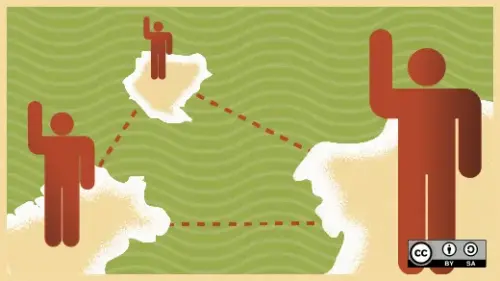
No matter what form open source takes, or what industry it serves, it is fundamentally and unalterably a network. Sometimes, this manifests as a literal network of computers, servers, and repositories sharing code across continents. But most importantly, open source is a network of people.

Human interaction is the lifeblood of the open source movement. Whether people are gathering physically at an international technology conference, catching up informally at a local pub, or collaborating asynchronously in an online chat room, open source is, above all else, a community of living, breathing human beings. Technology provides the tools, but the community provides the soul, the maintenance, the documentation, and the vision.
For the past twelve years, the website Opensource.com has been proudly supported by a commercial entity. Corporate backing has provided stability, resources, and a platform for millions of readers to explore the world of open development. However, the people who truly make up the Opensource.com community—the readers, contributors, commenters, and advocates—are not commercial entities. They are simply people, united by a shared passion for creating, adopting, and sharing open source solutions.
Now, a new chapter is about to unfold. In exactly one month, Opensource.com is going to resolve that lingering bug and step into its next iteration. Stay tuned for what comes next as the community builds its future together.


Leave a Reply