
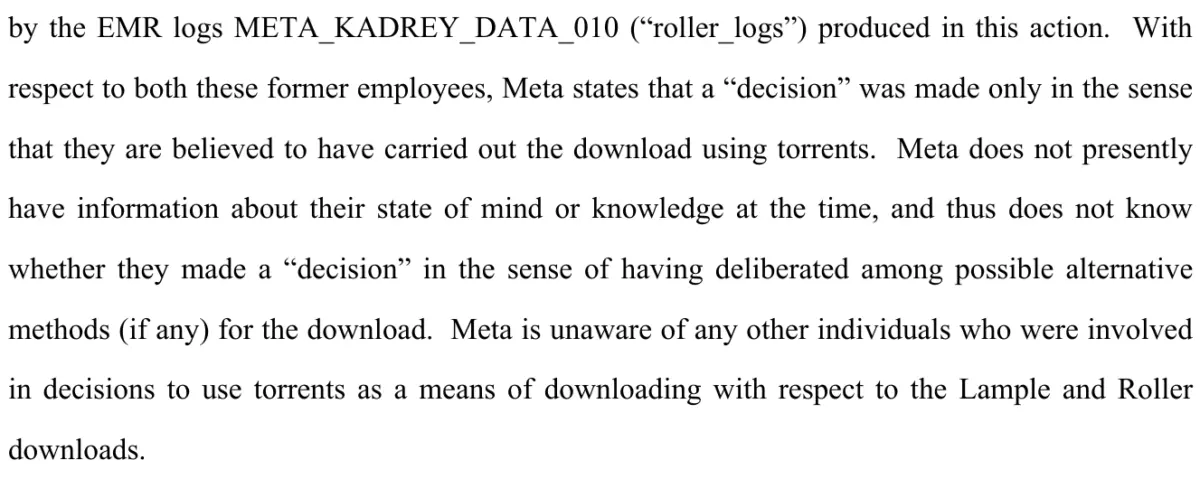
A federal magistrate judge has ordered Meta to disclose the names of all employees involved in decisions to use BitTorrent to download copyrighted books from shadow libraries for AI training. The ruling marks a major development in ongoing copyright litigation, piercing through Meta’s defense that its data acquisition was merely the result of diffuse team consensus and low-level technical choices.
The order, handed down by Magistrate Judge Thomas Hixson, addresses a persistent discovery dispute between Meta and publisher Entrepreneur Media. While Meta previously secured a significant fair use victory regarding the actual training of its artificial intelligence models on copyrighted texts, claims centered around the company’s use of peer-to-peer BitTorrent networks to acquire datasets remain very much alive in court.
Unraveling the ‘Technical’ Decisions Defense
The legal battle stems from class-action lawsuits and individual corporate complaints accusing Meta of contributory copyright infringement and unauthorized distribution. Plaintiffs argue that by downloading datasets from unauthorized repositories like Library Genesis (LibGen) and Anna’s Archive via BitTorrent, Meta inherently functioned as a seed node, uploading and distributing pirated materials to third parties on the peer-to-peer network.
In an effort to establish liability and prove the willfulness of the alleged infringement, Entrepreneur Media—the publisher of Entrepreneur magazine—demanded that Meta identify every individual who "made, authorized, or approved" the decisions to acquire the shadow library datasets using BitTorrent protocols.

Meta’s initial responses offered a narrow view of corporate responsibility. The tech giant named several individuals associated with data handling but asserted it could not identify anyone who "formally" made or approved decisions to acquire books for its early Llama AI models, characterizing those milestones as the product of general team consensus. When pressed specifically on the mechanics of the downloads, Meta labeled the execution as routine technical work carried out by engineers, adding that acquisitions from Anna’s Archive underwent a generalized internal legal review in early 2024 involving in-house counsel.
Crucially, Meta pointedly avoided naming high-ranking executives or specific managers who authorized the deployment of BitTorrent software to retrieve the files.
This corporate stance drew sharp criticism from the plaintiffs. "On that construction no one at Meta decided to torrent anything, yet Meta torrented shadow libraries repeatedly from 2022 to 2024," Entrepreneur Media countered in court filings.
Internal Revelations and ‘Legally Not Okay’ Warnings
The friction over accountability intensified as internal company logs and engineer testimonies came to light during the discovery process. Evidence revealed that the legal and operational risks of peer-to-peer file sharing were not lost on Meta’s internal teams.

One engineer who participated in downloading LibGen data previously testified that the distinct legal risks posed by BitTorrent seeding—the simultaneous uploading of fragments of files to other users on the network—were explicitly raised and discussed internally, prompting some discussion about implementing technical safeguards to limit outbound data transfers.
More damningly, internal Meta logbooks uncovered by the plaintiffs showed explicit awareness of the legal hazards. Prior to initiating a download from Anna’s Archive, an employee reviewed a logbook entry that explicitly advised against utilizing peer-to-peer networks.
"Decided to go with direct file uploads without using torrents for the following reasons: Using torrents would entail seeding the file such as sharing content outside. This would be legally not okay," the internal logbook read, as quoted in Entrepreneur Media’s legal submissions.
Despite these internal warnings, Meta proceeded to use BitTorrent to acquire both LibGen’s Scimag collection and data from Anna’s Archive. While Meta does not deny downloading the files via the protocol, it maintains that it is unaware of any individual who explicitly authorized the distribution aspect of the downloads. Furthermore, the company argues that proactive measures were taken to minimize seeding activity.
The precise volume of data shared externally remains a contested point. Last year, an expert retained by Meta estimated that uploads originating from its Amazon Web Services (AWS) servers accounted for roughly 30 percent of the total data volume downloaded during specific torrenting windows between April and July 2024.
Judge Hixson Rejects Meta’s Collective Responsibility Argument
Faced with an impasse, Entrepreneur Media asked the court to compel clearer answers. Magistrate Judge Hixson sided firmly with the publisher, dismissing Meta’s assertions that collaborative workflows and decentralized team discussions absolved it from naming responsible parties.
In his ruling, Judge Hixson emphasized that the interrogatories submitted by the plaintiffs were not restricted solely to formal board-level decisions. Furthermore, he noted that Meta’s previous disclosures focused heavily on the downstream use of the data rather than its initial acquisition and downloading methodology.
The judge rejected the notion that group consensus creates a legal vacuum of accountability. Under the court’s order, if a decision to utilize BitTorrent was made collaboratively by a team, Meta is legally required to identify every single person who participated in that group.

The directive mandates that Meta must specifically identify individuals who took part in discussions preceding the 2023 LibGen torrent download, those who approved the pivot to BitTorrent, and the person or persons who greenlit the April 2024 data acquisition from Anna’s Archive.
Crucially, the scope of the order extends directly to the contentious issue of network distribution. Meta is now required to name everyone who decided "whether or how to seed, or to mitigate seeding," during the acquisition of the pirated library datasets.
Next Steps in the Litigation
For plaintiffs like Entrepreneur Media, identifying these individuals is vital. The publisher argues that the personnel decisions and internal awareness directly bear on the question of willfulness, which can significantly influence statutory damages under copyright law, alongside supporting core claims of contributory infringement and illegal distribution.
While the immediate dispute centered on untangling Meta’s internal decision-making hierarchy and forcing the disclosure of names, the broader legal war is far from over. The fundamental questions of whether Meta’s specific use of BitTorrent constituted fair use under copyright law, and whether the company can be held legally liable for the downstream distribution of pirated texts to third-party peers on the network, remain to be adjudicated by the court.

Leave a Reply