
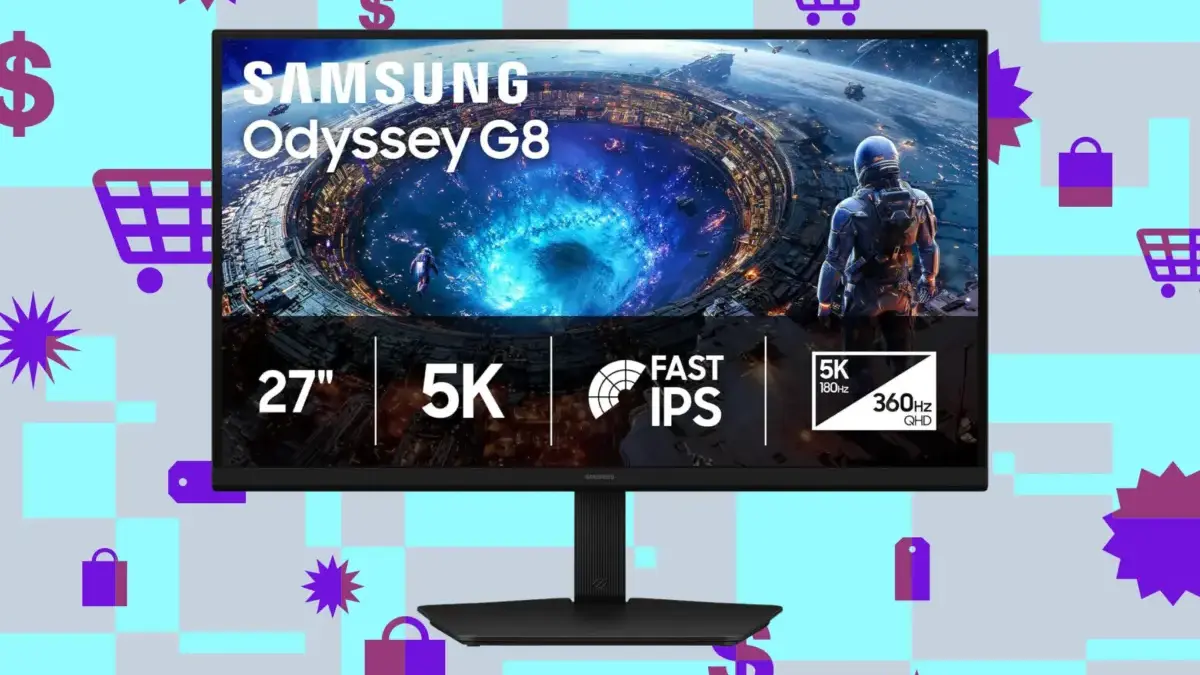
The market for high-resolution displays has expanded significantly over the past several years, driven largely by users seeking pixel-dense screen options that rival Apple’s high-end Studio Display without demanding an equivalent financial investment. While many of these 5K alternatives are tailored specifically for productivity workflows and creative professionals utilizing macOS, finding a display that balances ultra-high pixel density with genuine gaming performance has historically proven difficult. However, Samsung’s 27-inch Odyssey G80HF successfully bridges that gap, offering a specialized feature set for users who want ultra-sharp visuals alongside high refresh rates. For shoppers keeping an eye on high-end hardware discounts, the Odyssey G80HF is currently available for $599.99 at major retailers including Amazon and B&H Photo, marking a notable price drop that undercuts its previous best by $100.

The Odyssey G80HF sets itself apart from standard productivity-focused 5K monitors by incorporating a versatile Fast IPS panel that features a unique dual-mode display system. Users can configure the monitor to operate at its native 5K resolution with a maximum refresh rate of up to 180Hz, providing an exceptionally sharp workspace for detailed tasks alongside smooth motion handling. Alternatively, users looking for maximum fluidity in fast-paced competitive titles can switch the display to 1440p resolution, which unlocks a blistering 360Hz refresh rate. To ensure that fast-moving visuals remain tear-free and fluid across varying hardware loads, Samsung has equipped the monitor with support for both Nvidia G-Sync compatibility and AMD FreeSync Premium technologies, keeping the display’s refresh rate synchronized with the output of a connected graphics processing unit.
Connectivity on the Odyssey G80HF is geared toward modern desktop setups, featuring a single DisplayPort 2.1 connection alongside a pair of HDMI 2.1 ports. While Samsung has not publicly detailed the specific bandwidth capabilities of the DisplayPort 2.1 interface on this model, the inclusion of modern video inputs ensures compatibility with contemporary high-end graphics cards and gaming consoles. Additionally, the monitor includes a built-in USB hub, allowing users to connect and charge peripherals using two USB-A 3.2 Gen 1 accessory ports.

For many gamers and hardware enthusiasts, one of the most compelling aspects of the Odyssey G80HF is its one-millisecond response time. While a one-millisecond response time is a standard benchmark among dedicated gaming monitors—even those retailing at significantly lower price points—it remains an uncommonly seen specification in the 5K monitor category, particularly at this price bracket. Experience with alternative high-resolution displays highlights why this specification matters. Testing of other budget-oriented 5K offerings, such as a sub-$500 model from KTC released previously, demonstrated that despite marketing claims of gaming readiness, actual gaming performance on typical high-resolution productivity panels can often fall short of expectations, resulting in a less-than-ideal user experience.
The launch and pricing of the Odyssey G80HF also place it in direct competition with other premium high-resolution options currently on the market. For instance, LG’s 27-inch UltraGear evo 5K Mini LED monitor retails for $799.99, sitting $200 above the current promotional price of Samsung’s display. The LG alternative offers a slightly different array of specifications, including a Mini LED backlight with a higher number of local dimming zones for improved contrast and picture accuracy, higher peak brightness levels, and a USB-C video input port capable of delivering 90W of power delivery output to charge laptops and other host devices simultaneously during use. While the LG monitor’s dual-mode refresh rates max out slightly lower than Samsung’s at 165Hz for its high-resolution mode and 330Hz for its high-speed mode, the differences in maximum refresh capability represent a minor distinction compared to the broader feature sets and price considerations between the two displays.


Leave a Reply