
The players in venture capital sometimes change, but the foundational philosophy of Silicon Valley’s most storied firms can prove remarkably resilient. When a reporter sat down with four of Benchmark’s general partners three years ago, three of those individuals were no longer with the firm by the time the next cycle rolled around. Capital commitments have also experienced a historic shift. This summer, Benchmark announced a staggering $2 billion deployed across two separate funds, marking only the second time in its 31-year history that the firm has veered away from raising a far smaller, tightly capped vehicle.
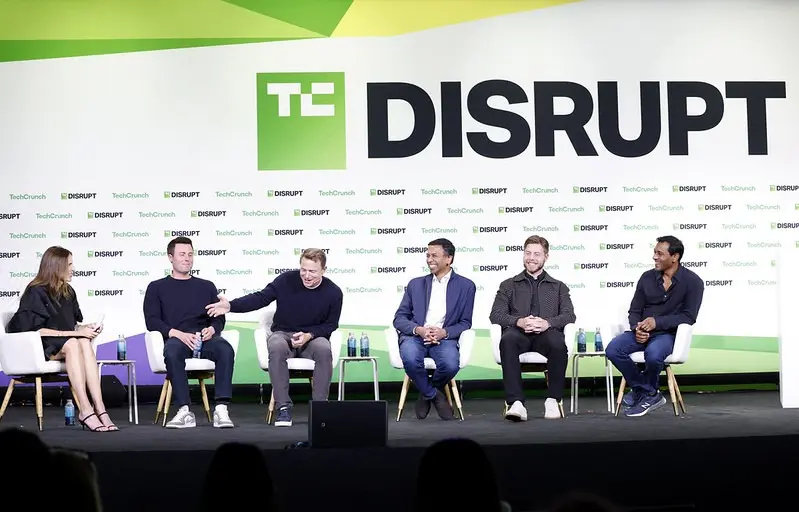
Yet, at TechCrunch Disrupt, the venture firm’s current lineup of five general partners convincingly portrayed a close-knit, highly disciplined team that has no intention of putting the pedal to the metal, even as many of their industry rivals do precisely that. While the global technology landscape seems to be speeding up at a breakneck pace, Benchmark continues to invest at the measured, deliberate tempo it has always maintained: just two or three new bets per year, per partner. The world may be drowning in an endless stream of real-time information, but their Monday partner meetings still famously feature no agenda. And while broader economic indicators point toward potential trouble ahead, the partners do not seem overly bothered, viewing many of the prevailing warning signs simply as products of social-media-fueled hysteria.
Gathered together on the main stage, Benchmark’s five general partners offered a rare, collective look inside the inner workings of one of venture capital’s most exclusive partnerships.
Evolving the Core Without Losing the Craft
For decades, Benchmark’s identity was inextricably linked to its lean, highly focused early-stage core fund. Addressing how the firm has adapted its strategy—including the introduction of a larger core fund and a massive new growth fund—without sacrificing its core DNA, general partner Peter Fenton emphasized that the foundational craft has not fundamentally changed.
Working closely with founders at the very beginning of their journeys typically demands a 10-to-15-year commitment, Fenton noted, working shoulder-to-shoulder in a manner that fundamentally does not scale. At the same time, the broader economic landscape has experienced undeniable inflation. Benchmark held its core fund steady at $500 million for 20 years before letting it inflate to remain consistent with the broader economy, a move Fenton conceded was perhaps a tactical delay on their part.
The introduction of a $1.25 billion growth fund, however, represents a deliberate expansion of their mandate. Fenton explained that the ecosystem has effectively given the firm permission to extend its reach beyond early-stage businesses. Operating without a growth vehicle previously felt like a severe restriction—a "fork in our eye"—given that numerous opportunities over the years could have yielded massive returns for Benchmark, yet the firm was legally constricted by its strict early-stage focus.
When asked whether the firm plans to distribute that massive growth capital across a handful of concentrated bets, Fenton pointed to the natural diversity of thought within a healthy partnership. Drawing on a recent J.P. Morgan paper detailing "the agony and ecstasy of a concentrated portfolio," Fenton noted that if the fund ultimately succeeds, one or two investments will likely generate upwards of 90% of the returns, pointing to a target of perhaps four to six, or maybe seven to eight, total growth investments.
A Small Partnership Dynamic
For Ev Randall, who previously spent time at Founders Fund, Bond, and Kleiner Perkins, the fundamental differentiator of any venture firm boils down to the people within it and how they collaborate. While some prominent institutions operate under heavily hierarchical structures featuring 50- or 60-person investment teams and federated processes divided into product groups, Benchmark represents the opposite extreme: a small, egalitarian partnership.
Randall noted that he was drawn to small partnerships early in his career because they facilitate a higher level of throughput and conversational fidelity. Decisions are not made by navigating a Byzantine corporate structure; instead, the partners operate like a sports team stepping out onto the field together. Finding people you not only like but genuinely admire—a group where everyone constantly learns from one another—is exceedingly rare in modern venture capital.
That sentiment was echoed by Jack Altman, who joined Benchmark as a general partner in February. Just a year prior, Altman had raised a $275 million fund for his own firm in what he described to the press as a lightning-fast one-week sprint, alongside hosting a hugely popular podcast. Having recorded a podcast with the Benchmark partners at the start of the year, Altman was struck by their unwavering commitment to remaining a small fund focused on being the first person a founder calls. In an industry frequently obsessed with money and status, Altman found a team that genuinely cares about founders. Despite enjoying his time as an independent investor, navigating a volatile market alone felt daunting, making the prospect of learning alongside a deeply driven, focused group of peers an irresistible opportunity.
Inside the Agenda-Free Monday Meetings
One of the most persistent legends surrounding Benchmark is that its weekly Monday partner meetings take place entirely without an agenda. When asked about this unorthodox practice during the Disrupt panel, Chethan Puttagunta joked that Altman had actually tried to introduce an agenda, prompting Altman to quip that he still had one prepared for the following Monday.
Eric Vishria described the lack of structure as weirdly arbitrary, explaining that the gathering is simply an ongoing, multi-year conversation. In an era of rapid technological transformation, the partners constantly attempt to figure out what is suddenly possible that could not be achieved six months prior, and which founders are truly "bending light." They discuss the companies they are meeting, what piques their interest, and the underlying dynamics they observe inside boardrooms. While larger firms often try to systematize these workflows, Vishria noted that one of the primary beauties of a five-person team is that such bureaucratic scaffolding is entirely unnecessary. The decades-long conversation only functions because the partners remain small and genuinely enjoy spending time together, often following up their sessions with dinners alongside legendary entrepreneurs who have built multi-hundred-billion-dollar companies—even those outside their own portfolio—simply to stretch their collective thinking.
Puttagunta added that maintaining a blank slate provides the necessary space to remain reactive. If a founder urgently requires assistance landing a high-level executive or securing a critical strategic partnership, all five partners can immediately place themselves at the entrepreneur’s disposal.
When pressed on whether a single partner possesses veto power to kill a deal, Puttagunta admitted that no formal rules exist around the process, with Altman adding that he was still waiting to see how his colleagues handled such a scenario. Because the firm intentionally maintains a low volume of deals, heavy-handed structural rigor, customer relationship management software, and formal voting procedures are completely absent. Fenton observed that the firm’s brand relies on avoiding the "Shark Tank" mentality of forcefully declaring winners and losers in favor of maintaining a sense of awe at new possibilities. If a prospective founder happens to be polarizing among the partners, the deal is dead; if someone in the room does not connect with an entrepreneur, Benchmark simply recognizes they are not the right partner.
Navigating the AI Era and Competitive Conflicts
Addressing whether the firm has felt compelled to pick up its investment pace amid an environment where companies are growing faster than ever, Puttagunta maintained that their cadence remains consistent. Acknowledging the baseline reality of venture capital, he emphasized that Benchmark does not expect to back every single successful company. Instead, the firm identifies entrepreneurs possessing unique strengths and focuses entirely on amplifying those capabilities, regardless of how much capital a startup wants to raise or where it is geographically located.
The conversation quickly turned to an increasingly sensitive topic for modern founders: venture capital firms backing competing companies within the same vertical. As artificial intelligence startups scale rapidly and expand aggressively into adjacent territories, conflicts of interest have grown more common. Vishria explained that Benchmark operates on a strict ethos of making a dedicated commitment to an entrepreneur, working closely enough that the partnership genuinely matters to both parties. However, he acknowledged the harsh reality that modern companies evolve and pivot at unprecedented speeds, making occasional conflicts an inevitable feature of the current market dynamic.
While maintaining strict confidentiality and avoiding the kinds of insane, direct rivalries that have recently surfaced among competing firms in the broader ecosystem, Vishria noted that the demand for exclusivity in core areas remains paramount. Puttagunta pointed out that founders in the contemporary AI era are exceptionally ambitious. As the marginal cost of coding new products effectively drops to zero, founders naturally seek to attack expansive new surface areas, ensuring that competitive overlaps will likely increase.
For Altman, stepping into the Benchmark partnership has involved backing a diverse array of sectors. Having originally focused primarily on software, Altman has since invested in semiconductors, robotics, and infrastructure since joining the firm. Reflecting on his onboarding process, Altman quipped that it was entirely non-existent—his colleagues simply advised him not to feel pressured by his first deal, reminding him of the extreme power-law dynamics that govern venture capital, where the odds of a first investment generating the bulk of a fund’s returns are statistically low.
Unorthodox Bets and Public Market Volatility
Benchmark’s willingness to embrace unorthodox bets was highlighted by its early investment in Cerebras, an AI chip company that Vishria backed in the spring of 2016 during its initial funding round, marking the firm’s first hardware investment in a decade. Vishria recalled that on the eve of the founders’ partnership pitch, Fenton warned him that the thesis went against everything he had learned in venture capital. Yet, following the Monday pitch, Fenton completely flipped his perspective.
Fenton described Andrew and his co-founders as ideological "heretics" whose unorthodox messaging continues to generate polarizing market reactions today. True to Benchmark’s contrarian philosophy, Fenton argued that if an investment thesis is entirely built on consensus, there is little reason for a startup to exist in the first place.
That polarization has been visibly reflected in Cerebras’s public market trajectory. After pricing its shares at $185 earlier this year, the stock spiked to $350 before settling back down near its original price point. Asked about the drastic fluctuations, Vishria noted that leading up to the IPO, he reviewed stock charts for numerous prominent tech companies—including CoreWeave, Datadog, DoorDash, and Amazon—discovering that peak-to-trough movements of 500% in a given year are surprisingly common. Surviving as a public company demands a stomach of titanium, requiring both leadership and employees to maintain steady operational focus despite volatile market sentiment.
When the discussion shifted to whether a severe macroeconomic correction might be looming for the AI sector—particularly as several high-profile companies exhaust their free cash flow, borrowing costs remain elevated, and high-profile AI startups navigate bankruptcy proceedings—Randall offered a grounded macro perspective. Predicting macroeconomics with precision is a fool’s errand, Randall argued, adding that the most dramatic change in modern venture capital is the hyper-accelerated information environment.
Randall suggested that sensationalized media narratives surrounding isolated corporate failures often create an artificial chilling effect, driven largely by hyperactive echo chambers on social media platforms like X. In reality, Benchmark’s portfolio companies are experiencing such intense underlying demand that they routinely struggle to secure sufficient compute capacity to serve paying enterprise customers at strong gross margins. The broader AI ecosystem is not fundamentally unhealthy, Randall contended; rather, the true source of instability is market volatility sparked by unverified data points amplified for online clicks. He suggested that high-profile pure-play AI giants eventually going public would ultimately stabilize the market, preventing dramatic 5% to 10% swings every time an anonymous social media account updates an unverified estimate.
The Continuing Gravity of San Francisco
Finally, the partners addressed whether the modern tech landscape still requires founders to base their operations in San Francisco, or whether geographic decentralization is taking permanent root. While Altman acknowledged that founders do not strictly have to live in the Bay Area, he noted that the city remains by far the easiest place to aggregate top-tier talent, venture capital, and early customers.
Fenton reinforced that historical data demonstrates how over 90% of venture capital returns have consistently originated from companies founded locally. While extraordinary outliers like Shopify or Ramp prove that brilliant success stories can emerge elsewhere, the systemic network effects of a dense talent pool continuously raise the bar for excellence in a way few other regions can replicate.
Randall concluded the discussion by noting that nearly every non-San Francisco-based startup he has met with over the past 18 months either maintains a local office, splits its operational time between regions, or actively plans to relocate to the Bay Area. In the current era of artificial intelligence, iron continues to sharpen iron, and founders seeking to build alongside the most ambitious peers still find themselves inexorably drawn back to the streets of San Francisco.


Leave a Reply