
For decades, Charles Schulz’s Peanuts has resonated with readers not just through its gentle humor, but through its profound, often melancholic observations on the human condition. Many of the most memorable lines in the comic strip’s storied history involve a character saying something accidentally brilliant. While a line might be intentionally insightful when it is written by Schulz, when those words transfer from his mind to the mouths of his creations, the characters usually speak without ever meaning to utter anything profound—or even noticing that they have done so.
Consider, for example, what is perhaps the strip’s definitive line about heartbreak: "Nothing takes the taste out of peanut butter like unrequited love!" That quote perfectly encapsulates the strange, hollow physiological sensation associated with romantic rejection. Yet, for Charlie Brown, he is simply reacting to the immediate ache of the moment without any deeper, premeditated philosophical intention.

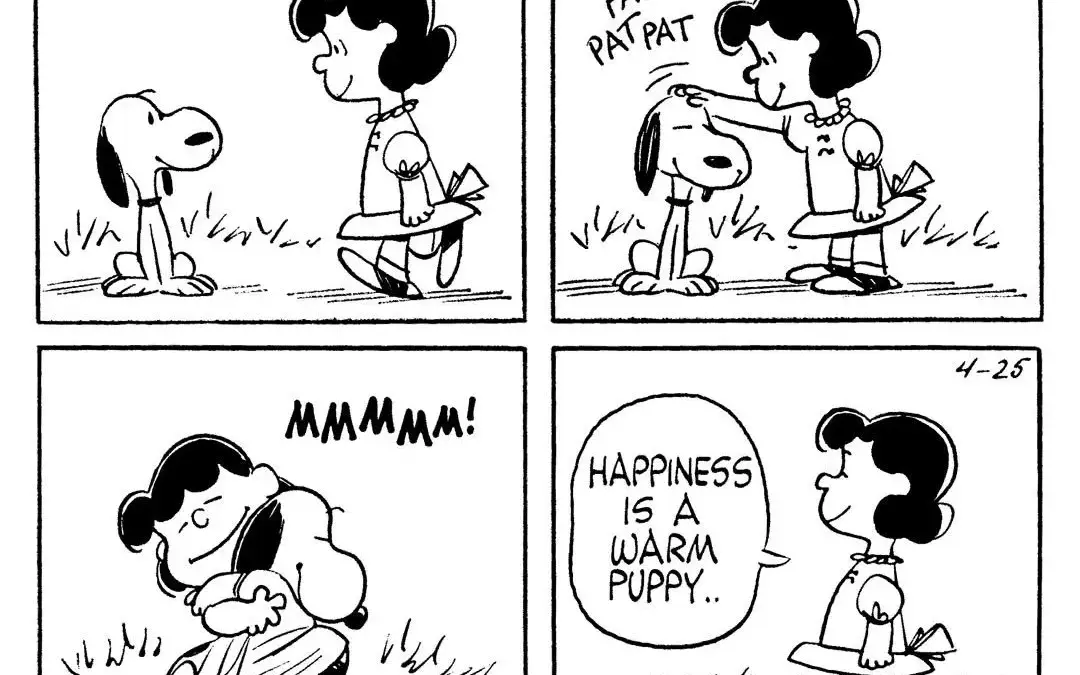
Similarly, Lucy’s famous declaration, "Happiness is a warm puppy," touches on life’s simple joys on a remarkably deep level. But when attempting to determine the single best quote ever uttered by Charlie Brown himself, the approach requires a shift away from accidental brilliance. Instead, the focus falls on something where the character understands his reality just as clearly as the audience does—a moment where he tells the reader who he is with complete self-awareness. That distinction separates a brilliant Charlie Brown quote from a brilliant Charles Schulz quote, defining the character’s core philosophy on life.
To find that perfect quote, one must first confront the fundamental question: Who is Charlie Brown? While Charlie Brown may not possess a vast social circle, he remains steadfastly loyal to the friends he does have. He is a devoted and caring pet owner to Snoopy, and he is generally kind and polite to those around him. Yet, beneath these virtues, Charlie Brown is, by all traditional metrics, a loser. While that description might sound harsh, it forms the entire comedic and emotional engine of his character. Charlie Brown is perpetually unlucky in love, a thoroughly mediocre student, and a boy who almost never secures a definitive "win" at anything he attempts.
That persistent underachievement is precisely what makes him so deeply relatable to millions of readers. Many people navigate daily life with the quiet suspicion that they are not really winning, either. Charlie Brown is forever the child who approaches the football with hope, only to watch Lucy yank it away at the absolute last microsecond, sending him crashing onto his back.

Yet, Charlie Brown is equally defined by his relentless persistence. He falls for the football gag again and again, driven by the quiet internal conviction that "this time I’ll get it." There is an indomitable element of hope embedded in his character, even when that optimism is entirely unwarranted and repeatedly unrewarded. That quiet optimism is precisely why readers cannot help but root for him. Sure, he is a sad sack, but his endearing refusal to quit elevates him from a mere punchline to a symbol of human endurance.
Charlie Brown’s Philosophy on Life
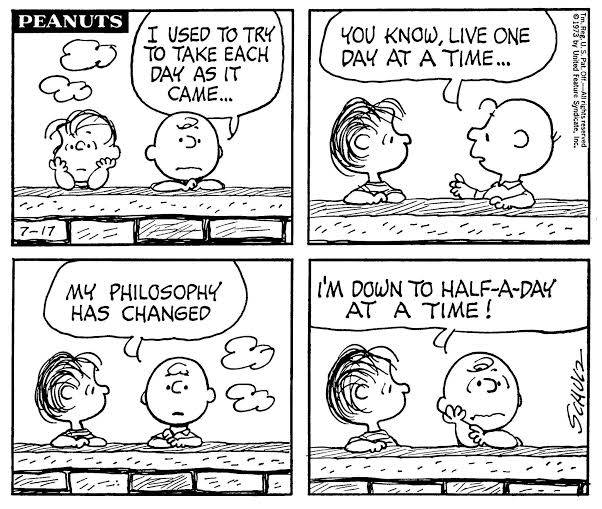
Charlie Brown’s definitive quote should exemplify both his characteristically bleak outlook and his underlying persistence, all while articulating his personal philosophy on life, free from accidental brilliance. One particular comic strip from 1973 comes remarkably close to capturing this sentiment. In that strip, Charlie Brown is seen leaning against a brick wall alongside his philosophical pal Linus. Looking out at the world, Charlie Brown remarks, "I used to try to take each day as it came… You know, live one day at a time… My philosophy has changed. I’m down to half-a-day at a time!"

While clever, that quote carries a slight ambiguity. Without the context of the profound misery etched plainly across Charlie Brown’s face, the line could easily be misinterpreted as an optimistic, motivational directive to "live life to the fullest."
To find the unvarnished truth of his worldview, one must look to an earlier, structurally similar conversation from 1966. Once again, the scene is set against that familiar brick wall, where Linus and Charlie Brown are engaged in a quiet afternoon chat. Linus opens the exchange with a sweeping observation about the human condition: "Life is difficult, isn’t it, Charlie Brown?"
"Yes, it is," Charlie Brown replies. It is right there, in the quiet aftermath of that mutual acknowledgment, that he utters what is arguably his best line across the entire 50-year publication run of the comic strip:
"But I’ve developed a new philosophy… I only dread one day at a time."
Those words speak unmistakably to Charlie Brown’s pessimistic outlook on existence, while seamlessly incorporating that stubborn streak of persistence that defines his character. When it comes to life—much like with the football—Charlie Brown fully expects the worst possible outcome, and more often than not, that is precisely what he gets. Yet, he refuses to surrender. He simply adjusts his expectations downward, choosing to take his anxiety in manageable increments.
The weight and resonance of the line are such that it eventually found its way beyond the printed page, making a memorable appearance in the 1969 animated feature film A Boy Named Charlie Brown. In the movie, Linus and Charlie Brown reenact the exact same conversation by the exact same brick wall. Because the film was written directly by Charles Schulz himself and released three years after the initial comic strip appeared, the sentiment clearly lingered in the creator’s mind long after it was first published. It is a sentiment that is equally likely to endure for anyone who shares Charlie Brown’s uniquely resilient, if deeply weary, outlook on the passage of time.

Leave a Reply