
The United Kingdom has launched a major blow against the digital infrastructure powering illicit international finance, issuing stringent economic sanctions against Cryptomus, a shapeshifting cryptocurrency platform that investigators say operates as a primary conduit for ransomware, narcotics trafficking, darknet markets, fraud, and cybercrime services designed to help Russia bypass global financial restrictions.
Announced on October 8, the U.K. Treasury’s sanctions target Cryptomus—which has previously operated under the corporate aliases Certa Payments and Xeltox Enterprises—for processing high-volume payments that directly benefit the Russian government and its sanctioned financial institutions. Under the terms of the new enforcement action, all domestic assets held by Cryptomus at British banking institutions have been instantly frozen, while British companies and citizens are strictly barred from conducting any business with the platform, whether through virtual assets or traditional financial channels.
Alongside Cryptomus, the U.K. government targeted several other affiliated virtual payment platforms integral to the illicit web, including VexPay, TokenSpot, and the Tsunami Payments service. The coordinated crackdown aims to dismantle the complex layers of obfuscation that enable transnational criminal networks and rogue states to convert digital currency into liquid capital.
A Chameleonic History of Evasion and Corporate Rebranding
Emerging onto the global financial ecosystem in 2022, Cryptomus quickly established itself as a go-to payment processor for dozens of Russian cryptocurrency exchanges and online storefronts peddling cybercrime-as-a-service. However, as law enforcement agencies and blockchain analytics firms began tracking its operations, the platform repeatedly changed its corporate identity to dodge scrutiny. Most recently, following a record-breaking enforcement action in late 2025 where Canada levied a CAD $176 million fine against the platform for severe anti-money laundering violations, Cryptomus shifted its branding to "Heleket."
Despite the cosmetic rebrand, the underlying plumbing of the service remained largely intact. When users attempted to access Cryptomus support channels on Telegram following the U.K. announcement, automated bots and support agents abruptly informed inquiries that the platform was suddenly unable to process transactions, while simultaneously attempting to distance Heleket from its sanctioned predecessor despite mounting blockchain evidence proving their identical operational lineage.

Major blockchain intelligence firms have underscored the scale of the threat posed by these networks. In an October 8 blog post analyzing the U.K. move, blockchain data analytics firm Chainalysis noted that Cryptomus and its successor entities formed a critical backbone for Russia’s wartime economy. According to Chainalysis, the platforms received more illicit funds across tracked categories than traditional cryptocurrency mixers in their dataset, with the number of illicit counterparties surging past 900 in a single month during late 2025.
Similarly, an extensive threat intelligence report published by TRM Labs in April 2026 revealed that Cryptomus had processed more than $7 billion in cumulative transactions since its inception. The platform’s transaction ledger included substantial volumes tied to vendors of child sexual abuse material, international terrorist financing networks, and human trafficking operations. TRM Labs further observed that while Cryptomus experienced a temporary cratering in transaction volume after briefly attempting to institute formal "know your customer" (KYC) compliance policies, it swiftly bypassed regulatory pressure by launching Heleket as a parallel service explicitly engineered to maintain no-KYC payment processing.
The Shift from Fines to Targeted Sanctions
The decision by British authorities to deploy economic sanctions has been welcomed by independent investigators who spent years mapping out the network’s labyrinthine infrastructure. Richard Sanders, a blockchain analyst and investigator who has spent months tracking Cryptomus and interacting with its customer base, emphasized that economic sanctions carry a decisive legal and operational weight that monetary fines alone cannot achieve.
Sanders pointed out that Canada’s massive CAD $176 million penalty, while significant on paper, ultimately proved unenforceable and uncollectible against a decentralized, cross-border entity operating out of reach of traditional domestic jurisdictions. By appealing the Canadian penalty while simultaneously spinning up Heleket to continue processing billions of dollars in suspicious transactions, the operators demonstrated the limitations of conventional financial penalties.
As Sanders noted in a public analysis, a regulatory fine does not inherently stop a digital payment processor from executing transactions, whereas comprehensive economic sanctions effectively choke off the operational lifeblood of the enterprise by cutting it off from institutional banking partners and compliant liquidity pools.

Furthermore, investigators noted that the U.K. action marks a historic milestone in international law enforcement cooperation. It represents the first known instance of a "Five Eyes" intelligence-sharing nation—comprising Australia, Canada, New Zealand, the United Kingdom, and the United States—formally sanctioning a cryptocurrency operation incorporated within another jurisdiction belonging to the Five Eyes alliance.
Tracing the Phony Regulators of Western Sahara
The question of how illicit platforms like Cryptomus and Heleket manage to establish the veneer of legitimate international financial institutions has long baffled casual observers. Investigations into the corporate genealogy of Certa Payments, the original parent company of Cryptomus, reveal a trail pointing toward fictitious regulatory bodies positioned in territories without mainstream international recognition.
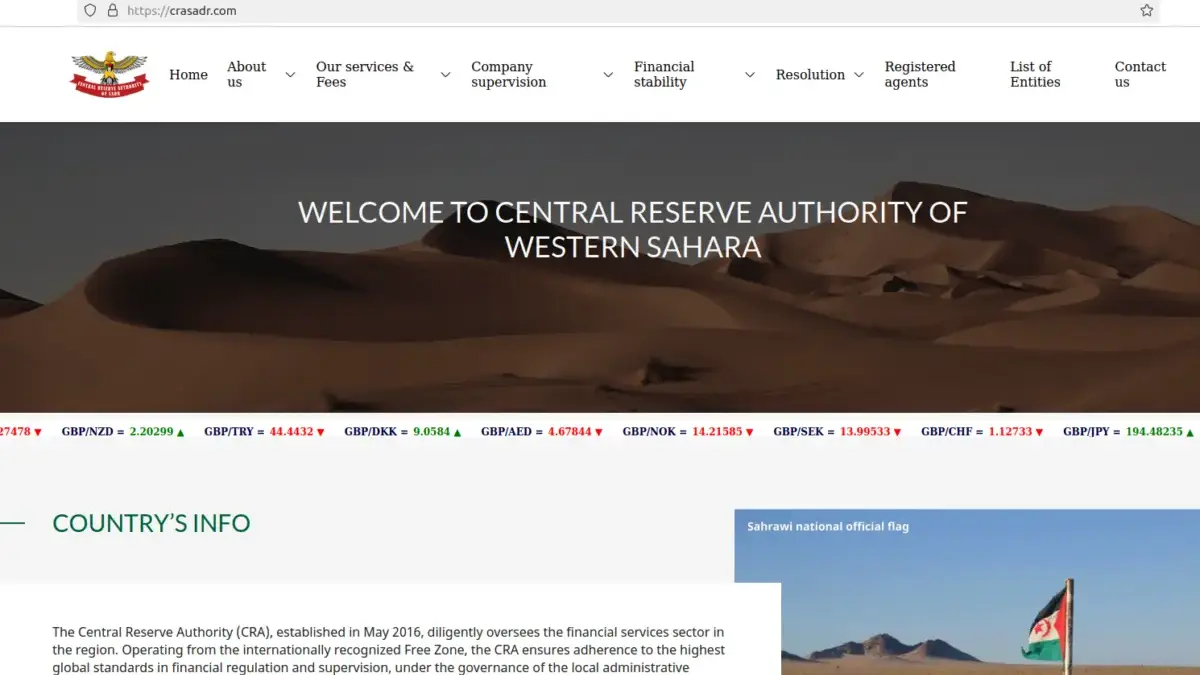
Detailed corporate mapping previously uncovered that the sole shareholder of Certa Payments was a 25-year-old Ukrainian national. Alongside Cryptomus, she headed several other corporate entities, including the WS Management and Advisory Corporation. This particular enterprise marketed itself as an exclusive regulatory body responsible for issuing licenses to cryptocurrency exchanges, foreign exchange brokers, and online gaming businesses incorporated within the disputed northwest African territory of Western Sahara.
The regulatory website operated by this entity—crasadr.com—offered prospective applicants assistance with corporate formation, bank account setup, and virtual asset licensing. Digital infrastructure analysis demonstrated clear administrative ties between the payment processor and these fringe regulatory structures; one of Certa Payments’ early web properties shared a server with a dozen distinct domains, including rasd-state.ws, which purported to be the official digital portal for the Central Reserve Authority of the Western Sahara.
With the imposition of the U.K. economic sanctions and the tightening net of international law enforcement, the operational space for these opaque, multi-branded payment hubs continues to contract, signaling a concerted shift by Western governments to target the infrastructure that bridges illicit cybercrime proceeds with conventional financial systems.
Leave a Reply