
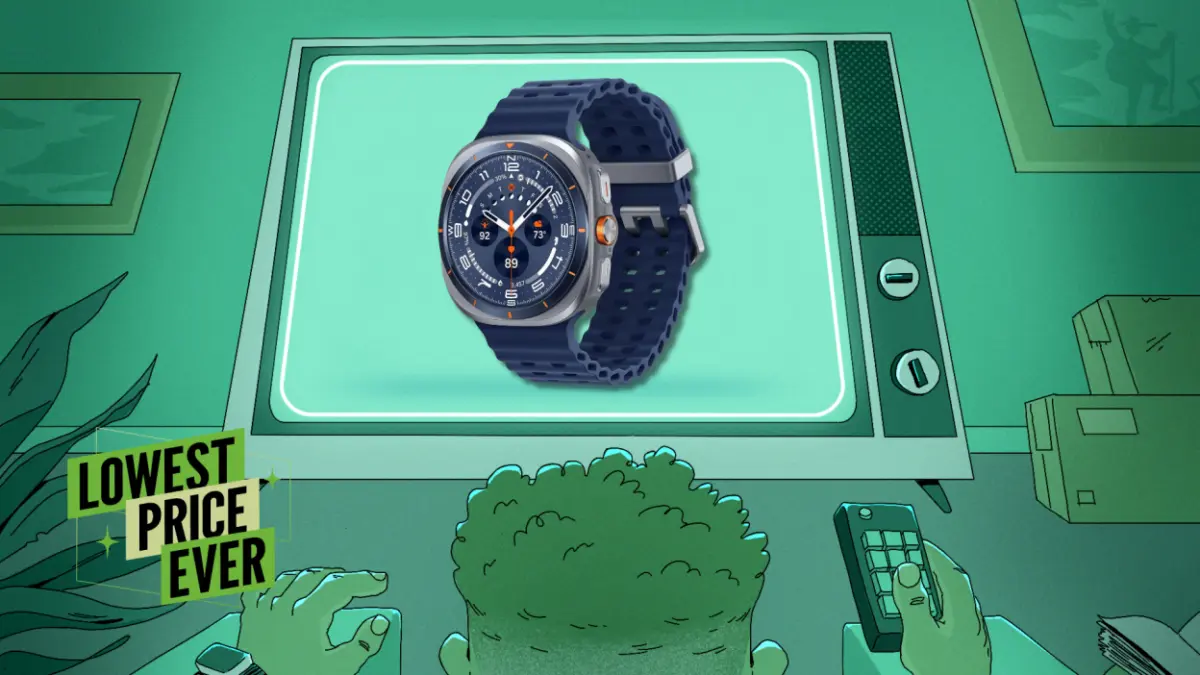
Consumer technology pricing operates on a predictable rhythm, where the arrival of new hardware reliably opens up some of the best buying opportunities for previous-generation flagships. Following the recent rollout of Samsung’s latest product lineup—highlighted by the launch of the Galaxy Watch Ultra2 alongside the Galaxy Z Fold 8 and Galaxy Z Flip 8—prices on the company’s existing high-end wearables have begun to adjust significantly. For consumers seeking premium outdoor and endurance capabilities without paying peak flagship launch prices, the 2025 iteration of the Samsung Galaxy Watch Ultra has reached an all-time low price point of $471.78.
According to retail price-tracking tools, this current discount represents a markdown of more than $175 from the smartwatch’s original standard retail price of $649.99. The price adjustment presents a notable entry point for Android users looking to acquire a heavy-duty fitness wearable equipped with expanded storage and advanced ruggedization features. For buyers who want to trim their spending further and do not require the expanded internal capacity of the refreshed model, the original 2024 version of the Galaxy Watch Ultra has also seen steep reductions, holding steady at a discounted price of $399.99 down from its initial $649.99 launch price.
The trajectory of Samsung’s flagship wearable line reflects a strategic shift in how the tech giant approaches high-performance fitness technology. Samsung initially introduced the first-generation Galaxy Watch Ultra in the summer of 2024, signaling a direct attempt to establish a presence in the premium adventure-watch market—a sector heavily populated by specialized multisport devices and rival offerings like the Apple Watch Ultra. Recognized for its distinct square-circle casing and substantial physical footprint, the Galaxy Watch Ultra was designed from the beginning to prioritize structural durability, extended battery lifespan, and specialized outdoor tracking utilities over standard lifestyle aesthetics.
Building on that foundation, Samsung issued an updated version of the Galaxy Watch Ultra in August 2025. While maintaining the core industrial design and rugged exterior of the original, the 2025 release introduced subtle yet practical internal enhancements, most notably doubling the onboard storage capacity and expanding the aesthetic lineup with new color choices. With the subsequent debut of the Galaxy Watch Ultra2 in 2026, the 2025 model has transitioned into an optimal value tier, delivering nearly identical core hardware and durability standards to its successor at a significantly reduced financial investment.
At the core of the Galaxy Watch Ultra’s design philosophy is an emphasis on environmental resilience and extreme outdoor utility. Constructed from Grade 4 titanium, the watch body is built to withstand physical impacts, extreme temperatures, and harsh outdoor environments that would easily damage standard aluminum or stainless steel smartwatches. The device carries an IP68 rating for water and dust resistance, providing high-grade protection against fine particles and submersion. Furthermore, its water-resistance rating reaches up to 10ATM of pressure, allowing the watch to function reliably under aquatic pressure equivalent to a depth of roughly 330 feet underwater.
For high-altitude athletes, mountaineers, and wilderness hikers, the Galaxy Watch Ultra is rated to operate at extreme elevations up to 9,000 meters above sea level, making it suitable for high-altitude trekking and expedition environments where ambient pressure and temperature fluctuate dramatically. To assist with outdoor safety and emergency response, the watch incorporates a built-in safety siren designed to emit an audible alert signal in critical situations where a user requires immediate assistance or needs to signal their physical location in dense terrain.

Visual clarity in direct sunlight is a critical component for outdoor wearables, and the Galaxy Watch Ultra addresses this through its 1.47-inch Super AMOLED display. The screen is notably brighter than those found on earlier generations of Samsung AMOLED smartwatches, ensuring that navigation maps, pace metrics, and health data remain crisp and legible under harsh, reflective sunlight. However, potential buyers should note that the device is engineered with a singular form factor. Available exclusively in a 47mm case size, the watch prioritizes screen real estate and structural space for internal hardware over universal fitting, resulting in a large, substantial wrist presence that may feel heavy or oversized on smaller wrists.
Underneath its rugged titanium casing, the Galaxy Watch Ultra operates on Samsung’s customized version of WearOS, driven by a hardware configuration that includes 2GB of system RAM alongside 64GB of internal storage in the 2025 refreshed model. The double-sized storage capacity provides users with ample space to store offline mapping data, extensive music playlists, and third-party fitness applications directly on the wrist, reducing the reliance on a connected smartphone during extended outdoor excursions where cellular service or physical phone transport may be impractical.
Power management remains one of the primary hurdles for feature-rich smartwatches, yet the Galaxy Watch Ultra addresses endurance requirements through its internal 590mAh battery. The battery configuration is engineered to support long-duration training sessions and multi-day outdoor trips without frequent recharges. Under standard usage patterns without enabling conservative power-saving modes, the watch delivers approximately 60 hours of continuous operation. When switched to conservative energy-saving modes designed to throttle non-essential processes while maintaining vital tracking services, the operational longevity can extend up to 100 hours on a single charge. This operational flexibility allows long-distance runners, multi-day hikers, and weekend campers to track extended activities without carrying dedicated charging cables or external power banks.
Beyond its physical architecture and hardware endurance, the Galaxy Watch Ultra integrates advanced health tracking and wellness monitoring powered by artificial intelligence. The device’s sensor suite gathers continuous biometric data, providing personalized algorithmic health insights and advanced sleep analysis designed to measure recovery quality, sleep stages, and physiological stress. Third-party testing and tech reviews, including an evaluation by PCMag that awarded the smartwatch an "excellent" rating, highlight the device’s capability as a comprehensive health tracker that bridges the gap between everyday lifestyle monitoring and specialized athletic telemetry.
While the Galaxy Watch Ultra is tailored specifically for demanding wilderness tracking and high-impact sports, Samsung maintains alternative options within its ecosystem for users with different hardware priorities. For consumers who prefer a lighter, more streamlined form factor for daily activity tracking, office wear, and general smartwatch functions, the standard Samsung Galaxy Watch 7 offers a practical alternative. Available at a discounted price of $220 down from its original $329.99 MSRP, the Galaxy Watch 7 delivers core WearOS functionality, health monitoring, and smartphone connectivity in a smaller, more traditional smartwatch chassis at less than half the price of high-end outdoor flagships.
Ultimately, the steady price decline of the 2025 Galaxy Watch Ultra to $471.78 highlights a favorable market shift for outdoor enthusiasts and fitness-focused users. By balancing Grade 4 titanium durability, 10ATM water resistance, 64GB of local storage, and multi-day battery life, the device retains its standing as a formidable multisport wearable. As inventory cycles shift following Samsung’s 2026 hardware updates, current pricing offers a compelling opportunity to secure flagship-grade outdoor tracking technology at a substantially lower cost.



Leave a Reply