
The United Kingdom has officially issued sweeping economic sanctions against Cryptomus, a chameleonic cryptocurrency platform that digital forensics experts and blockchain analysts identify as a primary financial conduit for ransomware payments, narcotics trafficking, darknet markets, fraud, and cybercrime services. According to authorities and investigators, the platform’s operations have actively assisted the Russian government and associated entities in circumventing international financial restrictions and sanctions.
The official sanctions notice, released by the U.K. government, targets Cryptomus—which has previously operated under the corporate aliases Certa Payments and Xeltox Enterprises—for processing illicit payments that directly benefit Russian state institutions and the country’s wartime economy. Under the terms of the directive, any assets belonging to Cryptomus held within U.K. financial institutions are immediately frozen, and British corporations, citizens, and legal entities are strictly barred from conducting any business with the platform, whether through virtual assets or traditional financial channels. In addition to Cryptomus itself, the U.K. government’s punitive measures also target several other virtual payment platforms connected to the same operational network, including VexPay, TokenSpot, and the Tsunami Payments service.
The crackdown follows extensive investigative reporting, including a December 2024 analysis detailing how cryptocurrency is systematically converted into cash within Russian banks. Over the years, Cryptomus has established itself as an indispensable payment processor for dozens of underground Russian cryptocurrency exchanges and dubious websites hawking malicious cybercrime services. Since emerging on the global stage in 2022, the company has repeatedly changed its corporate identity and branding to evade law enforcement scrutiny. Most recently, the platform adopted the name “Heleket” following a historic regulatory enforcement action by Canada, which levied a record CAD $176 million fine against the platform for severe anti-money laundering violations.

Major blockchain intelligence and data-analytics firms have weighed in on the geopolitical and financial significance of the U.K. action. Chainalysis noted in an official public assessment that the U.K. sanctions represent a direct strike against the broader financial infrastructure underpinning Russia’s wartime economy. Pointing to the massive scale of the platform’s illicit throughput, Chainalysis observed that Cryptomus and its successor incarnation Heleket emerged as dominant payment hubs for illicit activity, receiving more illicit funds across tracked categories than traditional cryptocurrency mixers. According to their dataset, the number of illicit counterparties interacting with the network surged to more than 900 in a single month during late 2025.
Parallel findings from TRM Labs, another prominent blockchain intelligence firm, revealed that by April 2026, Cryptomus had processed more than $7 billion in cumulative transactions since its inception in 2022. This staggering volume included substantial financial flows associated with vendors distributing child sexual abuse material, international terrorist financing networks, and clandestine human trafficking operations. TRM Labs further observed that while Cryptomus’s direct transaction volume experienced a temporary contraction after the platform instituted nominal "know your customer" (KYC) rules, the organization swiftly adapted to regulatory pressures. In the wake of the record-breaking Canadian fines, the platform launched Heleket as a parallel service designed explicitly to continue offering uninhibited, no-KYC payment processing to high-risk actors.
Richard Sanders, an independent blockchain analyst and investigator who spent months painstakingly mapping out Cryptomus’s payment infrastructure and transacting directly with its customer base, emphasized that the U.K. sanctions carry far more operational weight than previous regulatory penalties. Sanders noted that Canada’s earlier administrative fines against the platform ultimately proved unenforceable and uncollectible. Writing on professional networking platforms, Sanders stressed that financial penalties alone are insufficient to deter entrenched illicit payment processors, whereas targeted economic sanctions possess the power to dismantle their underlying business models entirely.
The initial investigation into Cryptomus revealed structural anomalies that underscored its dubious nature. The platform previously shared a registered address in Vancouver, Canada, with dozens of other foreign currency dealers and money transfer businesses—none of which appeared to maintain any physical presence at the location. Following the imposition of the CAD $176 million fine by Canadian authorities for alleged money laundering violations, Cryptomus formally appealed the penalty while simultaneously spinning up Heleket as a parallel operational entity, allowing it to sustain large volumes of high-risk transactions without interruption.

Furthermore, Sanders highlighted that the U.K. sanctions mark a significant milestone in international cooperation, representing the first known instance of a "Five Eyes" intelligence-sharing nation—comprising Australia, Canada, New Zealand, the United Kingdom, and the United States—imposing direct sanctions on a cryptocurrency operation incorporated within another jurisdiction belonging to the same alliance.
The question of how illicit entities such as Cryptomus and Heleket manage to establish corporate legitimacy and secure authorization to offer international financial services points to an elaborate network of shell companies and questionable regulatory oversight. Investigators discovered that the sole shareholder of Cryptomus’s original parent company, Certa Payments, was a 25-year-old Ukrainian woman who simultaneously headed several other corporate entities. Among these was the WS Management and Advisory Corporation, which markets itself as an exclusive regulatory body responsible for issuing licenses to cryptocurrency businesses, foreign exchange brokers, and online gaming operations incorporated within the disputed northwest African territory of Western Sahara.
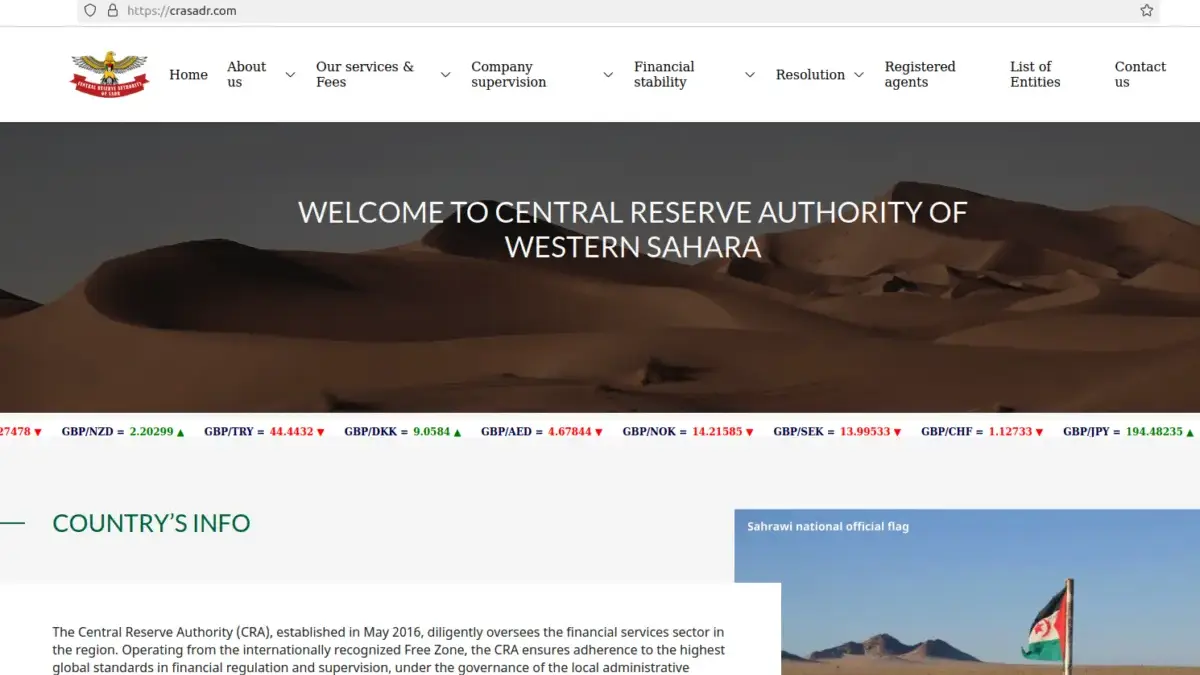
The regulatory body’s official web portal, crasadr.com, outlines services aimed at assisting applicants with corporate formation, bank setup, and the acquisition of online gaming and foreign exchange licenses. Forensic digital investigation revealed further operational ties when it was discovered that one of Certa Payments’ former web properties shared a hosting server with a dozen other domains, including rasd-state.ws, which serves as the official website for the Central Reserve Authority of Western Sahara—the entity that formally publishes lists of organizations granted licenses for cryptocurrency and financial services in the disputed region.
Leave a Reply