

A coalition of major book publishers has asked a New York federal court to issue a $19.5 million default judgment against WeLib, a shadow library that allegedly cloned its underlying source code and the vast majority of its digital collection from Anna’s Archive. The legal move follows a nearly identical copyright infringement case that concluded in May against Anna’s Archive, resulting in a severe financial and operational penalty. Interestingly, a close examination of the publishers’ recent legal filing reveals that the plaintiffs’ legal team seemingly "copied" portions of their own previous briefs—including factual claims and typos that do not actually apply to WeLib’s distinct setup.
The legal battle underscores the escalating efforts by traditional publishing giants to stamp out the modern ecosystem of automated shadow libraries. Last year, the team behind Anna’s Archive issued a public warning to its own user base regarding WeLib, describing the platform as a new and opportunistic entrant into the shadow library landscape. According to the original developers, WeLib appeared to have mirrored most of Anna’s Archive’s expansive collection and utilized a direct fork of its codebase. Because WeLib’s anonymous operators were allegedly taking scraped data and code improvements without contributing anything back to the broader project, Anna’s Archive cautioned prospective visitors against utilizing the service.
In June, a coalition of major book publishers arrived at a strikingly similar conclusion regarding the site’s origins, albeit through the lens of intellectual property law. Representatives from industry giants including Penguin Random House, Elsevier, and HarperCollins filed a formal copyright infringement lawsuit against WeLib in a New York federal court. The complaint alleged that WeLib was deliberately established after its unknown operators copied both the foundational source code and the bulk of the contents belonging to Anna’s Archive.
Despite being formally served with allegations of widespread copyright infringement, WeLib’s anonymous operators chose not to mount a legal defense or respond to the lawsuit in any capacity. This total lack of engagement prompted the plaintiffs to push the litigation forward, leading the court clerk to formally enter a default against the site in August. That procedural milestone cleared the path for the publishers to request a final, sweeping judgment from the bench.

On Monday, the coalition of publishers formally petitioned U.S. District Judge Victor Marrero to issue a default judgment against WeLib and its unnamed operators. In their legal memorandum, the publishers did not mince words regarding the platform’s commercial purpose. Defendant WeLib is characterized squarely as a pirate site whose sole business model revolves around the distribution of protected, copyrighted content in direct violation of the legal rights held by the plaintiffs and countless other copyright owners.
To calculate the staggering financial penalty, the publishers requested the maximum statutory damages permitted under U.S. copyright law: $150,000 for each of the 130 specific literary works listed across the complaint, breaking down to ten targeted titles per publisher. This math totals exactly $19.5 million, matching the exact financial penalty that U.S. District Judge Jed Rakoff awarded to the publishers in the earlier Anna’s Archive case.
The damages are split evenly across the thirteen corporate entities participating in the lawsuit. Apress Media, Cengage Learning, Elsevier, Hachette Book Group, HarperCollins, John Wiley & Sons, Macmillan Learning, Macmillan Publishing Group, McGraw Hill, Pearson Education, Penguin Random House, Simon and Schuster, and the Taylor & Francis Group are each slated to receive $1.5 million if the court approves the request in full.
Beyond the statutory damages, the publishers’ motion places a sharp spotlight on WeLib’s monetization and revenue generation model. While the platform presents itself as a free service to casual visitors, it actively prompts users to provide monthly monetary contributions disguised as "donations," with requested tiers scaling up to $90 a month. According to the publishers’ brief, these transactions are not altruistic contributions at all, but rather direct payments used to bypass artificial throttling and secure faster download speeds.
To cripple the platform’s ongoing operations, the publishers are also pressing the court to enact a permanent injunction. If granted, this sweeping order would legally compel domain registries and registrars to completely disable the primary domains associated with the enterprise, specifically welib.org, welib.st, and welib-public.org, while simultaneously blocking any attempts to transfer those domains to entities outside the control of the plaintiffs. Furthermore, web hosting providers offering infrastructure services to the sites would be legally required to cease serving them immediately.

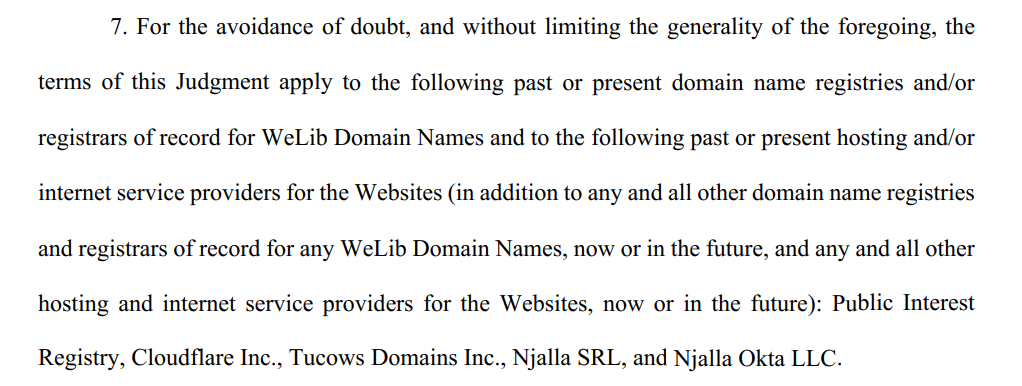
While the proposed injunction would broadly bind all applicable technical intermediaries, the legal filing specifically names five key entities that play a structural role in maintaining the web presence of the service. These named intermediaries include the Public Interest Registry, Cloudflare, Tucows, and two distinct corporate entities tied to Njalla. Notably, this list is considerably shorter than the one featured in the Anna’s Archive judgment, which targeted more than twenty different internet intermediaries.
A Curious Copy-Paste in the Legal Brief
As the legal proceedings advanced, a peculiar detail emerged regarding the preparation of the publishers’ default judgment brief. It is standard practice for modern law firms to utilize successful arguments from prior, closely related litigation, and that efficiency was clearly exercised by the law firm Oppenheim + Zebrak, which represents the publishers in both cases. However, the reliance on previous templates appears to have gone a step further, resulting in arguments that describe operational mechanics unproven or entirely absent in WeLib’s case.
According to the text of the brief, WeLib actively diverts revenue away from the publishers at a scale made significantly worse by its reliance on the viral BitTorrent protocol. Despite this assertion, public reporting and the underlying complaint against WeLib do not contain any evidence or allegations that the platform utilizes BitTorrent for file distribution. Instead, the specific paragraphs discussing this mechanism originally detailed various market harms, including lost retail sales and the exploitation of copyrighted texts for artificial intelligence training data, in the Anna’s Archive lawsuit.
The exact same sentence appears, word for word, in the brief filed against Anna’s Archive. In that earlier context, the claim was directly supported by the factual record of the complaint, which thoroughly outlined how Anna’s Archive provides torrent files for bulk data harvesting via a dedicated download page. WeLib’s own operational structure, by contrast, relies on a different mechanism, serving files directly from centralized servers through a tiered system of slow and paid fast downloads.

The borrowing from the previous legal filing extends beyond isolated sentences. The brief also alleges that WeLib’s infringement continued despite multiple prior legal actions brought against the operators. While Anna’s Archive has faced various legal onslaughts across multiple jurisdictions, legal observers note there are no public records of any prior lawsuits directed specifically at WeLib’s anonymous creators.
Even minor stylistic artifacts from the earlier brief managed to find their way into the new document. Both legal memoranda contain identical phrasing regarding what happens if the court is "satified" that the established default standards are met, alongside an identical grammatical construction arguing that the defendants cannot establish they have not presented any meritorious defenses.
A Paper Victory on the Horizon?
It now falls to U.S. District Judge Victor Marrero to review the filings and render a final decision on the motion for default judgment and the accompanying permanent injunction. Regardless of the judicial outcome, legal analysts point out that the publishers are statistically unlikely to recover any of the multi-million-dollar award, given that WeLib’s operators continue to operate under a veil of anonymity.
The precedent set by Anna’s Archive suggests that an American court order may cause logistical hurdles for WeLib, but it rarely spells the definitive end of such platforms. Despite being hit with a massive financial judgment and global domain takedown orders, Anna’s Archive successfully maintained its web presence by shifting operations to alternative domain extensions tied to registries and registrars located outside the jurisdictional reach of the United States.
If Anna’s Archive serves as any reliable indicator, a favorable ruling and ensuing injunction will likely strip WeLib of its current domains and cause temporary disruption. However, in the decentralized ecosystem of shadow libraries, such enforcement actions rarely guarantee the permanent disappearance of the platforms.
Copies of the publishers’ memorandum in support of the motion for default judgment, along with the proposed default judgment order, the formal statement of damages, and the comparative briefs from the Anna’s Archive litigation, have been filed into the public docket of the New York federal court. Representatives for Oppenheim + Zebrak were approached for comment regarding the BitTorrent references in the legal filing, but did not provide a response prior to publication.



Leave a Reply