
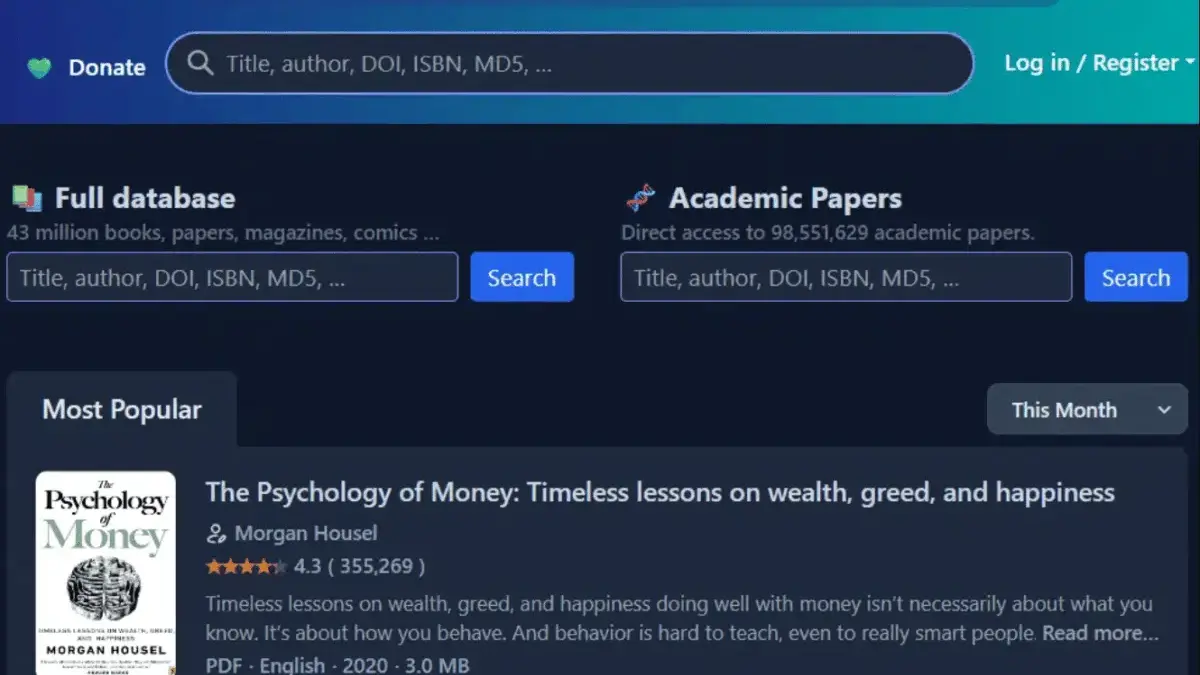
A coalition of major book publishers has formally asked a New York federal court to issue a $19.5 million default judgment against the shadow library WeLib. According to the lawsuit, the unauthorized repository allegedly copied its underlying source code and the vast majority of its digital collection directly from Anna’s Archive, a prominent shadow library that faced a nearly identical legal defeat earlier this year. Ironically, the legal brief submitted by the publishers also appears to "copy" from Anna’s Archive, or at least heavily borrows from the legal filings used in the publishers’ prior lawsuit against that separate platform.
The legal battle highlights the ongoing, escalating whack-a-mole dynamic between major intellectual property holders and decentralized, anonymous operators within the digital piracy ecosystem. Last year, the operators of Anna’s Archive publicly warned their own user base about WeLib, describing it as a new entrant in the shadow library landscape. At the time, Anna’s Archive noted that the site had essentially mirrored most of its existing collection and implemented a fork of its codebase. Because WeLib’s operators were reportedly taking the compiled data and code without contributing newly discovered collections or software improvements back to the ecosystem, Anna’s Archive cautioned prospective visitors against utilizing the platform, famously writing that they recommended users steer clear of the service.

In June, a consortium of major book publishers arrived at a strikingly similar conclusion regarding WeLib’s origins, albeit through the lens of copyright infringement. The publishers filed a lawsuit against WeLib in the U.S. District Court for the Southern District of New York, alleging that the site was created specifically after its operators copied the source code and the bulk of the contents belonging to Anna’s Archive. Despite facing severe copyright infringement allegations and formal legal notices, WeLib’s anonymous operators chose not to respond or mount a defense in court. This lack of participation allowed the publishers to push forward with their litigation, leading the court clerk to enter a formal default against the platform in August, thereby opening the door for the current request for a final monetary and injunctive judgment.
On Monday, a prominent group of publishing houses—including Penguin Random House, Elsevier, HarperCollins, Hachette Book Group, John Wiley & Sons, Pearson Education, Simon & Schuster, and several others—formally asked U.S. District Judge Victor Marrero to issue a default judgment against WeLib and its unnamed administrators. In their legal memorandum, the plaintiffs pulled no punches regarding the platform’s alleged business model. They stated that Defendant WeLib is a pirate site whose sole business is the distribution of protected content in direct violation of the exclusive rights held by the plaintiffs and other copyright owners.
To calculate the financial penalty, the publishers requested the maximum statutory damages allowed under U.S. copyright law: $150,000 for each of the 130 specific copyrighted works listed in the complaint, averaging out to ten works per publishing company. This calculation brings the grand total to precisely $19.5 million. Notably, this is the exact same financial penalty that U.S. District Judge Jed Rakoff awarded to the publishers in the parallel lawsuit against Anna’s Archive. Under the proposed breakdown, each of the thirteen publishing entities involved in the suit would be awarded $1.5 million in statutory damages.

In addition to requesting millions of dollars in damages, the publishers’ legal brief shines a spotlight on WeLib’s financial monetization model. While the platform allows visitors to access certain materials for free, it actively prompts users to provide recurring financial "donations" of up to $90 a month. The publishers argue that these contributions are not charitable donations at all, but rather transactional payments designed to grant users priority access, faster download speeds, and smoother user experiences.
Alongside the massive monetary penalty, the publishers are seeking a sweeping permanent injunction. If granted, this order would require domain registries and domain name registrars to completely disable the primary domains associated with the platform—specifically welib.org, welib.st, and welib-public.org—while also blocking the transfer of these domains to any entity other than the publishers themselves. Furthermore, hosting providers servicing the platform would be legally compelled to stop hosting or supporting the sites.
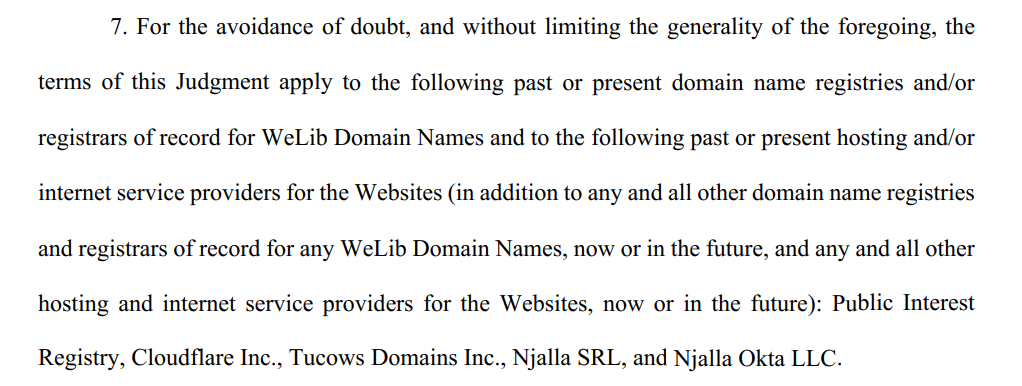
While the proposed injunction would apply broadly to all applicable internet intermediaries, the legal filing specifically names five key entities: the Public Interest Registry, Cloudflare, Tucows, and two corporate entities associated with the privacy-focused hosting and domain service Njalla. This list is notably shorter than the one included in the Anna’s Archive judgment, which targeted more than twenty different intermediaries worldwide.

As the litigation progressed, sharp-eyed observers noticed peculiar similarities within the legal documentation itself. It is standard practice for legal counsel to reuse successful arguments and templates across similar cases, and that appears to have happened here. Large portions of the memorandum filed against WeLib mirror the exact text that the law firm Oppenheim + Zebrak filed against Anna’s Archive in May on behalf of the same publishing houses. However, this direct reuse of legal text led to several curious anomalies where the arguments did not entirely fit the factual background of WeLib.
According to the brief submitted against WeLib, the platform allegedly diverts revenue away from the publishers at a scale made worse by its use of the viral BitTorrent protocol. However, investigative reporting and the underlying complaint against WeLib do not contain any evidence or allegations that WeLib actually utilizes BitTorrent networks for its operations. Instead, the specific paragraphs in question discuss various economic harms, including lost retail sales and potential market disruption for AI training data licensing.
That exact sentence appears, word for word, in the brief previously deployed against Anna’s Archive. In that separate case, the text was properly backed up by allegations in the complaint detailing how Anna’s Archive actively offers massive torrent files for bulk downloads through a dedicated downloads page. WeLib, by contrast, relies on an entirely different operational mechanism. Its own setup, as detailed in the legal record, describes a system where files are served directly from centralized web servers, offering a tiered system of slow free downloads and paid fast downloads.
The borrowed text goes even further. The brief against WeLib mentions that the platform’s copyright infringement continued despite this and several other cases filed against them. That entire paragraph was lifted straight from the Anna’s Archive filing. While Anna’s Archive has faced multiple legal challenges across various jurisdictions, legal observers note there are no known public lawsuits filed against WeLib’s operators prior to this action. Even a minor typo and a garbled sentence featuring a double negative managed to survive the transition between cases. Both legal briefs discuss what happens if the court is satified—missing the second ‘s’ in satisfied—that default standards are met, and both argue that the defendants cannot establish that they have not presented any meritorious defenses.
With the paperwork submitted, it is now up to Judge Marrero to review the request and decide whether to grant the default judgment and the requested injunction. Regardless of the final judicial outcome, legal experts note that the publishers are unlikely to collect any substantial portion of the $19.5 million award, given that WeLib’s operators have successfully maintained their anonymity throughout the proceedings.
The ongoing saga of Anna’s Archive serves as a precedent for what may happen next. Although Anna’s Archive was hit with a massive financial judgment and lost several high-profile domain names following earlier injunctions obtained by music and book industries, the platform has managed to remain operational. It continues to evade total takedown by migrating its web presence to alternative top-level domains such as .gl, .pk, and .gd, which rely on registries and registrars located outside the jurisdictional reach of United States courts. If Anna’s Archive serves as any reliable indicator, an injunction may strip WeLib of its current domain names, but it offers no absolute guarantee that the shadow library will vanish permanently from the internet.



Leave a Reply