
Federal Bureau of Investigation agents in Pennsylvania have arrested a prominent executive at a Canadian cybersecurity firm in connection with an escalating international investigation into the notorious "ShinyHunters" hacking syndicate. The high-profile arrest comes on the heels of a massive cyberattack attributed to the group, which recently compromised sensitive internal data belonging to thousands of federal agents.
According to multiple sources speaking with KrebsOnSecurity, the suspect was taken into custody on Thursday following an operation coordinated across multiple jurisdictions. The New York Times was first to report the arrest of the Canadian man in Pennsylvania on suspicion of assisting ShinyHunters, though initial statements from federal officials omitted his identity. An official announcement regarding the apprehension was shared on social media by FBI Director Kash Patel, though it similarly lacked specific identifying details regarding the suspect.
Sources close to the ongoing investigation revealed that the arrested Canadian executive had traveled to Pennsylvania to attend a prominent cyber insurance conference. The suspect’s professional background is deeply rooted in the specialized sector of handling ransomware negotiations and extortion advisories on behalf of corporate clients. Furthermore, intelligence gathered by investigators indicates that oversight and control of the sprawling ShinyHunters investigation have now been centralized at an advanced FBI field office in Texas.
An examination of public records and event schedules indicates that the gathering in question was the Cyber Risk Summit, held between October 5 and October 7 at the Loews Philadelphia Hotel. While the annual conference featured numerous corporate sponsors, summit documentation lists a Canadian security firm known as Cypfer as its primary and largest financial backer.
Publicly available professional networking profiles indicate that Cypfer was previously associated with Edward Dubrovsky, who is listed on LinkedIn as one of the firm’s early founders. Dubrovsky is currently affiliated with another Canadian security enterprise and conference sponsor, CyberSteward. Approximately one month prior to his arrest, Dubrovsky published a post on LinkedIn confirming his travel plans to attend the Philadelphia summit alongside his colleagues from the CyberSteward team.

Addressing the executive’s historical corporate affiliations, a spokesperson for Cypfer clarified that Dubrovsky was not a founder or co-founder of the enterprise, as his professional profile had asserted. Instead, the spokesperson stated that he had served in the capacity of a managing director prior to his formal resignation from the firm in November 2025.
Prior to his legal troubles, Dubrovsky maintained an active public profile within the cybersecurity community, frequently commenting on strategies for handling digital extortion. In a prior social media post, he noted his intention to advance discussions surrounding strategy and compliant-driven coercive advisory services, encompassing ransomware, extortion, negotiations, and global settlement solutions.
Federal court documents indicate that an individual named Edward Dobrovsky—noting a minor spelling variation in the surname—was formally arrested in Pennsylvania on October 8 on charges of cyber extortion and conspiracy. While a substantial portion of the judiciary file, including the foundational criminal complaint, remains strictly sealed by the court, a subset of the docket has been indexed publicly through legal documentation repositories such as CourtListener.
Available summaries of the federal complaint charge the defendant with conspiracy to threaten to impair the confidentiality of information with the intent to extort money, alongside charges of interference with commerce by threats. Inmate records maintained by the U.S. Bureau of Prisons confirm that a 54-year-old Edward Dubrovsky is currently detained at a federal correctional facility in Philadelphia. However, court filings indicate that the case was officially transferred on October 9 to the U.S. District Court for the Eastern District of Texas, which sources describe as the epicenter of the government’s comprehensive ShinyHunters crackdown. The FBI has consistently declined to comment on the specifics of the ongoing judicial proceedings.
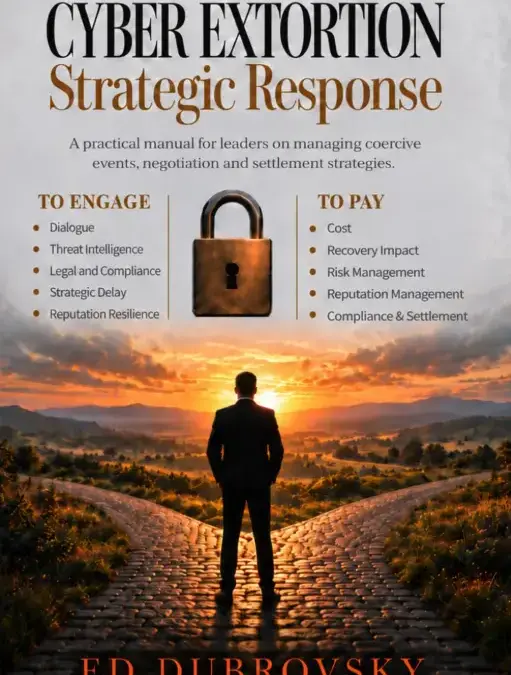
Beyond his executive duties, Dubrovsky is the author of a 252-page professional volume titled Cyber Extortion Strategic Response. Promotional materials for the book describe it as a guide designed to navigate organizations through the critical decision-making processes required during a ransomware incident, focusing on response, recovery, and asset protection. An excerpt from the publication emphasizes a central operational philosophy: that communicating with a malicious cyber actor is fundamentally distinct from negotiating a financial payment, and that entering into a dialogue does not constitute an agreement to pay a ransom. According to the text, engagement can serve alternative tactical objectives, including verifying threat actor claims, collecting actionable intelligence, buying operational time, and preserving institutional options while leadership evaluates its next steps.
Mr. Dubrovsky could not be immediately reached for comment following his detention, and representatives for CyberSteward have not yet issued a public response. Review of the currently accessible court dockets indicates that the defendant has not yet retained private legal counsel, nor has the court formally appointed a public defender to represent him in the proceedings.

The ShinyHunters cybercriminal collective has established a reputation for deploying sophisticated phishing campaigns and leveraging stolen enterprise credentials to infiltrate corporate environments, particularly software-as-a-service providers. Once inside, the group extracts large volumes of proprietary and confidential data, subsequently threatening to leak the information publicly unless exorbitant ransom demands are satisfied. Federal estimates indicate that the syndicate has successfully extorted upwards of $70 million from corporate and institutional victims over the course of the year.
Law enforcement agencies have intensified their pressure on the group in recent weeks. Sources indicate that federal investigators have spent significant time analyzing digital devices seized last month by Dutch law authorities during the arrest of Pepijn van der Stap, a reformed hacker apprehended in connection with the broader ShinyHunters conspiracy. Furthermore, intelligence sources suggest that criminal charges against principals at other corporate entities specializing in ransomware mediation may be imminent.
The pressure on the hacking collective escalated dramatically immediately following Van der Stap’s arrest. A prominent member of the ShinyHunters group operating under the online alias "Rey" assumed operational control of the syndicate and began publicly taunting federal authorities. The taunts stemmed from a high-profile breach in which the hackers exfiltrated sensitive data from the FBI’s online recruitment portal, exposing personal records that included agents’ military and governmental unit assignments, professional specializations, and confidential medical and psychiatric documentation.
Investigative reporting by Reuters revealed that the individual operating as Rey was identified as a teenager named Saif Al-din Khader. Authorities successfully detained Khader, who has since begun cooperating with federal investigators. Details emerged highlighting that Rey was apprehended just as the cybercrime unit prepared to execute an extortion attempt against a digital aviation and navigation unit that had been divested by Boeing in late 2025.
As federal authorities continue to execute search warrants, analyze seized hardware, and coordinate cross-border arrests, the investigation into the infrastructure and associates of ShinyHunters remains an active and rapidly evolving national security priority.



Leave a Reply