

Readers visiting Opensource.com lately may have noticed a distinct quietness across the platform. After twelve years of continuous publishing, the site has entered a transitional phase as the community behind it hard-codes a brand-new project. While concrete details regarding the exact nature, scope, and launch mechanics of the upcoming initiative remain under wraps for the time being, there is already plenty of momentum, speculation, and philosophical groundwork to discuss within the broader open source movement.
When looking for a lens through which to examine this impending shift, a natural starting point is to look at the very infrastructure of the internet itself—specifically, the foundational systems that connect billions of people worldwide every single day.
The Internet, and Top-Level Domains
To understand where the Opensource.com community is heading, it helps to examine where the digital world began. Most internet users know that the internet is fundamentally a network. By definition, a network is simply a group of interconnected connections. In fact, the word "internet" is a portmanteau born from the combination of "interconnected" and "network."
In its earliest iterations, the internet was a much smaller, highly specialized system consisting primarily of two distinct networks: the military network and the academic network. These closed ecosystems served specific institutional needs before expanding into the public consciousness.
Once the internet began to grow exponentially and gained popularity far outside those initial military and academic groups, it quickly became apparent that different designations were desperately needed. Administrators and early architects required a system to categorize digital spaces, making it possible to immediately differentiate between a commercial entity, a charitable organization, a university, or a governmental department.

These critical designations are formally known as top-level domains, or TLDs. While there are hundreds of available top-level domains today—ranging from geographic suffixes to specialized industry tags—for a very long time, there were only a handful in circulation. These original top-level domains remain remarkably popular and culturally embedded in the architecture of the web.
Most internet users intuitively recognize that when they navigate to a web address ending in .com, they are visiting a commercial site, whereas a visit to a .org address typically points toward a non-profit organization or a public-interest project. These distinctions matter because they signal intent, governance, and institutional backing to the end user.
Open Source Is a Network
Open source, much like the internet itself, can manifest in many different forms. It can be commercial, built and maintained by for-profit companies looking to innovate on shared codebases. It can be non-profit, driven by foundations dedicated to keeping digital infrastructure free and accessible. It can be academic, emerging from university laboratories where researchers study computer science and collaborative methodologies. It can even be purely cultural, existing as a shared ethos among artists, writers, and creators.
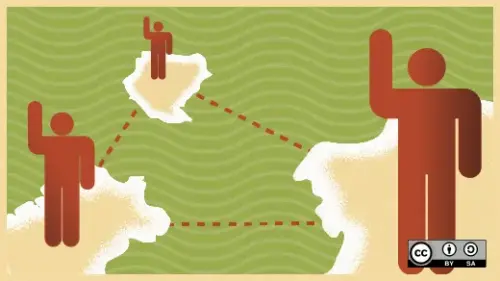
No matter what form open source takes, however, it is always a network.
Sometimes that network consists of physical computers, servers, repositories, and distributed nodes exchanging packets of data across continents. But most importantly, and at its very core, it is a network of people. Whether individuals are gathering in person at a massive international conference, chatting over drinks at a local pub, or collaborating asynchronously in an online chat room, open source is, above all else, a community of human beings working toward common goals.

For the past twelve years, the website Opensource.com has been supported by a commercial entity. Corporate backing has allowed the platform to publish thousands of stories, tutorials, essays, and interviews detailing how people use open source software, hardware, and culture to solve real-world problems.
However, there is a fundamental distinction to be made between the platform’s historical support structure and its true identity. The people—representing the readers, contributors, advocates, and creators who make up the Opensource.com community—are not commercial entities. They are individuals. They are human beings driven by curiosity, collaboration, and a shared belief in the power of open principles.
As the community looks toward the future, plans are already in motion to address this structural dynamic. In just one month, Opensource.com is set to resolve that long-standing bug and unveil the next phase of its evolution.
Until then, the community remains hard at work behind the scenes, and the digital world is watching closely to see what takes shape next.


Leave a Reply