

Launched quietly in February, TorrentClaw has rapidly evolved into a formidable player in the decentralized file-sharing ecosystem. Boasting an index of more than six million torrents—ranging from indie releases to the latest Hollywood blockbusters and hit television series—the platform stands out not merely for its vast catalog, but for the modern, automated philosophy underpinning its infrastructure. While traditional torrent search engines often rely on manual moderation, disjointed community reporting, or entirely unmoderated free-for-alls, TorrentClaw has embraced artificial intelligence as the core engine driving its development, categorization, and security protocols.
The site’s sleek, contemporary homepage immediately reveals subtle cues of AI design, a fact that its creators—who collectively operate under the pseudonym Deivid Soto—make no effort to conceal. On the contrary, the developers proudly center artificial intelligence in every facet of the site’s ongoing expansion and daily operations. According to Soto, the platform’s foundational architecture is built upon a combination of Claude Code alongside specialized local large language models (LLMs) tailored for specific execution and ingestion pipelines.
Rather than relying strictly on manual oversight or standard metadata scraping, TorrentClaw utilizes these AI systems to intelligently parse, match, and categorize torrents against official film and television titles. This automated categorization effortlessly handles heavy lifting that would otherwise demand extensive manual curation. Furthermore, this technological approach has enabled the creation of novel features designed to address some of the most persistent security and quality issues plaguing the torrenting landscape, most notably the prevalence of fake releases, mislabeled files, and malicious software.
TrueSpec: Download, Verify, and Detect
For years, users of torrent search engines have depended almost entirely on release names to gauge the quality and content of a file. These naming conventions typically detail resolution, audio codecs, and release groups, yet they offer zero empirical guarantee of accuracy. While prominent, closed private trackers often maintain rigorous manual moderation teams to police mislabeled content, automated public indexes usually lack the resources for active oversight. To bridge this gap, TorrentClaw introduced a proprietary feature known as TrueSpec.
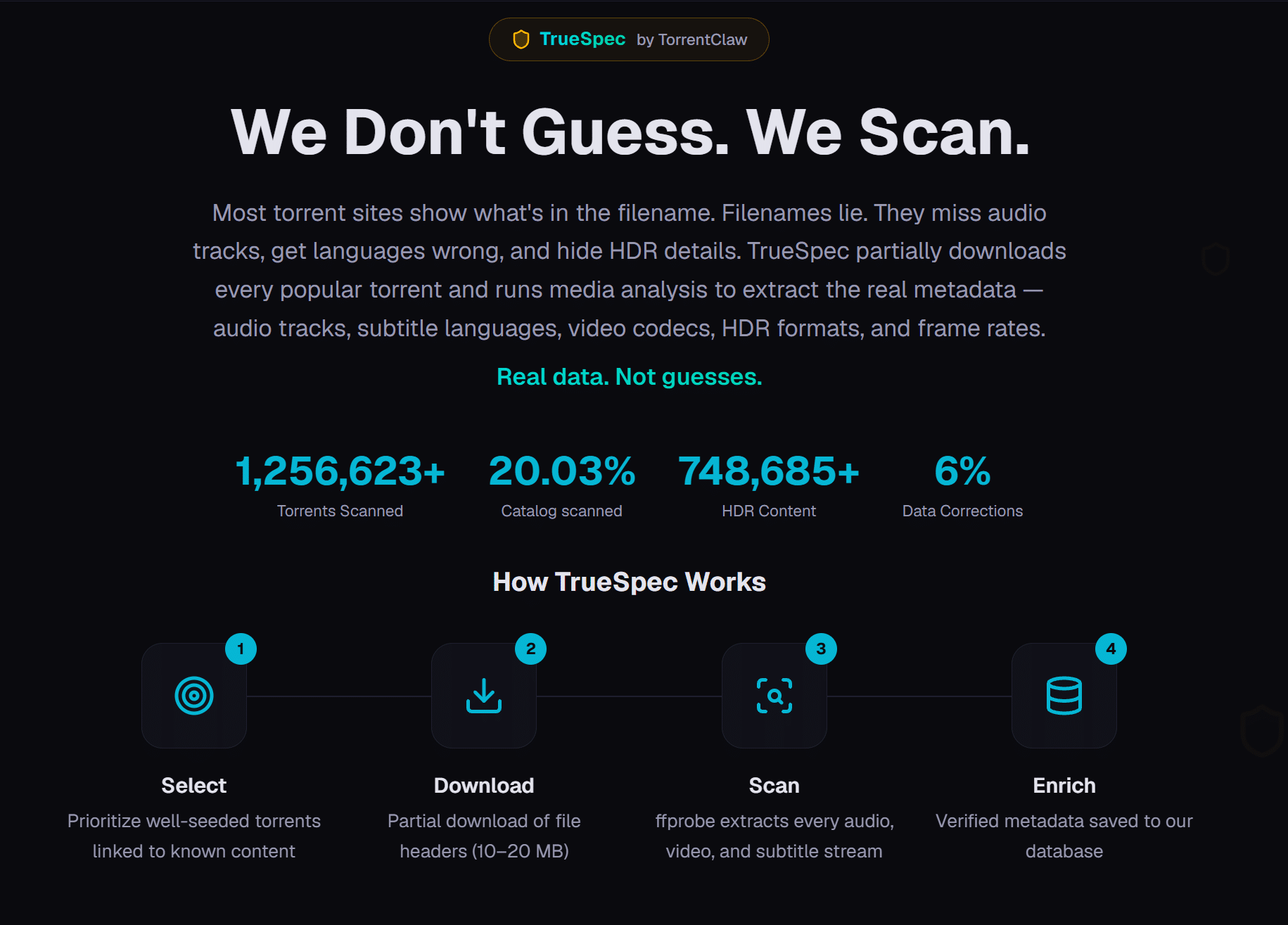
TrueSpec operates by actively engaging with the torrent swarm, reading the internal file listing, and selectively downloading a minuscule fraction of the data—specifically between 10 and 20 megabytes per torrent—to analyze the underlying video container using the standard analysis tool ffprobe. This targeted extraction allows the system to verify whether the file matches its purported specifications, thereby exposing deceptive naming conventions and outright fraudulent uploads.
Beyond name verification, TrueSpec also evaluates suspicious files by querying their cryptographic hashes against VirusTotal. When files fall within an appropriate size threshold, the system uploads them directly for comprehensive virus scanning. TorrentClaw itself does not operate an internal antivirus engine; instead, all malware verdicts are derived directly from VirusTotal’s aggregated threat intelligence.
When TrueSpec identifies malicious content, the platform refrains from entirely removing the torrent from its search index. Instead, the listing is conspicuously tagged with a "Malware detected" label, and the direct download button is disabled. Illustrating the scale of these ongoing threats, early iterations of this system flagged numerous items, though subsequent data refinements have sharpened the detection criteria. In late September metrics, TorrentClaw isolated specific confirmed malware cases, cross-referencing every instance with verifiable VirusTotal diagnostic reports.
Despite its utility, the TrueSpec system is not without limitations. Early datasets from July exposed various false positives, including harmless text files, specialized fansub scripts governing audio language switching, and simple scripts designed to open web browsers. Moreover, TrueSpec’s automated nature means it cannot probe large executables, heavily prioritizes well-seeded swarms, and remains incapable of checking entirely dead swarms. The platform also maintains a strict focus on films and television series, leaving pirated software and standalone video games largely unmonitored by the verification tool.
Beyond outright malware, TrueSpec flags deceptive practices such as programs disguised as video formats and fake resolution claims, though these account for a fraction of a percent of all checked files. Interestingly, the most frequent discrepancy uncovered by the system is entirely harmless: over half of all probed torrents contain subtitle tracks that go unmentioned in their release names. While TorrentClaw flags these as missing labels, such subtitle inclusions are standard practice and generally ignored by traditional scene distribution rules.
Uncovering VLC Player Malware Vectors
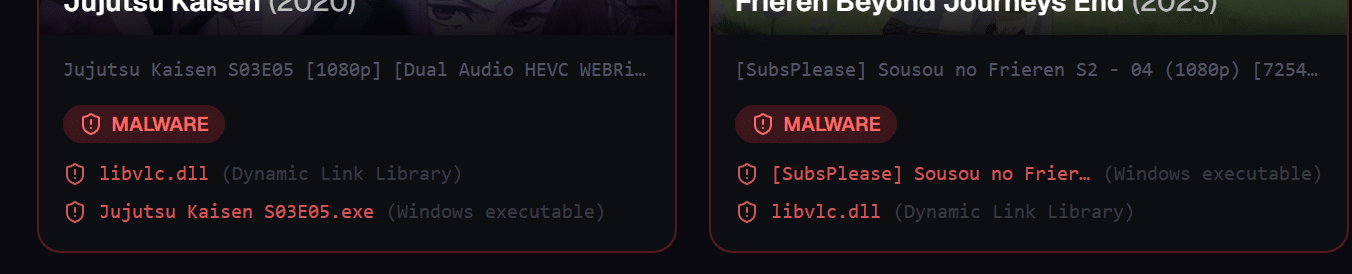
A closer examination of the confirmed malware torrents flagged by TorrentClaw reveals a consistent tactical pattern employed by bad actors. Among the verified cases, a vast majority bundle an executable file named identically to a popular new film or television episode, alongside a file named libvlc.dll and a genuinely playable video file nested within a subfolder.
Investigation into these applications reveals that the executable is a renamed, authentic copy of the legitimate VLC media player bearing the official code signature from VideoLAN. The malicious payload instead resides within the dynamic link library file, which VLC automatically loads upon startup. Security engines indexed by VirusTotal consistently flag this specific DLL as a trojan.
These malicious swarms frequently mimic high-profile entertainment properties, utilizing titles associated with popular streaming series and blockbuster movies. To add an air of legitimacy, the uploaders often appropriate the names of established release and distribution groups such as SubsPlease, ETHEL, and YTS. This vector reflects broader trends observed across the wider file-sharing ecosystem; earlier in the year, independent security researchers documented identical distribution campaigns utilizing compromised accounts on various platforms to spread infostealers through manipulated anime releases.

TorrentClaw successfully identified these threats across content sourced through its internal DHT crawler as well as prominent external aggregators, demonstrating that malicious actors actively target diverse ingestion pathways across the internet.
Built For AI, By AI
TrueSpec represents only one dimension of TorrentClaw’s unconventional operational model. The platform also features a Model Context Protocol (MCP) server, an advanced integration that enables AI assistants such as Claude and Cursor to directly query the search index and retrieve torrent files.
This technical capability allows users to interact with conversational artificial intelligence to locate media and pull necessary files without ever navigating to the web interface. According to the developers, certain automated accounts execute thousands of API requests daily, hinting at broader integration by external services and developers.
Remarkably, maintaining this infrastructure remains remarkably cost-effective. Developers noted that the core verification mechanics operate on a minimal footprint consisting of just a few nodes, keeping monthly operational expenses exceptionally low. This economic efficiency underscores a broader point emphasized by the creators: if automated verification can be executed at such a low cost, mainstream indexers possess the technical capacity to implement similar safeguards, though virtually none have chosen to do so.
Nevertheless, the aggressive crawling and partial downloading inherent to systems like TrueSpec carry potential legal ramifications. While TorrentClaw’s official policy states that the site does not host, store, upload, or distribute files directly, copyright holders may view automated swarm participation through a different lens.
To address intellectual property concerns, TorrentClaw maintains a dedicated takedown process. The developers describe TrueSpec strictly as a read-only client that avoids uploading or seeding data, fetching only the initial headers of video files before purging the temporary data entirely. Furthermore, the site has begun deploying an AI-managed system to process Digital Millennium Copyright Act (DMCA) notices, managing numerous takedown requests alongside historical complaints.
To support its ongoing development and server infrastructure, TorrentClaw has introduced tiered subscription options. The platform offers a PRO tier alongside a higher tier that bundles integrated virtual private network services. Whether this commercial monetization model will sustain itself within an industry historically dominated by ad-supported or entirely free services remains to be seen, particularly as commercialized projects often attract heightened scrutiny from rights enforcement organizations.


Leave a Reply