
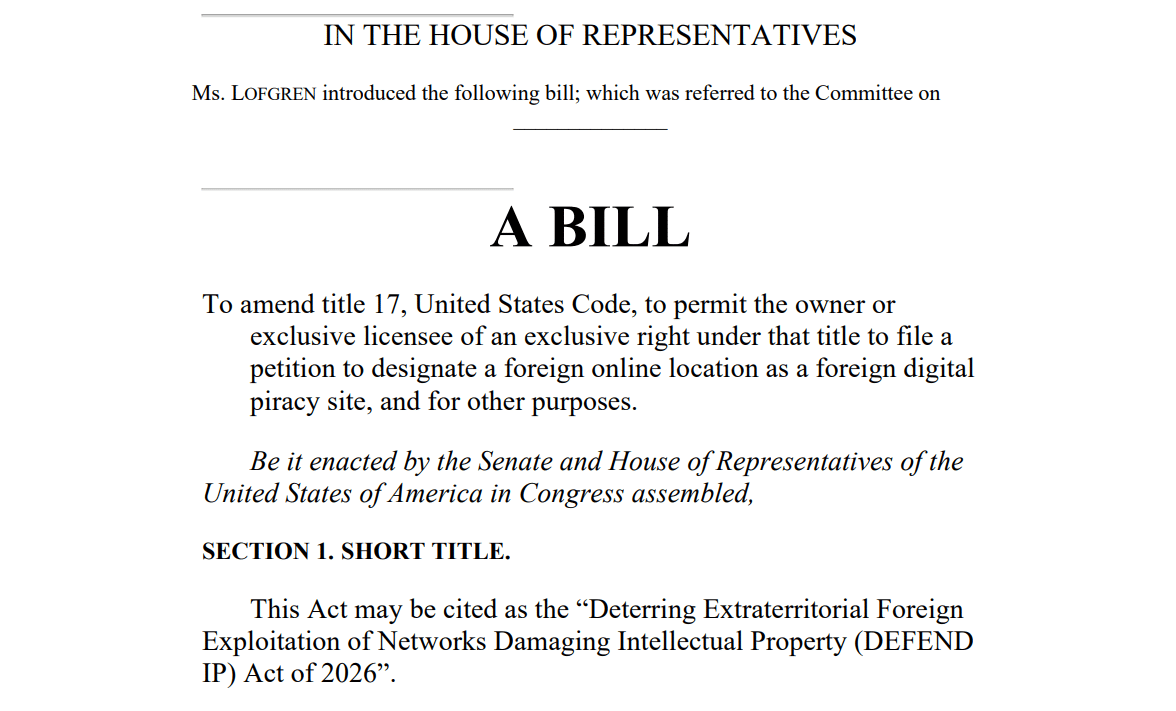
Just one week after the legislative introduction of the American Copyright Protection Act (ACPA)—a measure that notably placed virtual private networks squarely in the crosshairs of potential pirate site-blocking orders—the landscape of U.S. copyright law enforcement has grown even more crowded. As anticipated by policy analysts and industry watchers, a unified, bipartisan legislative effort has officially entered the fray. Spearheaded by Senator Thom Tillis and Representative Zoe Lofgren, the newly introduced DEFEND IP Act represents a significant attempt to streamline and harmonize federal site-blocking capabilities against overseas intellectual property theft.
The DEFEND IP Act is the direct product of a legislative merger, combining Representative Lofgren’s Foreign Anti-Digital Piracy Act (FADPA) and Senator Tillis’s Block BEARD draft legislation into a single bicameral bill. Both lawmakers had spent considerable time working on parallel tracks to address foreign digital infringement, and their decision to pool resources has resulted in a comprehensive proposal designed to capture bipartisan momentum.
While the acronym itself serves as a convenient shorthand, the title stands officially for the "Deterring Extraterritorial Foreign Exploitation of Networks Damaging Intellectual Property." Legislative backing for the measure stretches across both chambers of Congress. In the Senate, the initiative is co-sponsored by Senators Chris Coons, Marsha Blackburn, and Adam Schiff, while Representative Ben Cline is co-leading the legislative effort alongside Lofgren in the House of Representatives.
"I am proud to work across the aisle on this smart, targeted approach to crack down on foreign piracy while protecting Americans’ free speech and access to a free and open internet," Representative Lofgren emphasized in an official statement announcing the rollout of the legislation.
The Senate version of the measure, formally designated as S. 5529, has been referred to the Senate Judiciary Committee for review. While the complete legislative text of the Senate bill has not yet been published on Congress.gov, a copy of the House version has been made publicly available through Representative Lofgren’s office, offering legal experts, technology advocates, and copyright holders an opportunity to examine the specifics of the proposal.
VPNs Are Exempt Under the DEFEND IP Act
Like the ACPA bill introduced by Representative Darrell Issa, the DEFEND IP Act empowers copyright holders to petition federal courts for injunctions requiring specific network intermediaries to block access to foreign pirate sites. However, a critical point of divergence between the two competing legislative packages lies in precisely which intermediaries fall within the scope of the mandate.

Under the framework of the DEFEND IP Act, broadband service providers with a threshold of at least 50,000 subscribers are covered, alongside public DNS resolvers that generate more than $100 million in annual revenue. The inclusion of public DNS resolvers would likely sweep in major technology infrastructure providers such as Google and Cloudflare.
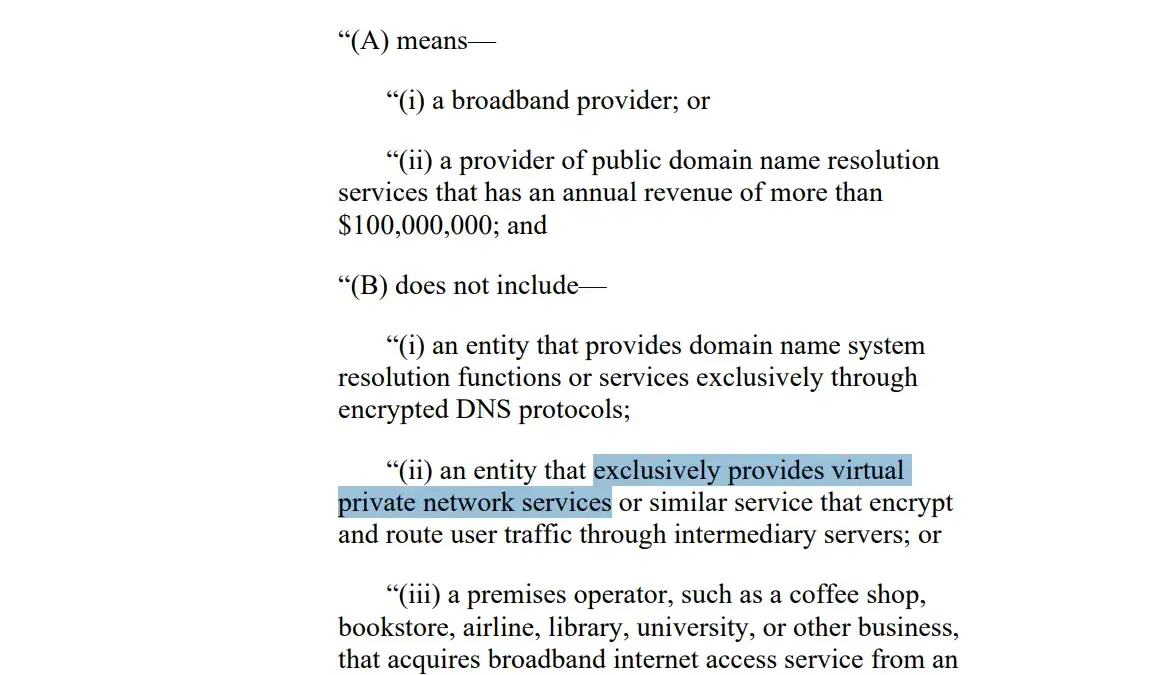
Crucially, however, virtual private network services are notably absent from the list of targeted intermediaries. The statutory definition of a service provider within the bill explicitly carves out an exemption for "an entity that exclusively provides virtual private network services or similar service that encrypt and route user traffic through intermediary servers."
This targeted exclusion marks a clear departure from the ACPA bill, which explicitly names VPNs among the intermediaries that could be compelled to implement site-blocking measures. Even so, the precise legal boundaries of the DEFEND IP Act’s exemption remain subject to interpretation. The text of the bill does not elaborate on how the exclusion applies to technology companies that offer a VPN product or service alongside other distinct telecommunications or software offerings, leaving a potential gray area for multi-service providers.
A parallel exemption exists for DNS resolvers, though it is subject to a stringent condition. The bill exempts DNS providers only if they furnish their services "exclusively through encrypted DNS protocols," such as DNS over HTTPS. Because major public resolvers like Cloudflare and Google handle a mix of encrypted and unencrypted traffic, this high compliance bar likely means those entities would still be required to implement blocking mechanisms across their encrypted service channels.
Designate First, Block Later
The procedural roadmap outlined in the DEFEND IP Act mirrors the two-step framework found in the ACPA bill. The initial phase requires rightsholders to secure a formal judicial determination from a federal court classifying a targeted internet domain or service as a "foreign digital piracy site."
To meet the legal threshold for this designation, a website must satisfy specific statutory criteria: it must be primarily designed or operated to facilitate digital piracy, it must lack any commercially significant purpose other than copyright infringement, or it must be intentionally marketed and promoted as a destination for pirated content. Operators of targeted sites are granted a 20-day window to respond to legal actions, but the statute permits federal judges to issue ex-parte orders without waiting for a defense if the fundamental statutory requirements are successfully met by the petitioner.

Once a site has been officially designated as a foreign digital piracy site, rightsholders can return to the presiding judge to petition for an injunction requiring qualifying intermediaries to block access. The court is tasked with evaluating whether the requested blocking measures are "technically feasible and effective," while also considering whether less burdensome alternatives exist to achieve the same objective.
Blocking orders issued under this authority remain valid for a maximum duration of one year, though they are eligible for renewal upon subsequent review. Furthermore, if a designated pirate site attempts to evade the restriction by migrating to a new domain name or shifting to an alternative IP address, rightsholders are permitted to petition the court for an updated order to maintain the integrity of the restriction.
Mirroring provisions in competing legislation, the DEFEND IP Act also addresses the pressing issue of live streaming piracy, particularly concerning premium sports broadcasts. Rightsholders can apply for expedited court orders when an upcoming live transmission "will likely violate" their exclusive distribution rights, allowing courts to flag and restrict access to unauthorized streams before the match or event officially commences.
Hollywood Applauds, Public Knowledge Objects
To mitigate the operational and financial burdens placed upon network operators, the DEFEND IP Act incorporates several statutory safeguards. Court orders are prohibited from prescribing specific technological blocking methods that providers must utilize, intermediaries are granted immunity from civil liability when they comply with blocking orders in good faith, and service providers retain the right to request that rightsholders help shoulder a portion of the operational costs incurred during implementation.
Websites that find themselves mistakenly blocked by an overly broad or erroneous injunction can petition the court to modify or rescind the order. However, unlike Representative Issa’s ACPA bill—which includes provisions for up to $250,000 in compensation for collateral damage—the DEFEND IP Act contains no direct financial payout mechanism for entities affected by erroneous blocks.
From its inception, the unified bill has secured robust backing from major content industries and trade organizations. More than a dozen prominent groups have lined up in support, including the Motion Picture Association (MPA), the Recording Industry Association of America (RIAA), the Copyright Alliance, SAG-AFTRA, and the Directors Guild of America.
"By enacting this legislation, our country can deploy a highly effective tool to protect creators and consumers from overseas digital piracy, all while safeguarding free speech and preserving the open internet," said MPA Chairman and CEO Charles Rivkin.
Conversely, digital rights and public interest organizations have mounted staunch opposition. Public Knowledge, an advocacy group that has consistently opposed the ACPA and earlier site-blocking initiatives, views the DEFEND IP Act as part of an unwelcome legislative trend.
"For the second time in as many weeks, rightsholders have convinced Congress to build out an expansive infrastructure for censorship rather than go after the root of the problem: operators of overseas piracy websites," Public Knowledge stated in a critical analysis of the bill. "Let us repeat: Applying blocking orders to global DNS resolvers causes global blocks."
More than fourteen years after the collapse of the Stop Online Piracy Act (SOPA) amid massive public protests, two distinct site-blocking bills are now competing for legislative attention and support within the halls of Congress.
Time, however, remains a formidable constraint for both measures. The legislative clock is winding down, and both bills are set to expire when the current congressional session concludes in January. Compounding this timeline, Representative Issa is retiring from public office, and Senator Tillis is not seeking reelection, ensuring that neither primary sponsor will be present to reintroduce their respective proposals next session. Whether either bill will manage to advance further than SOPA did over a decade ago remains an open question as lawmakers debate the future of online copyright enforcement.


Leave a Reply