
The legal net is tightening around the alleged operators of the prominent pirate IPTV services Kemo IPTV and Lemo TV, though the road to accountability is proving complex across multiple international jurisdictions. Ammar Towir, identified by major media corporations and satellite broadcasters as a central figure behind the illicit operations, is currently facing active criminal prosecution in Dubai. The enforcement action in the United Arab Emirates has unexpectedly intersected with a high-stakes civil lawsuit in a U.S. federal court, where satellite television provider DISH Network recently experienced a procedural roadblock in its pursuit of a multi-million-dollar default judgment.
The unfolding legal saga underscores the increasingly globalized nature of modern anti-piracy enforcement. While major entertainment conglomerates and broadcasting giants coordinate cross-border legal actions to dismantle illegal streaming empires, defendants caught in the crosshairs are increasingly forced to navigate simultaneous civil and criminal proceedings spanning multiple continents. In this instance, legal maneuvers in Florida and Dubai have brought the hidden financial and operational infrastructure of large-scale IPTV piracy into sharp focus.
The Origins of the Transnational Lawsuit
The civil component of the legal battle trace back to late last year, when DISH Network initiated aggressive legal action against the individuals it believes are masterminding Kemo IPTV and Lemo TV. Alongside the primary operators, the satellite broadcaster also targeted a Florida-based reseller known as 1 Dollar IPTV, accusing the network of systematically distributing unauthorized copyrighted television channels and video-on-demand content to paying subscribers.
As is common in complex international piracy litigation, securing cooperation or initial responses from overseas defendants can prove difficult. When the named defendants failed to formally respond or enter an appearance in the U.S. court proceedings, DISH Network elected to press its advantage. In March of this year, the broadcaster formally requested that the federal court enter a massive $28.65 million default judgment against the non-responsive parties. At the time, the legal trajectory suggested a swift, albeit one-sided, conclusion to the Florida lawsuit, handing a significant financial victory to the copyright holder.

That apparent momentum ground to a sudden halt in September. One of the primary defendants, Ammar Towir, formally petitioned the court to set aside the default judgment. In response to DISH Network’s assertions that Towir single-handedly owns and operates the domains, infrastructure, and financial accounts tied to Kemo and Lemo, the defendant raised a fundamental jurisdictional defense. Towir argued that he was never properly served with the initial lawsuit, pointing out that official legal documents had been sent to an address in Malaysia, whereas he actually resides in Dubai.
Court Denies $28.65 Million Default Judgment
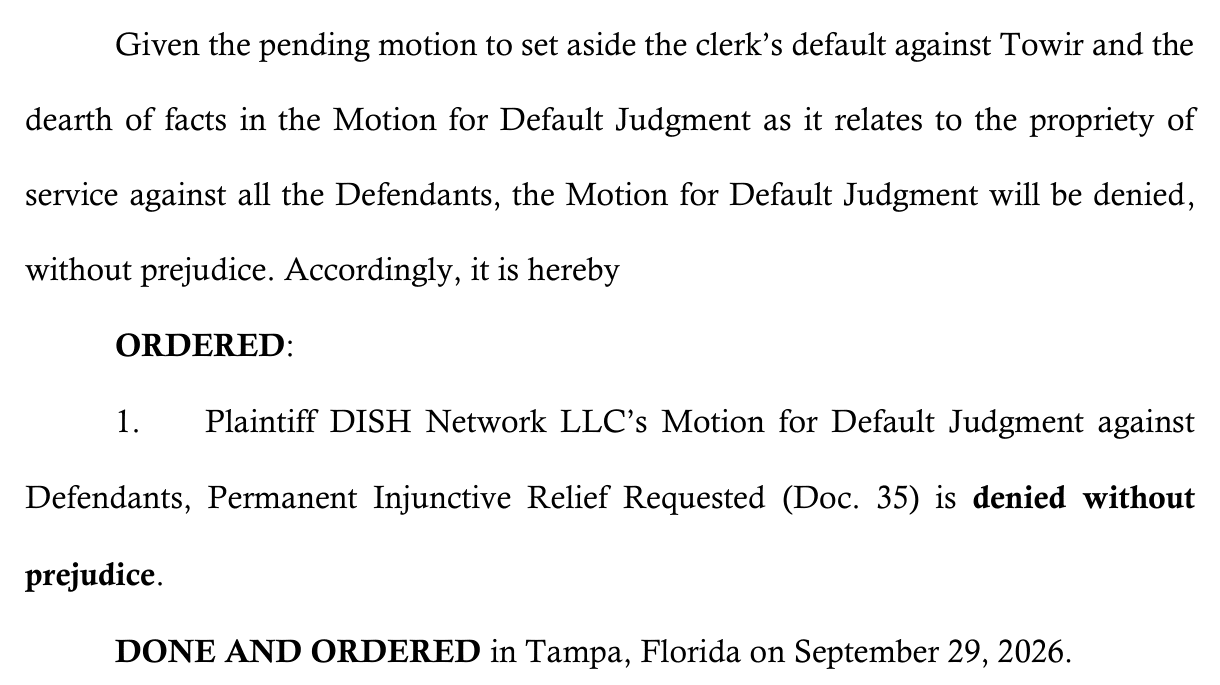
This week, U.S. District Judge Charlene Edwards Honeywell dealt a notable setback to DISH Network’s aggressive financial strategy, issuing an order that denied the broadcaster’s request for a default judgment without prejudice. According to the court’s written evaluation, DISH fell short of establishing that proper legal service had ever been executed under applicable rules and international standards. The judge noted that the broadcaster’s motion simply asserted that the defendants had been properly served without providing the necessary factual backing or legal justification.
The court order explicitly pointed out that DISH failed to set forth any concrete facts or relevant Malaysian legal authority within its motion that could establish the propriety of service upon the defendants. Consequently, while the door remains technically open for DISH Network to refile its $28.65 million financial request, the federal court must first resolve the foundational question of whether the defendant was legally and properly served in the first place. That procedural hurdle has now been handed over to a magistrate judge for deeper evaluation.
This development marks the second major procedural setback for DISH Network’s broader legal campaign against the Kemo and Lemo infrastructure this year. Earlier in March, a California federal court dismissed a separate $25 million IPTV piracy lawsuit that DISH had brought against UK-based hosting provider Innetra, citing a lack of jurisdiction. However, the ongoing procedural skirmishes in the Florida litigation also forced a much more serious reality to light: the revelation that Towir is currently pinned down in the United Arab Emirates facing severe criminal allegations.

Criminal Investigation and Prosecution in Dubai
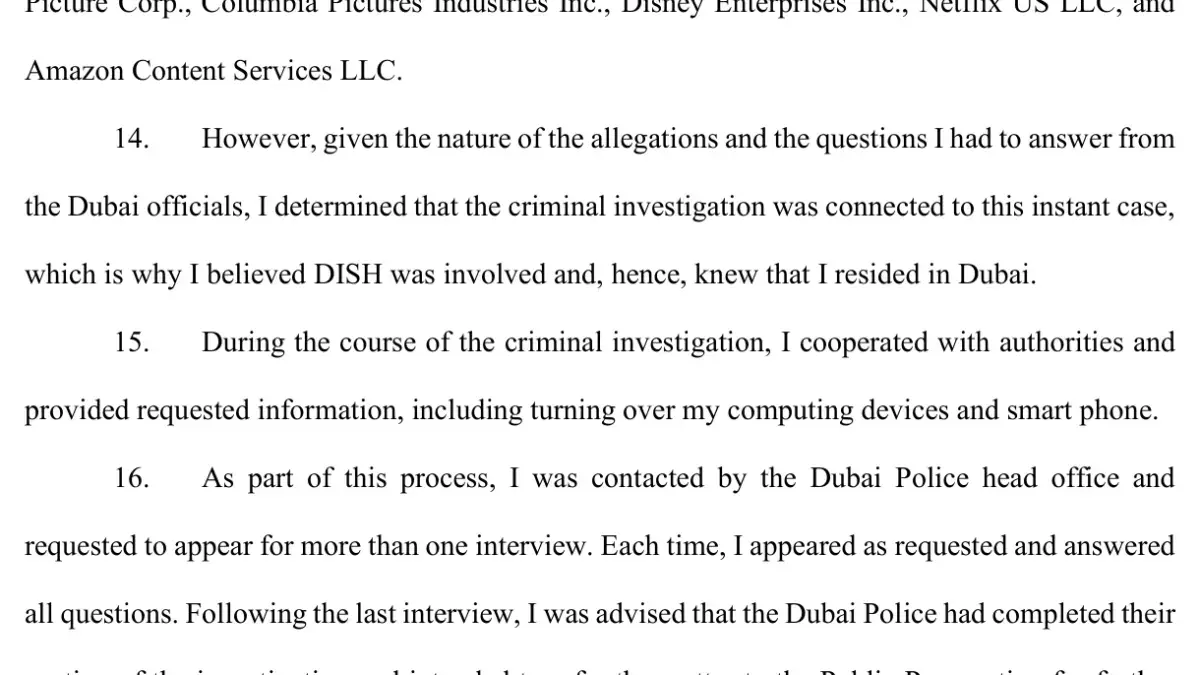
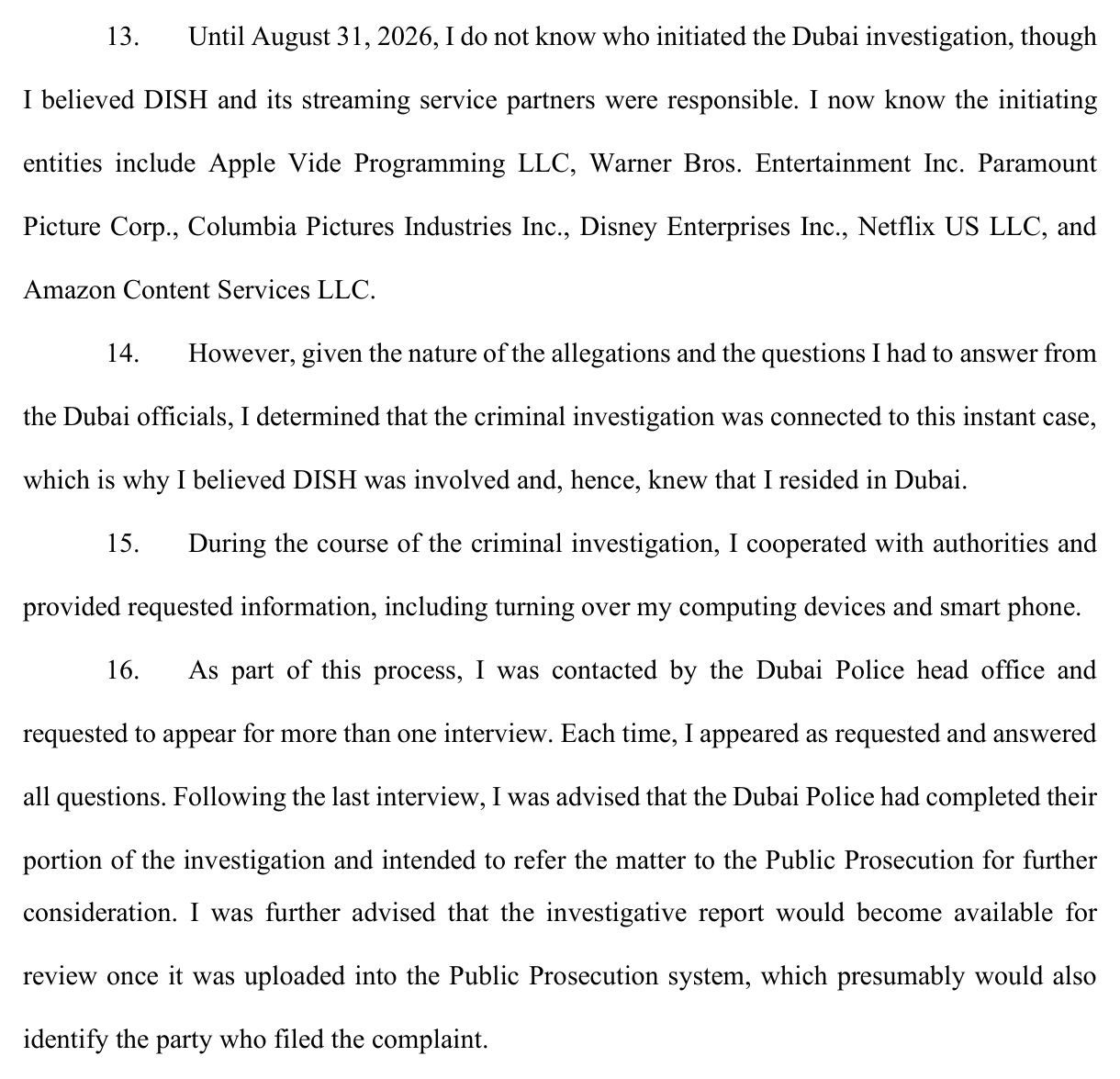
While fighting off civil financial claims in the United States, Towir has found himself occupied with a much graver legal challenge in the Middle East. In formal declarations submitted to the U.S. federal court, the alleged IPTV operator explained that his initial silence in the American litigation was not born of negligence, but rather out of necessity due to an active criminal complaint filed against him by Dubai authorities.
While Towir initially suspected that DISH Network was pulling the strings behind the Middle Eastern investigation, he later discovered that the complaint had actually been initiated by a coalition of Hollywood studios and media giants, including Apple, Warner Bros., Paramount Pictures, Columbia Pictures, Disney, Netflix, and Amazon. All of these entertainment powerhouses are prominent members of the Alliance for Creativity and Entertainment (ACE), the world’s leading anti-piracy coalition.
When contacted for comment, representatives for the global anti-piracy coalition confirmed their direct involvement in the overseas enforcement action. ACE stated that it spearheaded the complaint filed in Dubai in late July against Ammar Towir, targeting his alleged operation of the Kemo and Lemo IPTV ecosystem. Following the initial complaint, local authorities referred the complex matter directly to a specialized law enforcement unit for comprehensive investigation.
The timeline of these events indicates a highly coordinated international strategy. The ACE-backed complaint was filed in July, nearly three months before DISH Network initiated its civil lawsuit in Florida, and more than three months after DISH’s initial legal salvos in Texas. The earlier American filings likely played a crucial role in helping investigators map out the financial pipelines and identify the individuals allegedly pulling the operational strings behind the streaming services.
The criminal prosecution within the UAE has since advanced through local legal channels. ACE confirmed that the Public Prosecutor officially referred the criminal case to the Dubai Criminal Court, where formal proceedings are currently pending. While anti-piracy representatives declined to elaborate further due to the active nature of the judicial process, court declarations filed by the defendant provide a rare glimpse into the immediate impact of such international criminal probes.
Travel Bans and Ongoing Interrogations
In his sworn court declarations, Towir described a rigorous interaction with local authorities. He stated that he has been subjected to multiple interrogations by the Dubai Police and was required to surrender his personal computers and smartphone for forensic analysis. Furthermore, the legal process has severely restricted his personal freedom of movement, as he is currently subjected to a strict travel ban prohibiting him from leaving the country.
Detailing the compounding nature of the legal pressure, Towir noted that just as the automatic travel ban instituted upon the filing of a criminal complaint was set to expire, an additional criminal complaint was lodged against him, effectively extending his prohibition on international travel. Acting on local legal counsel in Dubai, the defendant chose to prioritize the unfolding criminal matter and await its outcome before mounting a defense in the U.S. civil court. DISH Network, conversely, has characterized this waiting strategy as a mere pretext designed to delay proceedings and avoid financial accountability. Despite various settlement discussions between the opposing parties, no formal resolution has been reached.
Disputed Evidence and Financial Trails
At the heart of both the civil and criminal disputes are conflicting narratives regarding Towir’s direct involvement in commercial-scale digital piracy. In his court filings, the defendant acknowledges that he engages in wholesale purchasing and subsequent reselling of services to customers located outside the United States. However, he maintains that these commercial activities were entirely unrelated to the operation of Kemo IPTV or Lemo TV.
DISH Network has forcefully challenged these assertions, presenting extensive digital evidence gathered through subpoenas and financial investigations. In its opposition briefs, the satellite broadcaster pointed to authenticated PayPal records listing Towir as the verified owner and operator of commercial accounts explicitly named "KEMO IPTV" and "KEMO E MARKETING SDN. BHD." Additionally, DISH introduced credit card transaction records bearing the defendant’s name that were utilized to pay for the Namecheap domain registrar accounts responsible for renewing key operational web addresses, including kemoiptv.com and lemotv.com.
This contested evidence and the broader financial documentation will likely regain central importance once the magistrate judge renders a final decision on whether the default judgment against Towir should be permanently set aside. Meanwhile, the criminal prosecution in Dubai continues to move forward through the local judicial system. Despite the intense international pressure and coordinated legal assaults from both corporate broadcasters and anti-piracy coalitions, digital resilience remains visible across parts of the network; at least one primary storefront associated with the brand, operating at kemoiptv.io, has continued to market subscriptions, though definitive confirmation regarding who currently controls the underlying domain remains undetermined. Lawyers representing Ammar Towir did not respond to requests for comment prior to publication.


Leave a Reply