

President Donald Trump has officially named Jay Clayton, the U.S. director of national intelligence, to lead the nation’s newly established Super Intelligence Force. The high-profile appointment was confirmed through a post on Truth Social on Sunday, following a wave of media speculation and prior reporting regarding the administration’s strategic focus on artificial intelligence and advanced computing dominance.
The announcement builds upon preliminary reports indicating that the administration planned to forge a dedicated "AI Force" modeled structurally after the United States Space Force, alongside the appointment of a specialized artificial intelligence czar. According to the president’s official statement, the newly formed entity will serve a crucial coordinating function across the federal government.
"The Super Intelligence Force is tasked with coordinating the effort of the Federal Government to ensure that America continues to lead the World in Super Intelligence," Trump wrote in his announcement.
Clayton brings a notable legal and regulatory background to the role, having previously led the Securities and Exchange Commission during Trump’s first term. His tenure at the SEC famously concluded with the launch of a high-profile enforcement action against Ripple for the unregistered sale of securities on his final day in office. Furthermore, as the U.S. Attorney for the Southern District of New York, Clayton oversaw the criminal trial against Roman Storm regarding his involvement with Tornado Cash.

Reacting to the appointment and the broader policy trajectory, Storm expressed skepticism regarding the administration’s approach to technology, commenting that it does not appear the country is heading toward a future that actively supports open-source artificial intelligence.
The terminology shift toward "superintelligence" has already begun echoing through private industry. Elon Musk announced plans to rename SpaceXAI to SpaceXSI in direct honor of the president’s directive shifting official terminology from artificial intelligence to superintelligence.
NEAR Intents Hack Resolves Following Ultimatum
In the decentralized finance sector, the NEAR ecosystem experienced a turbulent yet ultimately resolved security crisis this week. NEAR has commanded significant market attention recently, with its native asset more than doubling in value over the past month. This momentum was accompanied by strong institutional backing, highlighted by the debut of its Bitwise exchange-traded fund, which drew nearly $60 million in inflows during its launch week.
However, sentiment was severely tested when NEAR’s SHIELD AI system successfully blocked stolen funds originating from the Bitget exploit from entering its INTENTS cross-chain swaps platform. Shortly thereafter, SHIELD also helped intercept a separate $3.8-million exploit targeting NEAR Intents, which stemmed from a vulnerability in the Omni deposit and withdrawal infrastructure interacting with the NEAR Intents smart contract.

Market sentiment turned sharply bearish for a brief window until NEAR Intents general manager Alex Shevchenko publicly addressed the situation. Issuing a firm 48-hour ultimatum, Shevchenko stated that the perpetrator had been identified and warned them to return the funds or face legal repercussions.
"You know better than most how responsible disclosure works — this is the last window to use it. After 48 hours, that window closes," Shevchenko stated.
The targeted funds were subsequently returned, prompting Shevchenko to urge individuals attempting to pose as white-hat hackers to utilize established bug bounties rather than disrupting live network services. Despite the positive resolution, the decision by SHIELD to block Bitget’s stolen funds sparked intense industry debate. Critics contrasted the move with platforms like THORChain, which famously refuses to intervene or block transactions in strict adherence to decentralized ideals. Legal experts have also raised questions regarding whether automated intervention leaves protocols legally liable for subsequent platform activity. Amid these developments, NEAR traded down 11% for the week.
Arthur Hayes Argues Macroeconomic Pressures Make Money Printing Inevitable
Speaking at a fireside chat during the CONNECT by Cointelegraph Seoul Edition at Korea Blockchain Week, Arthur Hayes, chief investment officer at the Maelstrom fund, asserted that global macroeconomic pressures will inevitably force a return to aggressive monetary expansion. According to Hayes, the convergence of the capital-intensive AI revolution, escalating U.S. national debt, and mounting financial distress in France leaves major economies with few viable alternatives.

Hayes emphasized that artificial intelligence infrastructure companies require trillions of dollars to finance massive data centers, a capital requirement persisting even as the market prices for AI services experience downward pressure.
"They’ve not really given themselves a lot of options other than print money and make it less bad," Hayes remarked.
Beyond domestic fiscal strains, Hayes pointed to potential monetary stimulus measures in China and widening financial stress indicators in Europe, citing credit-default swaps tied to BNP Paribas and widening French government bond spreads as warning signs. He characterized the unfolding scenario as a slow-motion train wreck developing beneath the surface of global markets.
Blast to Wind Down Ethereum Layer-2 Network After Costs Outpace Revenue
Ethereum layer-2 scaling network Blast has announced its impending closure after operating expenditures surpassed the revenue generated by the protocol. In a public statement on social media, the Blast team stated that they could no longer identify a credible path toward economic sustainability, advising users to bridge their assets back to the Ethereum mainnet.

"We launched Blast with the goal of building a self-sustaining chain for users and developers," the team stated. "Unfortunately, the economics of operating the chain no longer make sense."
Founded in November 2023 by Tieshun "Pacman" Roquerre—who also created the NFT marketplace Blur—Blast initially attracted over $2 billion in total value locked prior to its mainnet launch in February 2024 by offering native yield on Ether and stablecoins alongside an anticipated token airdrop. However, DeFiLlama data indicates that the network’s total value locked subsequently dropped by more than 98% from its peak in June 2024.
Ethereum Schedules Glamsterdam Upgrade on Sepolia Testnet
Core developers on the Ethereum network have officially scheduled the upcoming Glamsterdam protocol upgrade to activate on the Sepolia testnet on Oct. 6. Ahead of the deployment, the Ethereum Foundation has urged Sepolia node operators to update both their execution-layer and consensus-layer client software.
The Glamsterdam upgrade introduces several significant protocol improvements, most notably enshrined proposer-builder separation. This change integrates the handoff mechanism between specialized block builders and network validators directly into the core protocol, reducing the network’s reliance on external middleware. Additionally, the upgrade introduces block-level access lists—which meticulously record the accounts and storage locations utilized during each block execution—and enables parallel processing capabilities for clients to enhance overall transaction throughput.

Market Overview and Altcoin Performance
At the close of the trading week, the broader cryptocurrency market capitalization stood at approximately $2.92 trillion, according to CoinMarketCap tracking data. Major digital assets registered modest weekly gains, with Bitcoin rising 1.4% to trade near $85,821, Ethereum increasing 0.6% to reach $2,701, and XRP slipping 0.8% to trade at $1.50.
Among the top 100 cryptocurrencies by market capitalization, the strongest weekly performers included Midnight, which rallied 60.6%, Pump.fun with a 24.3% gain, and StarkNet, which advanced 14.5%. Conversely, the most significant weekly pullbacks were observed in Lighter, down 22.2%, Zcash, declining 16.4%, and Ethena, which fell 14%.
Peter Brandt Projects Bitcoin Could Reach $600K by 2029
Veteran commodities and cryptocurrency trader Peter Brandt has reversed his previous market outlook, adopting a firmly bullish stance following earlier warnings that prices might retrace into the high $40,000 range.
"There’s a good possibility we have seen the low and now are entering a new bull market cycle in Bitcoin," Brandt noted during an appearance on Cointelegraph’s Trade Secrets program.

Brandt has correspondingly revised his price targets for the current cycle’s ultimate peak, estimating that Bitcoin could reach between $300,000 and $600,000 by late 2029, a notable upward revision from the $250,000 to $300,000 range he outlined earlier in July.
Crypto Exploits Peak in September as Monthly Losses Surpass $766 Million
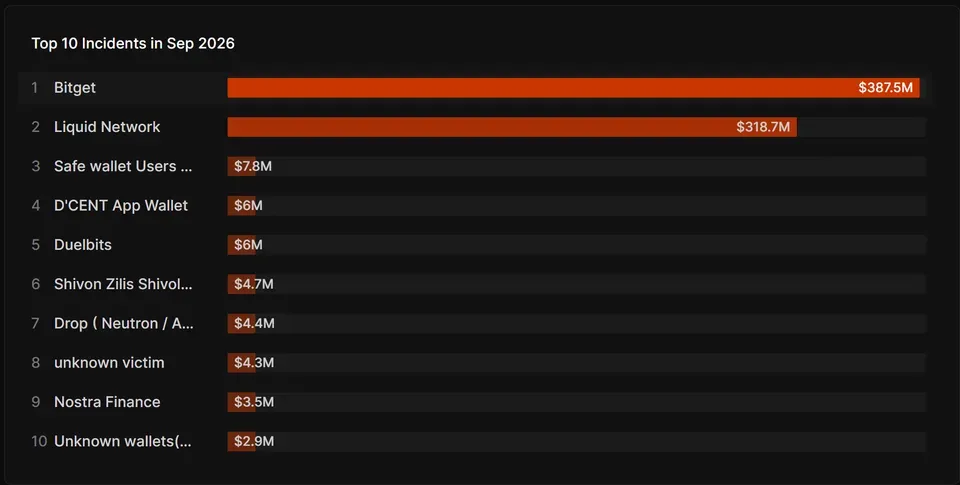
The digital asset sector endured its most challenging month of the year regarding security incidents in September, with independent blockchain security firms estimating aggregate losses between $766 million and $768 million.
Data compiled by PeckShield identified 55 major security breaches accounting for $766.5 million in stolen assets, while CertiK recorded 97 incidents totaling $768.4 million in estimated damages. The surge in losses was heavily driven by major exploits, including a $388 million breach impacting Bitget and a $320 million attack on the Liquid Network, though reports indicate that more than $270 million of the Liquid Network funds were subsequently recovered by white-hat interventions. Additional security incidents during the month targeted protocols such as Safe Wallet, D’CENT, and Duelbits.
Despite the broader industry figures, protocol maintainers acted swiftly to isolate peripheral vulnerabilities. Following an incident that drained approximately $305,000 from two Safe multisig wallets through an external third-party adapter built on top of Aave, founder Stani Kulechov clarified that the core lending protocol remained entirely secure, emphasizing that the vulnerability resided strictly within an external third-party integration rather than the core Aave v3 smart contracts.
Meanwhile, stablecoin issuer Tether reported that it had assisted international law enforcement agencies in freezing nearly $550 million in Iran-linked USDT throughout the year. The company disclosed that it has collaborated with global authorities for years, freezing more than $130 million across four wallets in 2026 alone, following an earlier freeze of over $344 million linked to the Central Bank of Iran in April.
The disclosure from Tether coincided with the release of a congressional report by Democratic investigators on the Senate Permanent Subcommittee on Investigations, which alleged that stablecoins had increasingly served as an instrument for evading international economic sanctions.



Leave a Reply