
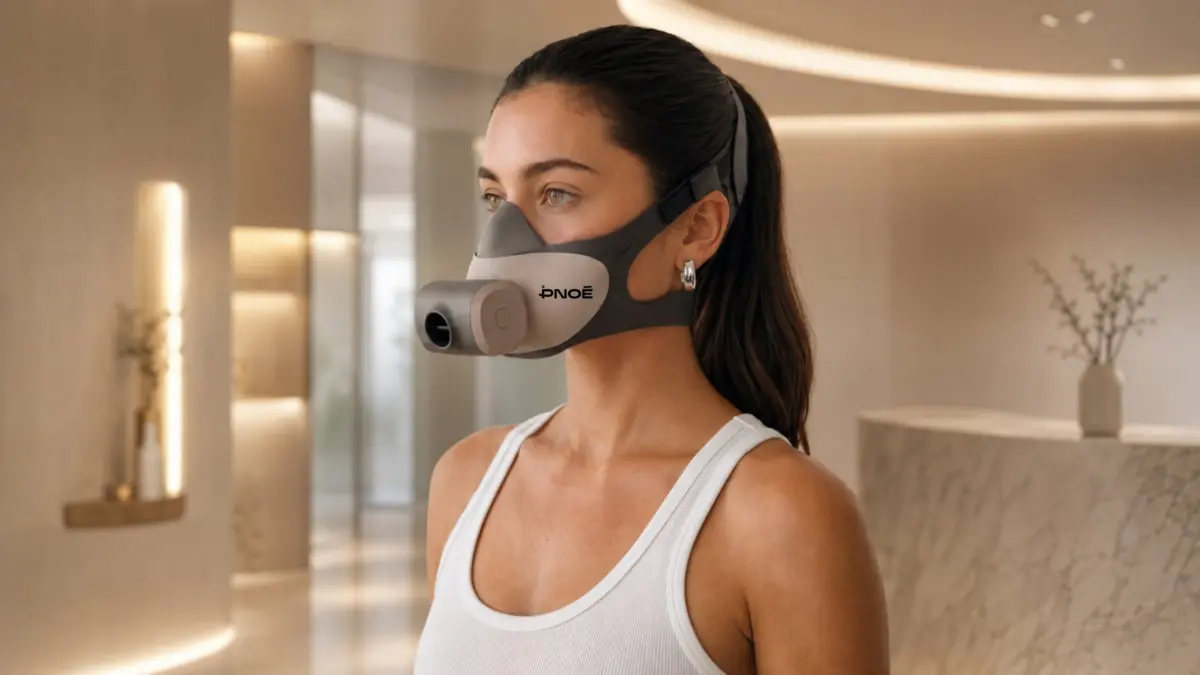
At first glance, the newest hardware from the health-tech startup PNOĒ looks like something straight out of a comic book. The device, which fits securely over the nose and mouth and straps tightly around the back of the head, bears more than a passing resemblance to the mask worn by Bane, Batman’s hulking and formidable nemesis. But beneath the intimidating aesthetic lies a purpose that is far more health-oriented and benign. The mask is engineered to measure how much oxygen a user consumes and how much carbon dioxide they exhale, seamlessly transforming that raw respiratory data into actionable advice about how to eat, how to train, and, the company ultimately hopes, how to live a longer and healthier life.
Headquartered in Malden, Massachusetts, with significant operational and development hubs in Athens, Greece, PNOĒ is gearing up for the official commercial launch of its flagship device, the PNOĒ 2.0, on October 1. The most critical and disruptive change from the company’s current generation of hardware is that users will now be able to administer the test entirely by themselves, eliminating the need for specialized laboratory personnel.
According to co-founder and CEO Apostolos Atsalakis, the new user experience is designed to be frictionless. A fitness enthusiast can walk into a local gym, place the mask over their face, push a single button, sit comfortably in a chair, and breathe normally for roughly eight minutes.
“That’s it. It’s that easy,” Atsalakis said recently during a video call from the company’s Athens office.
That operational simplicity matters immensely for the future of the company and the broader market. PNOĒ’s current iteration of the device requires a trained technician or operator to calibrate and monitor the session, which inherently restricts where the test can be deployed. By introducing a self-serve version, the company is opening the door to a wide array of new environments, including fitness centers that lack dedicated wellness staff, corporate wellness rooms, and potentially even pharmacies.
The foundational science behind PNOĒ’s technology is far from new. Metabolic testing, a diagnostic process that analyzes the specific gases in a person’s breath to gauge precisely how their cellular metabolism produces energy, has been utilized in clinical and research settings for more than a century. For decades, it has served as the undisputed gold standard for measuring VO₂ max—the maximum volume of oxygen that an individual’s body can utilize during intense exercise. VO₂ max is widely recognized by exercise physiologists and physicians as one of the single most reliable indicators of overall cardiorespiratory fitness.
However, traditional metabolic assessments have historically required bulky, highly sophisticated, and expensive equipment that could only be housed in specialized sports science laboratories, elite athletic training centers, and major hospitals. Because of these logistical and financial barriers, comprehensive metabolic testing has largely remained the exclusive domain of professional athletes, Olympic hopefuls, and high-end executive wellness programs.
What a decade-old PNOĒ promises is to deliver that exact clinical-grade accuracy within a sleek, highly portable package, paired intelligently with proprietary software that translates complex physiological data into clear, easy-to-understand lifestyle recommendations.
“We made it accessible to everyone,” Atsalakis emphasized.
The company reports that its testing apparatus captures an impressive 23 distinct biomarkers during a single session. Beyond measuring VO₂ max, the system evaluates an individual’s resting metabolic rate, which calculates the exact number of calories the body burns while at complete rest, and metabolic flexibility, a crucial metric that reveals how efficiently the human body transitions between burning dietary fats and carbohydrates for fuel. Atsalakis argues passionately that these advanced respiratory metrics answer vital health questions that standard blood tests simply cannot address, such as precisely how many calories an individual requires to meet their goals or how they should structure their athletic training regimens.
The timing of this product launch appears exceptionally favorable for PNOĒ. Over the past several years, VO₂ max has rapidly evolved into a major buzzword among the burgeoning longevity and biohacking communities, largely propelled by ongoing scientific research linking higher levels of cardiorespiratory fitness to lower rates of all-cause mortality. Atsalakis goes so far as to describe VO₂ max as the single strongest predictor of human longevity, viewing his company’s diagnostic data as an essential scorecard for the rapidly expanding wellness industry.
The newly designed device is notably smaller, more compact, and features significantly fewer moving parts than its predecessor, an engineering evolution that Atsalakis notes makes the hardware considerably more reliable in high-traffic commercial environments. The physical product was meticulously designed in collaboration with the Milan-based Design Group Italia through what Atsalakis described as “a lot, a lot, a lot of iterations,” primarily because a self-administered metabolic testing device of this caliber had never successfully been brought to market before.
The design also thoughtfully addresses a practical concern that post-pandemic consumers are almost certain to raise: hygiene and shared hardware. Who wore it last? The answer, according to the company, is that it does not matter. The sensitive electronic components and sensors cleanly detach from the medical-grade silicone mask and adjustable straps. This allows multiple gym members to share the costly electronic hardware while each individual consumer retains and owns their own personal mask for sanitary purposes.
Despite its clear clinical ambitions and high-tech capabilities, PNOĒ exercises significant caution regarding the medical claims it makes to the public. The device is not cleared or regulated by the U.S. Food and Drug Administration as a diagnostic medical tool, and Atsalakis is careful to point out that the company does not provide medical diagnoses or prescriptions. Instead, PNOĒ positions its platform strictly as a consumer wellness device.
“It’s like a body composition device, like a scale,” Atsalakis explained. “A doctor cannot prescribe medication based on our results.”
That regulatory and clinical stance could potentially change further down the road. Medical researchers have spent years exploring whether specific chemical compounds exhaled in human breath can serve as early warning signals for serious diseases, including various forms of cancer. Atsalakis believes that the company’s rapidly expanding trove of anonymized respiratory data could eventually help it flag underlying health issues or metabolic dysfunctions. However, he readily acknowledged that full clinical diagnoses are “definitely a couple of years away,” with strict regulatory hurdles likely extending that timeline considerably. “We’re not there yet,” he admitted.
PNOĒ traces its corporate origins back to Atsalakis’s doctoral research in advanced sensing technologies at the University of Cambridge. During his time at Cambridge, consumer wearables were experiencing a massive surge in popularity, and he became deeply fascinated by the hidden physiological secrets that human breath could reveal about internal body functions. He ultimately co-founded the company alongside Panos Papadiamantis, a childhood friend who now serves as PNOĒ’s chief product officer.
The startup participated in Y Combinator’s Winter 2019 batch, entering the accelerator program long before “longevity” became the massive, heavily funded commercial industry it is today. Since those early days, the company has raised approximately $22 million in total funding. This includes a recently closed $11 million financing round backed by notable investors such as the venture firm 50 Years and Google Maps co-founder Lars Rasmussen, who himself is now based in Athens.
Currently, PNOĒ operates strictly on a business-to-business sales model, selling its hardware and software exclusively to commercial clients who then offer the testing services directly to their own members or patrons. Its impressive roster of clients includes fitness giant Equinox, where the technology is available at nearly all of its club locations, according to Atsalakis. Other prominent customers include Four Seasons hotels, Red Bull, the National Basketball Association (NBA), the Mount Sinai Health System, and the popular med spa chain Restore Hyper Wellness.
Approximately 85% of PNOĒ’s total business originates in the United States, a market Atsalakis described as “by far the most advanced market globally” when it comes to consumer interest in longevity and preventative health. Building on this domestic success, the company is actively expanding its footprint across Europe and, through strategic distribution partners, into Latin America and Asia.
Commercial businesses pay a recurring monthly subscription ranging from roughly $400 to more than $1,000. This fee comprehensively covers the hardware units, analytical software access, staff training programs, and marketing materials—a bundled offering that Atsalakis refers to as a complete “business in a box.” PNOĒ also intelligently links its diagnostic test results directly to the supplementary services that a business sells, allowing a gym, hotel, or wellness spa to automatically recommend specific personal training packages, nutrition plans, or spa treatments based on an individual customer’s unique test metrics. Many commercial clients deliberately integrate the metabolic test during the initial member onboarding process, positioning the assessment somewhere between a comprehensive clinical medical workup and the rough fitness estimates provided by consumer smartwatches.
This particular middle ground in the health-tech landscape is becoming increasingly crowded. Major technology brands like Apple, Garmin, and Whoop all attempt to estimate a user’s VO₂ max using continuous heart-rate and accelerometer data, while consumer-focused devices like Lumen analyze breath samples to gauge daily fat and carbohydrate burning. At the absolute high end of the market, traditional, cumbersome metabolic carts remain the entrenched standard inside university laboratories and hospital physiology departments.
PNOĒ, which currently employs a team of 110 people, reports that it recently achieved profitability while maintaining a revenue growth rate of more than 100% year-over-year. Atsalakis indicated that the company is already laying the groundwork to raise a formal Series B funding round within the next six to twelve months, fueling its ambitious mission to place its distinctive mask—Bane comparisons and all—in front of significantly more faces worldwide.



Leave a Reply