
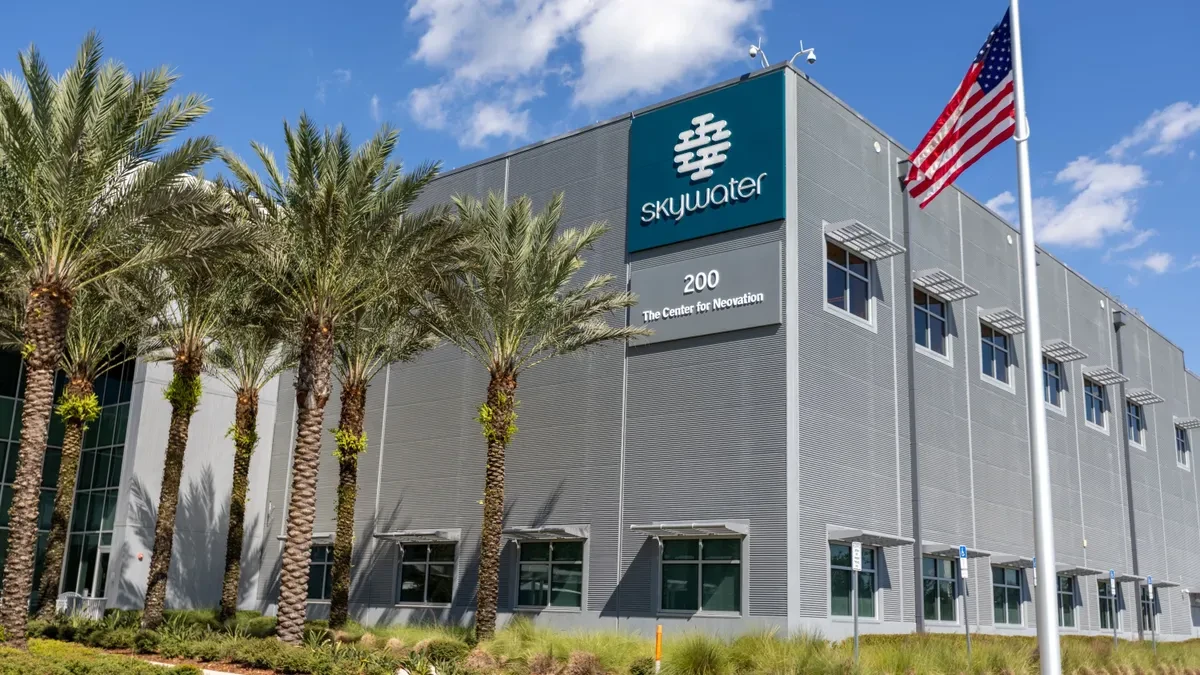
Following quantum computing company IonQ’s acquisition of SkyWater earlier this year, the foundry subsidiary has moved quickly to reassure the industry that it remains committed to a neutral business model. Leadership at SkyWater has pledged to treat all of its quantum chip customers on an entirely equal footing, maintaining a strict firewall between its manufacturing operations and its new corporate parent.
The acquisition, which was finalized in July, brought SkyWater under the corporate umbrella of IonQ, a prominent player in the trapped-ion quantum computing space. However, executives at the foundry are emphasizing that corporate affiliation will not grant preferential treatment or compromise the security of sensitive client data.
Mihir Bhaskar, the newly appointed senior vice president of quantum technologies at SkyWater, addressed these concerns directly in a recent interview. He emphasized that the foundry’s operational integrity relies entirely on absolute impartiality.
"IonQ is treated as a customer of the foundry, just like anyone else," Bhaskar said. "For all quantum customers SkyWater serves, their data and information remain strictly with the dedicated SkyWater team manufacturing their devices."

Bhaskar brings a deep background in the quantum sector to his new role. A quantum technologist with 15 years of industry experience, he previously founded Lightsynq in 2024, a venture specializing in photonic interconnects and quantum memory. IonQ subsequently acquired Lightsynq in 2025, bringing Bhaskar into the fold to help steer the company’s broader technological strategy, including the integration and acquisition of SkyWater.
With the transaction now complete, Bhaskar says his primary focus is guiding the SkyWater Quantum Solutions business unit to support a diverse and growing roster of external clients.
SkyWater currently maintains relationships with nine major quantum customers, operating in a market where foundry services are becoming increasingly critical to turning theoretical physics into scalable hardware. Competitors in the space are also scaling up; for example, startup competitor Anderon operates with IBM as its primary customer while actively seeking to expand its client base.
For SkyWater, safeguarding customer assets is not merely a policy, but an existential requirement for doing business. In the semiconductor and quantum foundry ecosystem, protecting proprietary designs is the baseline for building industry trust.
"Priority number one for any business—especially in the foundry space—is protecting customer intellectual property," Bhaskar noted. "If your customers don’t trust you, you can’t do business. It is critical in the foundry business because customers bring highly sensitive IP and designs, trusting us to manufacture them."

SkyWater is no newcomer to this delicate manufacturing environment. The company has been fabricating quantum chips for approximately a decade. Its roster of clients encompasses a wide cross-section of the quantum landscape, including IonQ, PsiQuantum, Qolab, and QuamCore.
Among these partners, companies like Qolab and QuamCore are pursuing innovative architectural approaches that Bhaskar describes as potentially disruptive. Their work focuses on superconducting technologies that could eventually eliminate the traditional "chandelier" design—the bulky, multi-stage cryogenic dilution refrigerators heavily laden with coaxial cables that dominate contemporary quantum laboratories.
Scaling up superconducting qubit systems has long presented a formidable engineering bottleneck for major industry pioneers like IBM, Google, and Rigetti. The primary hurdle lies in the immense complexity of wiring and controlling vast numbers of individual qubits without creating an unmanageable physical tangle of cables that generates unwanted thermal noise. To address this, SkyWater is actively collaborating with firms like QuamCore to build specialized platforms aimed at solving these high-density integration and routing challenges.
Modalities
The broader quantum computing landscape relies on a diverse array of foundational techniques, known as modalities, to create and manipulate qubits. These methods include trapped ions, quantum dots, silicon vacancies in diamond, photonics, and superconducting circuits.
Despite the wide variety of physical systems being researched across the globe, Bhaskar points out that every single one of these modalities ultimately depends on either superconducting or photonic methods when it comes to moving quantum information across a system.

"We support all major modalities," Bhaskar said. "That might sound impossible for a single foundry, but fundamentally, there are only two ways to transport quantum information across a chip or system."
To accommodate this technological diversity, SkyWater utilizes a dual-platform approach alongside a flexible business model. The company offers its SC250 platform for superconducting applications and its SP90 platform for photonic designs. These are paired with a technology-as-a-service model, which gives early-stage quantum developers access to customized process development necessary to prove manufacturability before committing to mass production.
"While we offer baseline process design kit platforms, our core business model accommodates custom process development within a volume manufacturing environment," Bhaskar explained. "We develop new processes outside standard PDKs to make breakthrough innovations manufacturable for the first time."
Anderon
The broader quantum manufacturing ecosystem is also experiencing shifts driven by outside capital and government intervention. In May of this year, IBM established Anderon with the backing of the U.S. government, positioning it as the world’s first pure-play quantum chip foundry. Shortly after, in early September, the U.S. Department of Commerce awarded Anderon $1 billion under the CHIPS Act to accelerate production scaling. While IBM remains Anderon’s anchor customer, the foundry is positioning itself to serve the wider industry.
Industry analysts note that bolstering domestic manufacturing capacity addresses critical supply chain vulnerabilities. Heather West, IDC’s quantum research lead, has previously highlighted that expanding domestic foundry options provides crucial manufacturing redundancy, giving emerging quantum companies more viable pathways as they transition from laboratory research prototypes toward commercial production volume.

Anderon’s leadership has outlined plans to supply wafers supporting superconducting qubit arrays, quantum input/output signaling, and readout signal chain components. Furthermore, the company intends to expand its fabrication capabilities to incorporate other emerging quantum modalities, such as spin qubits.
Fantastic Step
U.S. government investment aimed at bolstering domestic quantum semiconductor manufacturing is viewed broadly across the industry as a positive development. Bhaskar welcomed the influx of federal capital into the sector, noting that it validates the strategic importance of quantum hardware production.
"Competitors like Anderon are building new 300-mm facilities for future capability," Bhaskar observed.
In contrast, SkyWater points to its established operational footprint as a distinct near-term advantage. The company currently fulfills orders for its quantum customers utilizing two established 200-mm manufacturing facilities located in Minnesota and Florida. Additionally, the company operates a 300-mm advanced packaging facility in Florida dedicated to chiplet integration and the testing of novel materials.
"SkyWater is already shipping quantum wafers today and has been doing so for the last decade," Bhaskar noted. "Our active capacity has powered the last several generations of quantum innovation and will continue to power the next. While others are working toward becoming a quantum foundry in the future, SkyWater is already the operational quantum foundry today."

Leave a Reply