
Lindsey Elliott is exceptionally passionate about bolts. At last year’s 13th annual Bolting Symposium, she recalls that the absolute highlight of the event was playing a high-stakes game of “Bolting Bingo” against the many self-proclaimed “torque dorks” gathered in the room. For an outsider, the obsession might seem niche, but for Elliott, bolts represent the focal point of a massive, critical industrial challenge that she has dedicated her career to solving.
A former engineer and planner at energy giant ExxonMobil, Elliott has spent years thinking deeply about how to improve the sprawling infrastructure that moves oil, gas, and petrochemicals across North America and beyond. After analyzing where bottlenecks and physical hardships occur most frequently in the supply chain, bolts were what she ultimately landed on. More specifically, her focus is on the heavy-duty bolts that connect individual sections of industrial piping, technically referred to in the engineering world as “bolted flange joints.”
These critical connections require immense, hard physical labor to loosen and tighten, and they serve as the primary source of many common pipefitter injuries. Furthermore, much like many other trade and blue-collar industries today, the energy and manufacturing sectors are grappling with a persistent and severe labor shortage. The combination of grueling physical demands and dwindling personnel has placed an unprecedented strain on the existing workforce.
Those people get really tired when they are asked to work 12 hours a day for three months in a row, Elliott explained during an interview. Having spoken directly with pipefitters across the United States and Canada, she has been told repeatedly that North American pipefitting productivity is notoriously low, largely due to physical exhaustion, arduous manual workflows, and the sheer repetitiveness of the work.
The innovative solution that Elliott came up with to address this persistent industry pain point is housed within her startup, Nexterity. As a testament to the potential and relevance of her vision, Nexterity was selected as one of the Startup Battlefield 200 companies to participate in TechCrunch Disrupt. The core of Nexterity’s offering is a specialized, remote-controlled robot designed to handle the grueling task of loosening and tightening flange joint bolts. It is precisely the kind of bold technological idea that could fundamentally transform this particular blue-collar job if it achieves widespread adoption, making industrial workers significantly safer while simultaneously boosting operational productivity.
To put the company’s philosophy simply: more dork, less torque.
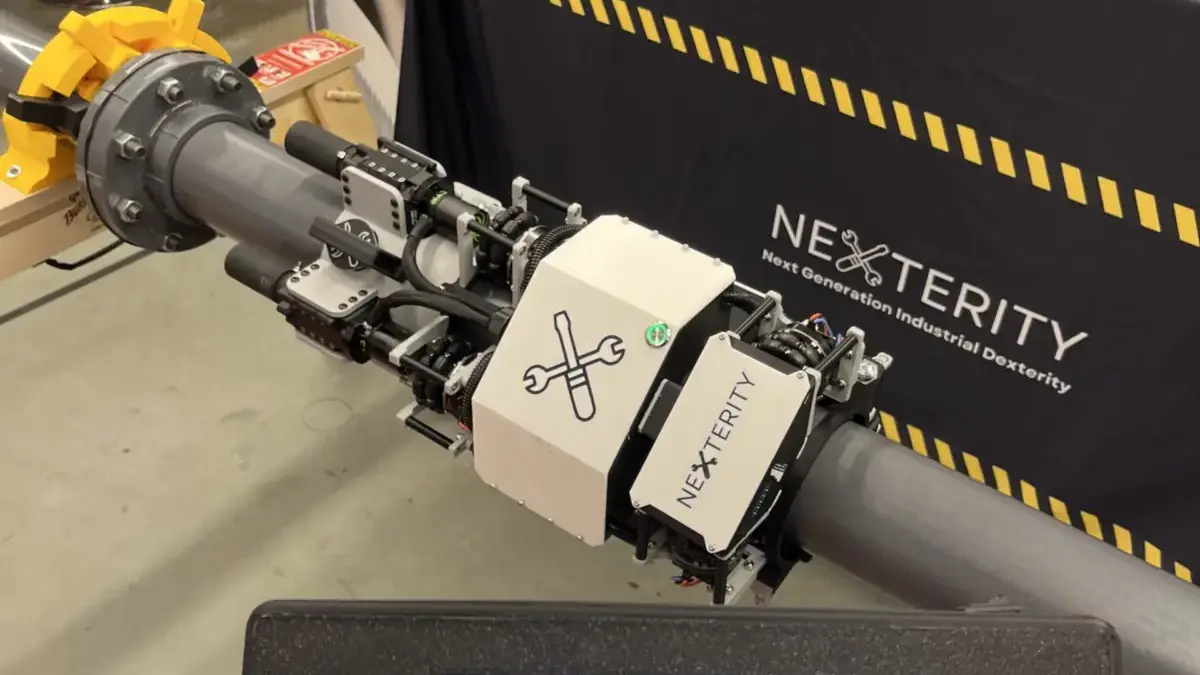
The physical design of the Nexterity robot is straightforward yet highly functional. The device arrives in two main modular pieces that are engineered to fit snugly around an industrial pipe. Powered by reliable onboard batteries, the robotic unit can smoothly slide across the exterior of the pipe once it is securely attached. From there, it possesses the capability to quickly and precisely loosen and tighten four heavy-duty bolts simultaneously, drastically reducing the time and manual exertion required for pipeline maintenance and assembly.
Elliott noted that Nexterity has successfully developed a few different configurations of the robot to accommodate various standard pipe sizes used across industrial facilities. Despite their capability to handle heavy industrial components, the robots are remarkably compact. They are small enough to fit neatly inside a standard Pelican case, allowing a single worker to easily transport the equipment to and from a job site.
This high degree of portability is crucial to Nexterity’s overall business model. Rather than forcing plants to purchase expensive, permanent machinery, the startup treats its robots much like rental construction equipment, ensuring flexibility and ease of deployment for industrial clients who constantly move between different maintenance sites and operational facilities.
Elliott explained that she arrived at this particular product design as a direct result of conversations she has had over the last few years. These insights came not only from attending specialized industry gatherings like the Bolting Symposium, but also from deep consultations with members of the Pressure Vessels and Piping Division of the American Society of Mechanical Engineers.
What she learned from the community of engineers—the torque dorks per se—is that a staggering 80% of industrial pipes fall within a diameter of two to eight inches, a standard classification known in the field as NPS2 to NPS8. When an industrial process exhibits that much structural repeatability and standardization, Elliott realized, it becomes a fantastic candidate for automation.
While the concept of automating industrial maintenance tasks is straightforward, Elliott firmly believes that the market upside for her startup’s approach is immense.
It would shock a lot of people just how big this market is, she noted. Day to day, most of us do not think about the vast and complex piping infrastructure that supports modern civilization. However, beyond oil and gas, virtually every major industrial sector relies on the exact same kind of piping. This includes water systems, wastewater management, water treatment facilities, food and beverage processing plants, mining operations, nuclear power plants, and any kind of modern green or sustainable manufacturing facility. All of them utilize standard bolted pipe connections, meaning the potential applications for Nexterity’s remote-controlled solution stretch far beyond traditional fossil fuel industries and into the broader landscape of global manufacturing and infrastructure.



Leave a Reply