

Pirate streaming platforms catering specifically to a Chinese-speaking diaspora have historically operated on the periphery of Hollywood’s primary anti-piracy crosshairs. While mainstream Western anti-piracy coalitions such as the Alliance for Creativity and Entertainment (ACE) and the Motion Picture Association (MPA) frequently target massive English-language or global piracy networks, platforms serving niche overseas language communities often escape their immediate enforcement priorities.
This dynamic previously applied to Olevod, a prominent Chinese-language streaming site operating across multiple domains including .com and .tv. Over the years, Olevod cemented its presence as a reliable streaming hub for millions of Mandarin-speaking individuals residing outside mainland China, including a substantial audience within the United States. Although the site previously surfaced in a batch of Digital Millennium Copyright Act (DMCA) subpoenas secured by ACE and faced regional blocking orders imposed by Australian authorities under pressure from industry giants like Netflix and Disney, it notably managed to avoid inclusion in the United States Trade Representative’s annual lists of key foreign piracy threats.
However, the legal landscape surrounding the platform shifted dramatically when Chinese streaming titan Tencent set its sights on the operation, launching a high-stakes legal challenge in a U.S. federal court.
Tencent Sues ‘Chinese’ Pirate Site in Florida
Seeking to dismantle the operation, Tencent filed a comprehensive copyright infringement complaint against Olevod at a federal court in Florida. As one of China’s dominant entertainment and streaming conglomerates, Tencent utilizes its platform, Tencent Video, to distribute massive quantities of proprietary content. The lawsuit targets more than 150 of the company’s most popular television shows and films, including high-profile series that have collectively accumulated tens of billions of streams worldwide.

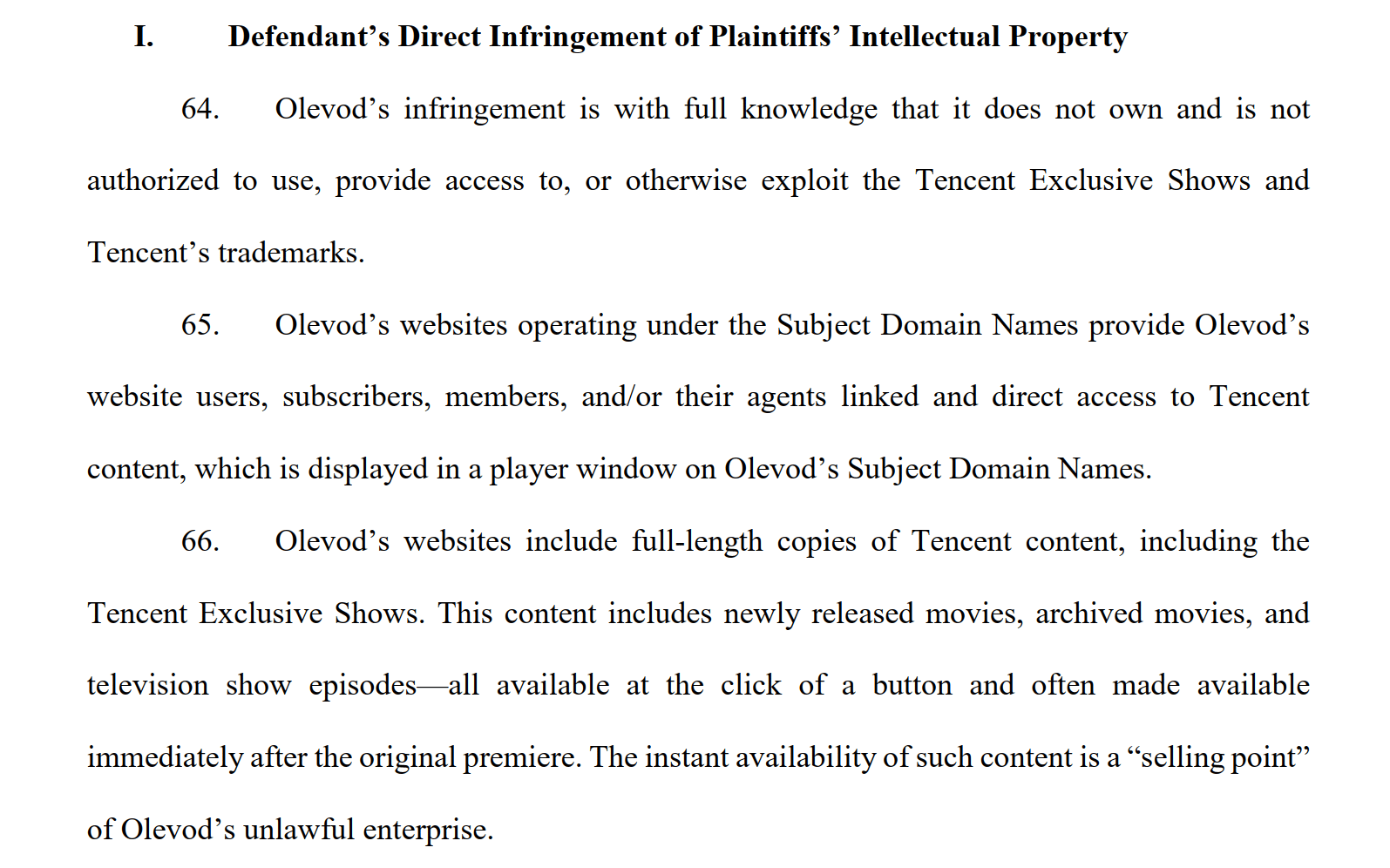
According to the court filings, Olevod.com and Olevod.tv systematically offer full-length, unauthorized copies of Tencent’s cinematic catalog and serialized dramas. The platform employs a dual-monetization model common in the illicit streaming economy, allowing visitors to watch copyrighted material for free alongside third-party advertisements, or alternatively purchase a VIP membership tier designed to remove interruptions and unlock premium features.
The complaint details the extent of the alleged infringement, emphasizing the speed with which pirated materials appear on the platform. Olevod’s websites allegedly feature full-length copies of proprietary content, including exclusive shows, newly released movies, archived cinematic works, and television episodes. This content is reportedly made available to users at the click of a button, frequently appearing on the platform immediately following its official domestic premiere.
Furthermore, Tencent highlighted the targeted nature of Olevod’s marketing strategy. In search engine results, the platform has advertised itself as an online video media platform explicitly tailored for overseas Chinese audiences. Interestingly, the site actively implements geo-blocking measures to prevent visitors located within mainland China from accessing its servers, a tactical move designed to circumvent complications with local domestic rightsholders.
$100 Million in Potential Damages and Broad Injunction Requests
Tencent’s legal action goes beyond allegations of direct copyright infringement. The conglomerate also asserted claims of trademark infringement, drawing attention to the controversial nature of the advertisements displayed alongside its intellectual property and corporate logos. According to the complaint, banners promoting online gambling, adult pornography, and unauthorized academic diplomas frequently populated pages featuring Tencent’s proprietary branding.
The scale of the financial penalty sought by Tencent is staggering. The lawsuit meticulously catalogs 670 registered television and film episodes. Under U.S. statutory damages provisions, the plaintiff is requesting up to $150,000 for each individual infringed work, bringing the theoretical maximum financial exposure to a massive sum exceeding $100 million.

Recognizing that operators of overseas pirate websites rarely comply with multi-million-dollar domestic judgments, Tencent also petitioned the court for a sweeping preliminary and permanent injunction. This request asks the judiciary to compel Internet Service Providers, web hosting companies, Domain Name System (DNS) resolvers, virtual private network (VPN) providers, banks, and digital payment processors to actively sever all operational ties with Olevod and render its domains inaccessible within a seven-day window.
Olevod Fights Back Over Jurisdiction
While many defendants in international copyright litigation choose to default by failing to appear in court, Olevod elected to mount a defense, retaining legal counsel based in Florida. In January, the defense team formally requested that the court dismiss the entire lawsuit, arguing fundamentally that a U.S. federal court lacked personal jurisdiction over the entities operating the site.
The corporate entity behind Olevod was identified in court documents as Jiayi Network Technology SL, a registered business enterprise located in Spain with no physical or corporate ties to the United States. According to the defense, the physical servers hosting the platform’s data infrastructure are located overseas in Germany and France. Furthermore, the company noted that subscription pricing is denominated in foreign currencies such as Chinese yuan and euros, while financial transactions are processed primarily through regionally dominant payment gateways like Alipay and WeChat Pay rather than traditional American financial networks. The defense underscored that the enterprise maintains zero employees, physical offices, or contractual agreements within the United States.
In response, Tencent’s legal team presented counter-evidence designed to establish a sufficient legal nexus with the forum state. Tencent demonstrated that Olevod actively accepts U.S. dollars via PayPal transactions, sells advertising space targeting American consumers, and utilizes IP infrastructure managed through a mail drop facility situated in Destin, Florida.
The initial momentum appeared to favor the defense. In June, Magistrate Judge Panayotta Augustin-Birch issued a formal report and recommendation siding with Olevod. While acknowledging that Tencent successfully proved that residents of Florida could technically access the streaming domains, the magistrate concluded that the plaintiff failed to establish concrete evidence proving that even a single Florida resident had actually streamed a Tencent production on the platform.
Judge Augustin-Birch warned that establishing jurisdiction merely on the basis of passive website accessibility would establish a dangerous precedent, subjecting every corporate entity or individual globally with an accessible website to litigation within the state of Florida.
Judge Rules Olevod Cannot Escape Florida Lawsuit
Despite the magistrate’s recommendation, District Judge David Leibowitz reached a contrasting conclusion, officially rejecting the report and denying Olevod’s motion to dismiss to keep the litigation alive.
The judicial pivot followed the submission of fresh web traffic analytics data derived from Semrush by Tencent’s legal team. The data revealed that Olevod.com attracted an estimated 123,400 visits from users located within Florida during the month of June alone, cementing the state as the platform’s fourth-largest source of domestic U.S. traffic.
While the raw visitor metrics bolstered the plaintiff’s position, the commercial activities conducted on the platform proved to be the deciding factor. The presence of targeted advertisements and paid subscriptions aimed at U.S. consumers established that the site actively conducted business within Florida. Judge Leibowitz drew a direct parallel between Olevod’s operations and an online merchant selling counterfeit designer goods, referencing a precedent where an online seller of imitation luxury merchandise lost a similar jurisdictional challenge.
The core of Tencent’s allegations centers on the trafficking of pirated content, and the judicial record confirms that the operator built a commercial enterprise facilitating this activity within Florida by monetizing ad space and selling premium memberships to local consumers, the judge noted. The distinction between physical counterfeit goods, such as designer handbags, and digital copyright infringement was deemed legally irrelevant. Judge Leibowitz characterized Olevod not as an isolated hobbyist operating a domestic server from a home office, but rather as a sophisticated commercial entity deploying interactive web applications.

A New Roadmap for Chinese Rightsholders?
Tencent’s strategy marks a broader trend among major Chinese entertainment platforms utilizing American courts to combat overseas piracy. In the preceding year, rival streaming giant iQIYI initiated a similar legal battle against another Chinese-language pirate portal, Aiyifan TV, within the exact same Florida court and utilizing the same legal representation.
While the anonymous operators of Aiyifan TV chose not to participate, resulting in a default judgment of liability within months, subsequent enforcement hit a procedural roadblock. When iQIYI petitioned the court for an astronomical $196.55 million in statutory damages alongside a broad domain-transfer injunction, the presiding judge intervened. The court criticized the rightsholder for pulling arbitrary per-work damage calculations out of thin air, leaving the final financial award pending further evidentiary support.
Unlike its peer, Olevod chose to actively contest the litigation, resulting in the recent jurisdictional defeat. However, the court’s latest ruling strictly addresses the preliminary question of judicial authority rather than the underlying merits of the copyright infringement claims. The core dispute—whether Olevod infringed upon Tencent’s intellectual property rights and the appropriate financial penalty for such violations—remains to be adjudicated.
Olevod has been given a court-mandated deadline of October 2 to formally file its answer to the initial complaint. It remains uncertain whether the platform will continue mounting a defense or ultimately follow the path of default taken by Aiyifan TV. At the time of publication, both primary Olevod domains remain fully operational and accessible online.
For Chinese rightsholders navigating international intellectual property enforcement, the judicial order validates the premise that foreign pirate streaming platforms relying on ad-supported models and paid subscriptions can face civil litigation in U.S. courts, even in the absence of a domestic plaintiff, local corporate offices, or American-based server infrastructure. Whether this ruling will catalyze a broader wave of litigation against international Chinese-language piracy networks remains to be seen as the case progresses.


Leave a Reply