
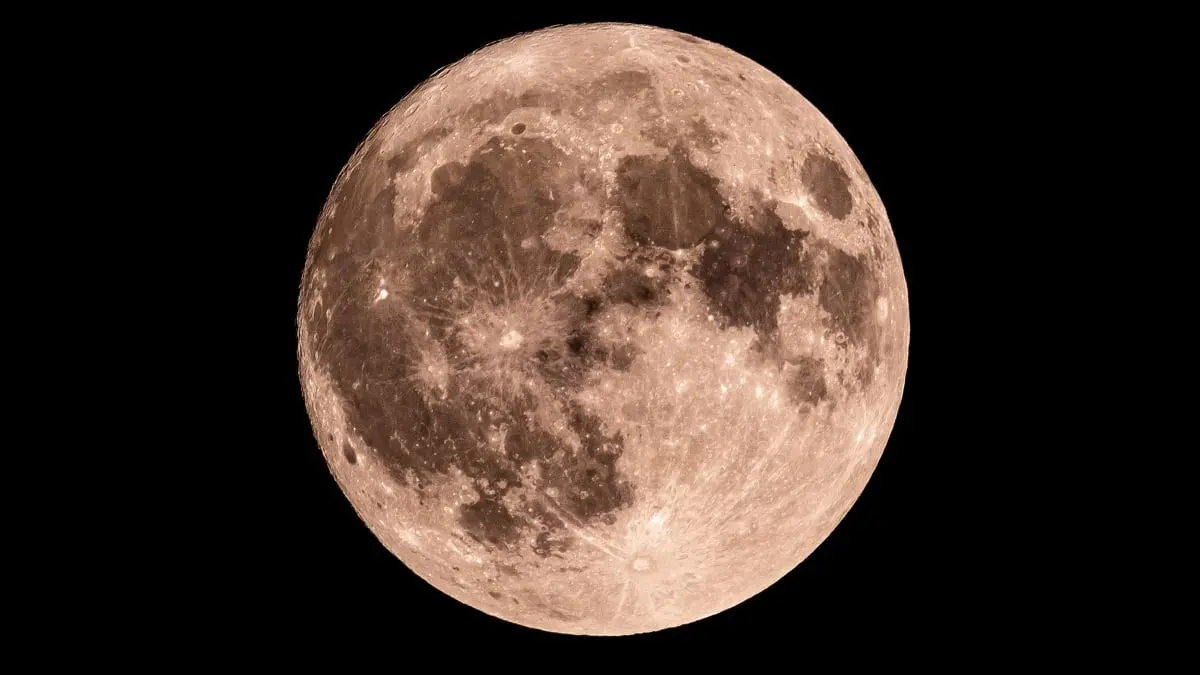
This celestial milestone offers prime viewing conditions for both amateur astronomers and casual evening walkers. Depending on the viewing equipment available, a wealth of lunar geography is currently open to inspection, ranging from ancient volcanic plains to dramatic impact craters carved into the lunar surface over billions of years.
What is today’s Moon phase?
The transition of the Moon from a slender crescent into its current swelling form is part of the predictable dance of celestial mechanics that governs our night sky. For those observing the Moon without the assistance of visual aids tonight, several notable features can be spotted with the naked eye. Observers can easily make out the dark, basaltic plains known as the Mare Tranquillitatis—the historic site of humanity’s first lunar landing—alongside the Mare Serenitatis and the prominent, bright Tycho Crater in the southern highlands, which is famous for its extensive system of bright ray-like ejecta spreading across the surface.
For individuals equipped with a pair of standard binoculars, the level of detail increases significantly. Binoculars will help reveal deeper structural features of the lunar landscape, including the massive Clavius Crater, one of the largest crater formations on the visible side of the Moon, as well as the Archimedes Crater. Observers can also scan the rugged terrain of the Montes Alpes, a mountain range that cuts sharply across the northern sector of the lunar disc.
Those who have access to a telescope will unlock an even deeper view of lunar history and exploration. Through higher magnification, viewers can spot the historical landing site of the Apollo 14 mission, where astronauts explored the Fra Mauro formation. Telescopes also bring into sharp focus the Descartes Highlands, another region visited by later Apollo expeditions, and the fascinating Rima Hyginus, a linear rille that snakes across the central regions of the Moon, offering a glimpse into the tectonic and volcanic forces that once shaped Earth’s natural satellite.
When is the next Full Moon?
As the lunar cycle continues its steady progression, the amount of visible illumination will reach its peak later this week. The next Full Moon is officially scheduled to take place on September 26. On that night, the Moon will sit opposite the Sun from the perspective of Earth, causing the entire near side of the lunar globe to be fully lit by direct sunlight, casting a brilliant glow across the night landscape and temporarily subduing the visibility of fainter stars and deep-sky objects for astronomers.
What are Moon phases?
The changing appearance of the Moon from night to night is one of the most familiar yet awe-inspiring sights in nature. These transformations are driven by the orbital journey of the Moon as it travels completely around the Earth, a circuit that takes approximately 29.5 days to complete from one new moon to the next. As the Moon moves along its orbital path, humanity observes different portions of its illuminated hemisphere, creating the cycle of lunar phases that gradually progresses from a thin, delicate crescent to a half-Moon, expanding into a Gibbous phase, culminating in a brilliant Full Moon, and then waning back into darkness before the cycle resets entirely.
According to NASA, the specific phase visible from Earth on any given night is fundamentally determined by the changing geometric position of the Moon relative to both our planet and the Sun. As the angle between the three bodies shifts, sunlight strikes different portions of the lunar globe facing our direction, while the rest of the sphere falls into shadow.
The complete cycle encompasses eight distinct phases that mark the progression of the lunar month. The sequence begins with the New Moon, a period during which the Moon is positioned directly between the Earth and the Sun. Because the illuminated side is facing away from us and the side facing Earth is shrouded in shadow, the Moon remains entirely dark and effectively invisible to the naked eye against the daytime or twilight sky.
Shortly after the New Moon, the cycle enters the Waxing Crescent phase. During this stage, as the Moon moves slightly eastward along its orbit away from the Sun in the sky, a small sliver of direct sunlight begins to appear on the right side of the lunar disc for observers located in the Northern Hemisphere.
As the days pass and the angle widens, the Moon reaches the First Quarter phase. At this precise juncture, exactly half of the visible lunar disc is illuminated on the right side, creating a classic half-Moon appearance that is often visible high in the sky during the afternoon and early evening hours.
Following the First Quarter, the Moon enters the Waxing Gibbous phase—the very state it occupies today. In this configuration, more than half of the lunar surface is lit up by the Sun, creating a bulbous, swollen appearance as it marches steadily toward total illumination, though it is not quite fully round yet.
The culmination of the waxing cycle arrives with the Full Moon. During this phase, the Earth sits more or less directly between the Sun and the Moon, allowing the entire face of the lunar disc to catch the direct rays of the sun. The result is a fully illuminated, glowing orb that dominates the night sky from dusk until dawn.
Once the Full Moon has passed, the cycle reverses its visual trend through the waning stages. The first of these is the Waning Gibbous phase, during which the Moon begins losing its illuminated coverage on the right side from the perspective of the Northern Hemisphere, slowly shrinking back down as it continues its orbital trek.
This is followed by the Third Quarter, frequently referred to as the Last Quarter. Like the First Quarter, this phase presents observers with a half-Moon appearance, but the geometry has flipped, leaving the left side of the lunar disc illuminated while the right side falls into shadow.
Finally, the cycle concludes with the Waning Crescent phase. In this final stage before the entire sequence restarts, only a thin, delicate sliver of light remains visible on the left side of the lunar disc, slowly thinning out over subsequent nights until the Moon disappears completely into the darkness of the next New Moon, ready to begin its journey anew.



Leave a Reply