
The scenario is a familiar one for modern knowledge workers: you sit down at your desk at 9:05 with a clear mandate. Yet, hours later, the progress report shows a nearly blank document with just a couple of sentences written. Nothing catastrophic has occurred. A notification blinked on the screen, a browser tab was opened to check a single piece of information, and a passing thought about a dentist appointment briefly hijacked your train of thought. Each micro-interruption cost only a few seconds—precisely why it is so easy to dismiss—and yet, entirely, the morning has vanished.
The standard cultural prescription for this widespread professional ailment is an endless index of behavioral tips. People are routinely advised to sleep more, meditate daily, employ the Pomodoro technique, block distracting websites, or download brain-training applications. These recommendations typically arrive as a dense, unranked fourteenth-point checklist. Naturally, professionals select the top three, run them for four days with varying degrees of enthusiasm, and ultimately find themselves right back at square one, staring at a blank screen while the morning hours slip away.
Industry observers and productivity researchers increasingly argue that the fundamental premise of this advice is flawed. Most struggling professionals do not have fourteen distinct problems requiring simultaneous intervention; rather, they are dealing with a single binding constraint, while the rest of their daily habits are operating at an acceptable baseline. Learning how to concentrate more effectively is largely an exercise in identifying which specific bottleneck is active during a given month, addressing it, and leaving the remaining variables alone.
Why Can’t We Focus and Concentrate?
Before diving into complex behavioral overhauls, experts suggest evaluating four primary conditions: cumulative sleep deficits over a series of nights, live digital inputs sitting directly within arm’s reach, tasks that were never defined with sufficient clarity to permit an immediate start, and scheduled recovery periods that are entirely absent from the calendar. Each of these conditions is backed by published scientific literature, though grouping them into a four-part diagnostic framework represents a practical organizational method rather than a clinical finding. This modular approach allows individuals to isolate and modify a single variable at a time rather than upending their entire daily routine.
It also helps to contextualize the baseline of human attention. In a large-scale experience-sampling study involving 2,250 adults and approximately 250,000 individual reports, participants indicated that their minds were wandering during nearly 47 percent of the moments sampled. Furthermore, respondents reported lower levels of happiness during those moments of drift. While this data relies on self-reported sampling and the link to happiness represents a correlation rather than a definitive causation, the finding settles an important psychological question: a drifting mind is not a broken mind. The realistic target of cognitive management is not zero drift.
The Myth of the 23-Minute Recovery Window
For years, office workers have been told that it takes precisely 23 minutes and 15 seconds to return to a deep state of focus after a minor interruption. However, researchers investigating the origins of this widely cited figure have been unable to verify it as a rigorously measured resumption time, prompting a shift toward more modest, empirically grounded metrics.
Controlled testing demonstrates that interruptions lasting merely 30 seconds to two minutes still produce measurable cognitive after-effects on verbal performance, visual-search capabilities, and monitoring tasks. Furthermore, switching between tasks carries a reliable cognitive cost that expands as the complexity of the rules increases, though that tax shrinks when the switch is signaled well in advance.
The distinction between these concepts carries profound practical implications. If cognitive recovery genuinely required nearly half an hour following every distraction, the only viable defense would be fortifying impenetrable, unbroken blocks of time—an increasingly impossible feat in modern collaborative workplaces. However, if the penalty is a smaller cognitive tax charged upon every individual switch, the logical solution is simply making fewer switches throughout the day, a far more achievable objective for the average professional.
Focus as a Constraint Problem
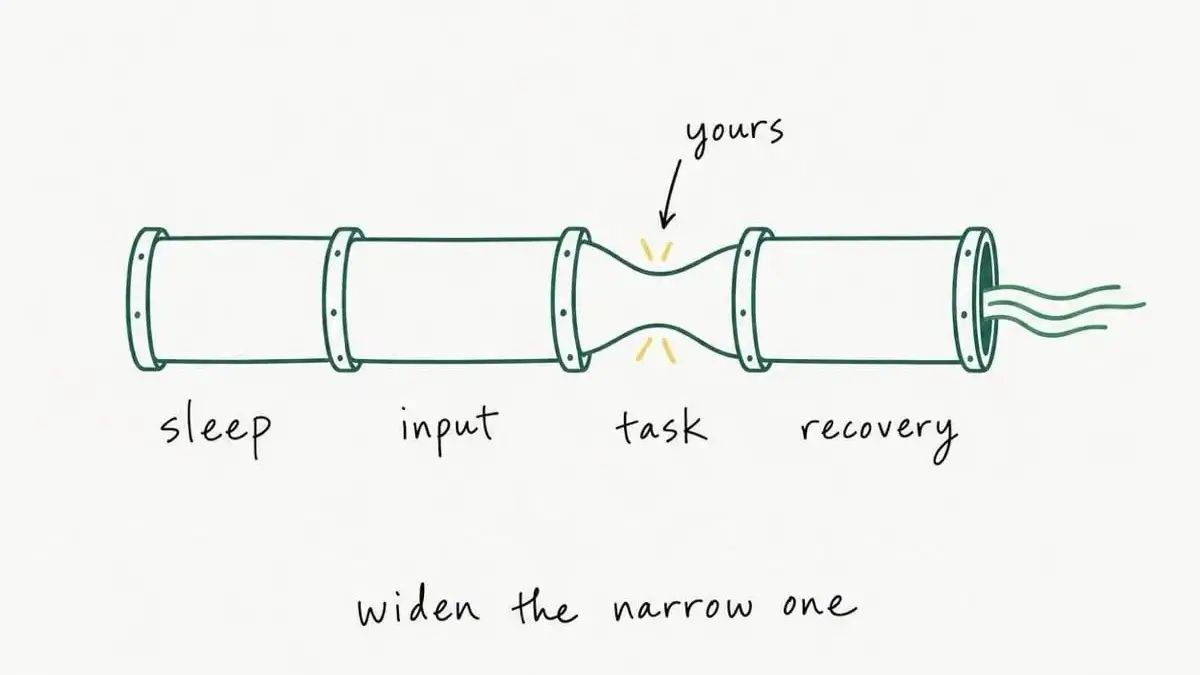
Concentration behaves much like a pipe composed of four distinct sections connected in series. Total output is strictly limited by the narrowest section, meaning that widening the three sections that are already sufficiently wide yields zero improvement in overall flow. This structural reality explains why unranked tip lists so frequently disappoint.
Attempting to incorporate meditation into a weekly schedule running on an average of five hours of sleep per night targets the wrong section of the pipe. Similarly, installing an aggressive website blocker is ineffective if the root problem is a professional assignment that was never defined well enough to initiate in the first place. Because a generic listicle cannot possibly diagnose which specific section is restricted for any given reader, the primary task must be diagnosis rather than blind effort. The most efficient strategy is to locate the narrowest constraint, adjust that single variable, and measure the outcome. Selecting the wrong constraint may cost a couple of weeks of experimentation, but it remains vastly preferable to years of unstructured frustration.

The Four Diagnostic Checks
To identify the primary constraint affecting performance, researchers recommend evaluating four distinct domains and acting solely upon the most deficient answer.
The first check examines sleep patterns across a sustained run of nights rather than focusing exclusively on the most recent night’s rest. In controlled laboratory studies, adults whose sleep was restricted to four or six hours in bed for fourteen consecutive nights exhibited cumulative, dose-dependent declines in sustained attention and working memory. The 4-hour restriction group deteriorated more rapidly than the 6-hour group, and these cognitive deficits continued to accumulate rather than leveling off over time. Crucially, the participants’ own subjective sleepiness ratings severely underestimated the extent to which their actual performance had degraded.
This self-assessment bias explains why sleep evaluation must precede other interventions. Feeling subjectively fine is not reliable evidence of cognitive readiness. Instead, professionals are advised to count: over the past fourteen nights, how many provided less than six and a half hours of sleep? If the tally reaches four or more, sleep deficit is likely the primary constraint requiring attention.
The second check inspects the physical environment immediately surrounding the workspace. While older literature emphasized the mere presence of a silent smartphone as a cognitive drain, subsequent replication efforts have introduced debate into the scientific community, rendering sweeping claims about passive phone interference an open question rather than an established universal fact.
However, a simpler, highly practical argument remains intact: relocating a smartphone to another room costs nothing and entirely eliminates the physical switch. The same logic applies to secondary monitors dominated by chat applications. The relevant diagnostic metric is frequency: during a recent work block, how many times did the individual reach for a device without a deliberate plan to use it?
The third check addresses the ambiguity of the work itself. When an employee blocks off ninety minutes for a broad objective like drafting a quarterly strategy plan, sits down at the desk, and immediately gravitates toward checking email, it is rarely a failure of willpower. Rather, the brain has been handed a task with no clear entry point, no defined finish line, and no metric for success. Faced with ambiguity, the human brain naturally seeks out tasks with immediate, clear next moves—an administrative requirement that email effortlessly satisfies. If an individual cannot state out loud the precise physical action required to begin an item, or describe what concrete artifact will exist at the conclusion of the session, the task itself is the bottleneck.
The fourth check evaluates scheduled recovery. Meta-analyses of micro-breaks confirm that brief pauses reliably improve vigor and reduce fatigue, while single bouts of exercise offer modest, timed benefits to cognitive function. Caffeine management is closely tied to this domain. Controlled pharmacological studies indicate that a 400-milligram dose of caffeine can significantly disrupt sleep architecture when consumed up to six hours before bedtime. Given that the half-life of caffeine in healthy adults ranges between four and six hours with wide individual variance, afternoon consumption can quietly undermine the sleep parameters evaluated in the first check.
Evaluating Long-Term Testing Protocols
To determine whether an intervention has succeeded, experts recommend a straightforward two-week tracking protocol centered on a single metric: completed work blocks. A completed block is defined as any planned stretch of focused work lasting between 30 and 90 minutes, executed on the designated task without mid-stream switching.
During the first week, individuals change nothing about their daily routines, merely marking their baseline tally on paper. In the second week, they modify solely the variable identified as most problematic by the diagnostic checks, while maintaining the same tracking method. If the tally rises significantly, the correct constraint has been identified, and the adjustment should be maintained for a month before introducing further changes. If the numbers remain flat, the initial diagnosis was incorrect, and the process shifts to the next-worst check.
Ultimately, moving past chronic distraction does not require overhauling every habit simultaneously. By systematically auditing sleep, workspace input, task clarity, and recovery schedules, professionals can isolate their primary bottleneck and reclaim their working hours.


Leave a Reply