
You finish a full workday, answer your teenager’s school message, pick up a prescription for your father, and call the insurance company from the grocery-store parking lot. At 9:40 p.m., someone tells you to make time for self-care. The advice is not wrong. It is simply too small for the load.
Caregiving can quietly expand to consume work, sleep, money, marriage, parenting, and personal health until no single task looks impossible, but the entire week does. You may still be successfully managing every appointment and bill. At the same time, you might also find yourself snapping at the person you love, forgetting routine details, or feeling completely numb when another request arrives.
That pattern deserves professional and social attention rather than a harsh character judgment. What is caregiver burnout? It is a practical and useful term for cumulative depletion under sustained care demands. It is not a formal diagnosis you can confirm from an online checklist, nor is it proof that you have stopped caring.
Experts emphasize that if you might hurt yourself or someone else, cannot keep yourself or the person in your care safe, or face an immediate emergency, local emergency services should be contacted immediately. In the United States, individuals can call or text 988 to reach the Suicide & Crisis Lifeline.
What is Caregiver Burnout?
Caregiver burnout is a recurring pattern of physical, emotional, and mental depletion linked directly to sustained caregiving demands paired with inadequate support, control, or recovery time. It frequently manifests as profound exhaustion, emotional detachment, irritability, a sense of dread, operational mistakes, or a reduced ability to manage the ordinary routines of daily life. The term describes a lived experience rather than a standalone medical diagnosis. Similar symptoms can also stem from underlying clinical depression, sleep disorders, medication side effects, or other health problems that require professional medical assessment.
A peer-reviewed framework for informal caregiving treats burnout as the result of interacting conditions: the care setting, the caregiver’s available resources, the surrounding environment, how demands are appraised, and the nature of the relationship itself. It does not reduce the complex problem to a simple lack of personal resilience.
Burnout research also operates within distinct real-world boundaries. A review published in the BMJ argued that, after decades of study, no universally valid clinical diagnosis for burnout has yet been established. That reality does not make the psychological and physical distress imaginary. Rather, it means an informal label should never replace a thorough clinical evaluation when symptoms persist, worsen, or actively interfere with personal safety and daily functioning.
The scale of informal caregiving underscores the magnitude of the issue. According to estimates from AARP and the National Alliance for Caregiving, roughly 63 million adults in the United States—nearly one in four—provided ongoing care to an adult or child with a medical condition or disability. While that figure does not represent a caregiver-burnout rate, it vividly demonstrates how many households quietly carry heavy responsibilities that frequently remain invisible to the outside world.
Caregiver Stress, Burnout, and Compassion Fatigue
Caregiver stress represents the immediate, acute strain of managing daily care demands. Burnout, by contrast, describes a cumulative state of depletion that occurs when high demands continue over time without sufficient resources or recovery opportunities. Compassion fatigue and secondary traumatic stress focus more specifically on the psychological impact of repeated exposure to another person’s suffering. Meanwhile, clinical depression is a distinct medical condition, not simply a stronger word for burnout. While these experiences can frequently overlap, ongoing research has not yet drawn a clean boundary that allows a simple online checklist to sort them safely.
Research conducted among medical professionals has revealed significant overlap among burnout, compassion fatigue, and secondary traumatic stress, alongside unresolved conceptual boundaries between burnout and depression. Because that sample focused on professionals rather than unpaid family caregivers, those specific concepts do not transfer perfectly to domestic settings. When attempting to understand caregiver burnout in everyday practice, these distinctions serve best as general directions rather than clinical diagnoses.
Individuals do not need the perfect label before asking for professional help. If low mood, persistent hopelessness, panic, severe sleep disruption, chronic pain, substance use, or difficulty functioning continues to worsen, contacting a health or mental-health professional is vital. Commentary concerning suicide among family caregivers highlights that suicidal thoughts can occur within this vulnerable population, and accessing specialized mental health care can frequently prove difficult.

The Problem is Capacity, Not Commitment
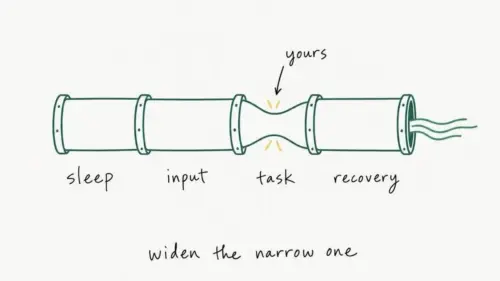
Caregiver burnout is frequently treated as a simple coping failure, with well-meaning advice suggesting better meditation, more exercise, positive thinking, or relaxing baths. While those activities may feel pleasant, they fail to answer the larger structural question: Has the overall care load exceeded the time, money, knowledge, backup, and recovery available to the individual? When capacity is the primary bottleneck, another self-care assignment often becomes just one more task the caregiver is failing to finish.
This pressure is especially sharp for adults in midlife. A caregiver may simultaneously coordinate an aging parent’s medical care, raise a teenager, protect demanding career obligations, and watch retirement costs loom closer. A national study examining sandwich-generation caregivers detailed substantial financial strain arising simultaneously from child-rearing costs, elder-care expenses, and employment opportunity costs. While the study did not prove that every sandwich-generation caregiver burns out, it clearly illustrates why the resulting pressure is not merely a private attitude problem.
The necessary reframe is blunt: Instead of asking how to tolerate an impossible care load more gracefully, caregivers must ask which part of the load can be made safer, clearer, smaller, shared, or professionally supported. That fundamental shift turns vague guilt into concrete operational decisions, allowing a life audit to reveal where caregiving is simultaneously undermining health, work, money, and personal relationships.
Applying Care Load Triage
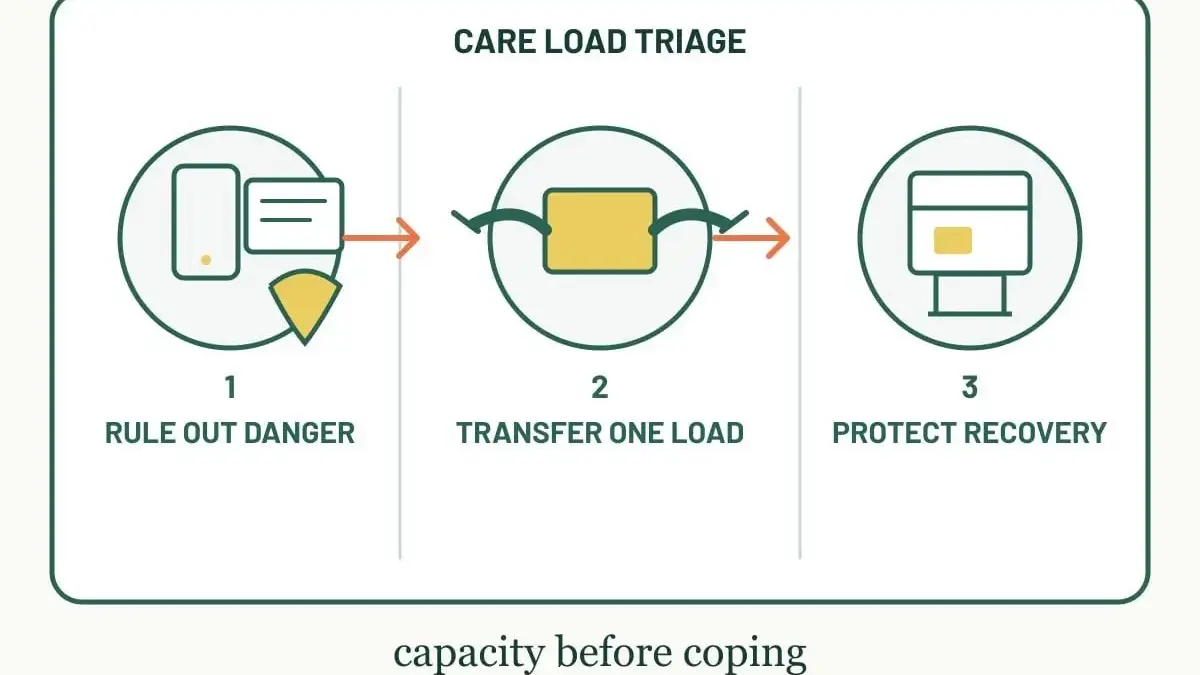
Care Load Triage functions as a practical editorial tool designed around three core objectives: ruling out immediate danger and persistent health concerns, transferring or simplifying one load-bearing responsibility, and protecting one realistic recovery block. It is not a validated medical treatment, nor does it promise immediate recovery. Its purpose is narrower and more immediate: helping individuals stop treating every demand as equally urgent, enabling them to choose a single change that reduces pressure within a 48-hour window.
The first step centers entirely on safety. Caregivers must evaluate whether they and the person receiving care can navigate the next 24 hours safely. Essential needs—including medications, food, mobility, supervision, transport, and urgent appointments—must be accounted for, while exhaustion or distress must not compromise driving, lifting, or medication management. If safety is in question, qualified help must be sought immediately.
The second step involves transferring at least one load-bearing task. Vague offers of assistance like "let me know if you need anything" are rarely usable in crisis situations. Help must be converted into an owned task with a defined scope and specific timeline. For families lacking immediate local relatives, resources such as the Eldercare Locator, the ARCH National Respite Locator, and state long-term care systems provide crucial leads for aging services and respite care, though availability and wait times vary.
The third step requires protecting a designated recovery block. This block cannot simply consist of whatever fragmented time remains after everyone else’s needs are met. It must be given an owner, a clear start and end time, and proper coverage. Even twenty minutes behind a closed door, a brief walk, a scheduled therapy appointment, or an evening free from administrative care tasks can create enough psychological distance to recognize what structural changes are necessary.
Recognizing the Signs Before Care Becomes Impossible
Recognizing the signs of burnout requires looking for changes across multiple areas of life rather than relying on a rigid scoring checklist. Warning signs include exhaustion that rest does not resolve, a growing sense of dread before routine care tasks, rising irritability, emotional detachment, forgotten steps in daily routines, missed work, social isolation, and a total loss of interest in activities outside the caregiving role.
These indicators do not automatically prove caregiver burnout. Many require professional medical attention because identical patterns can reflect depression, anxiety, underlying sleep disorders, medication side effects, or physical illness. If a care arrangement itself is unsafe, altering the fundamental structure of that arrangement must take precedence over attempting to perfect a daily routine.
A realistic 48-hour load reset replaces vague promises of self-care with a clear assessment of personal capacity. Over the course of two days, identifying the single riskiest gap, reassigning one heavy task, and scheduling a protected recovery block can test whether accumulated pressure can be successfully shifted. While such steps will not magically solve an entire care crisis, they demonstrate that sustainable changes are possible, helping caregivers navigate heavy responsibilities without sacrificing their own health and well-being.

Leave a Reply