

Ellen has been retired for precisely six weeks, and her internet browser currently holds nineteen open tabs. Among them are links for local pottery classes, volunteer recruitment portals, pickleball lessons at the community center, and a historic walking tour that she suspects her right knee might not actually tolerate. She stares at the screen for a moment, closes every single browser window, walks away from her desk, and goes outside to water the tomatoes.
Her dilemma captures a modern post-career paradox. The primary obstacle of retirement is rarely a lack of things to do; rather, it is the vast, exhausting distance between an appealing idea on a screen and a Tuesday afternoon that an individual would actually care to repeat. Every potential hobby or project stays artificially pristine in a browser tab because none of them have yet collided with reality—the household budget, physical energy levels, existing calendar commitments, or genuine personal interest.
When faced with endless choices, the impulse is often to accumulate more options rather than filter the ones already at hand. To combat this phenomenon, lifestyle experts and retirement researchers are increasingly pointing toward behavioral constraints. Instead of gathering endless wish lists, individuals are being encouraged to adopt a streamlined decision-making framework designed to turn hypothetical interests into actual weekly evidence.
Why Endless Options Leave Retirees Stuck
A long, comprehensive list of retirement activities is useful for initial discovery, but it is remarkably poor at making decisions on behalf of the individual. An entry that simply reads "learn pottery" conveys nothing about the weekly driving distance, enrollment fees, grip strength requirements, social dynamics, or whether the person genuinely enjoys the frustrating phase of being an absolute beginner. The solution to retirement paralysis is not to hunt for the elusive perfect item on paper, but rather to narrow the field using concrete personal constraints, allowing a handful of small-scale trials to provide more insight than another hour of online comparison.
Psychological research suggests that an abundance of choices does not always impair decision-making, but the detrimental effect often depends heavily on the task and the stakes involved. In one randomized experiment, 192 adults reviewed varying numbers of hypothetical Medicare drug plans. The data indicated that dealing with a higher volume of options, particularly when combined with older age, was consistently associated with fewer correct answers and lower confidence. While selecting a watercolor class carries significantly lower stakes than choosing healthcare coverage, the underlying cognitive fatigue remains the same. Setting firm criteria before diving into comparison shopping can prevent decision exhaustion.
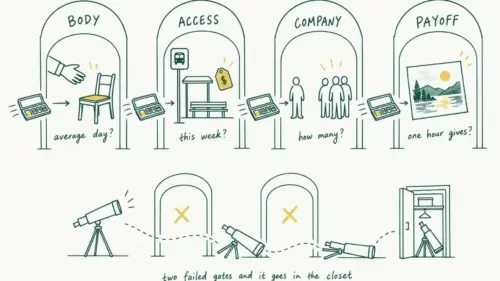
Experts recommend running every prospective activity through four foundational filters: personal access, available energy, financial cost, and the specific kind of reward or return the activity provides. A genuinely good option should seamlessly fit into an existing life before it attempts to improve it.
Testing Before Committing to a New Routine
To bridge the gap between browsing and doing, many are turning to a structured decision sequence known as the 3-2-1 Retirement Trial. This method involves selecting three distinct activities that offer different types of personal returns, trying each activity twice within a consecutive two-week window, and then committing to just one recurring engagement for the following month.
Attempting an activity twice prevents a single awkward class, an uncooperative piece of equipment, or a rainy morning from unfairly disqualifying an otherwise worthwhile pursuit. Conversely, committing to only one ongoing activity prevents retirement from inadvertently morphing into another overloaded, frantic calendar.

When choosing the initial three activities, experts advise picking options that provide varied forms of engagement: one that gets the individual around other people, one that asks them to learn or make something tangible, and one that involves physical movement, community service, or outdoor time. Overlap between categories is acceptable, but individuals are cautioned against choosing three solitary, screen-based hobbies or three options that rely completely on perfect weather conditions.
There is no universal "best first thing" to do upon leaving the workforce. Trying out an ordinary, mundane week is far more effective than attempting a dramatic reinvention right out of the gate. Retirement must function smoothly between the occasional high points and major highlights.
Keeping the initial trial small is essential. This might mean borrowing supplies from a neighbor, attending a club meeting simply as a guest, walking just the first mile of a trail, or volunteering for a single shift rather than signing up for a season. For activities involving physical exertion, medical considerations, balance, heat tolerance, or fall risks, consulting a healthcare clinician beforehand ensures safety. During the second attempt at the activity, changing a single variable—such as the time of day, location, pace, a companion, cost, or difficulty level—can completely shift the experience.
Navigating Constraints and Real-World Challenges
When a retirement activity ultimately fails to stick, it usually breaks down for one of four reasons: the logistics were impractical, the difficulty level was inappropriate, the social environment was uncomfortable, or the activity simply addressed a need the individual does not actually possess. Experts warn against converting one poorly fitted hobby into a sweeping generalization that "retirement is boring" or that one lacks follow-through. Instead, changing one variable and testing it once more provides clarity. If the second attempt still feels flat, the activity should be released without investing further money in equipment.
For many older adults, financial realities, mobility limitations, or ongoing caregiving responsibilities naturally narrow the scope of available options. In these cases, adjusting expectations is crucial. Long travel distances can be replaced by local access, expensive equipment by borrowing programs, long sessions by shorter commitments, standing roles by seated or remote tasks, and weekly obligations by twice-monthly participation. Acknowledging these boundaries beforehand ensures that an inaccessible option is recognized as a logistical mismatch rather than a personal motivation failure.
In the United States, community resources such as the federal Eldercare Locator connect older adults and their families with nearby Area Agencies on Aging and local support services. While such resources cannot guarantee immediate program openings, they provide a reliable starting point for inquiries regarding transportation, senior centers, educational classes, volunteer roles, and caregiver support systems.
Financial planning also plays a critical role in shaping what is realistically possible. While rules of thumb, such as estimating required savings based on desired monthly portfolio income, are frequently discussed by financial planners, they cannot replace comprehensive planning that accounts for taxes, inflation, unpredictable healthcare costs, geographic location, and individual time horizons. Consulting qualified financial professionals helps establish a safe discretionary budget for hobbies and interests without jeopardizing long-term security.
Ultimately, navigating the transition out of the workforce is less about discovering a massive, definitive list of 101 things to do and more about finding a single, grounded part of next Tuesday that an individual would willingly experience again. By focusing on small, manageable trials rather than overwhelming reinvention, retirees can turn an intimidating expanse of open time into a balanced, sustainable daily rhythm.

Leave a Reply