For millions of women navigating midlife, nighttime rest ceases to be a restorative retreat and transforms into a frustrating, repetitive ordeal. Menopause sleep problems typically manifest at both ends of the night—making it increasingly difficult to fall asleep initially and even harder to remain asleep through the dark hours. According to data from the landmark Study of Women’s Health Across the Nation (SWAN), which meticulously followed 3,045 women aged 42 to 52 at enrollment, the statistical odds of encountering both types of sleep disruptions rise steadily across the entire menopausal transition.
What distinguishes these midlife awakenings from ordinary bad sleep is their relentless predictability. The nights repeat in identical, exhausting cycles, often occurring against the backdrop of a life where nothing else has fundamentally changed. This eerie consistency is the primary indicator of hormonal and physiological shifts, and it is precisely why generic sleep advice—such as dimming lights or drinking chamomile tea—fails to make an impact.
For a vast number of women, the staying-asleep phase is the most disruptive component, following a depressingly familiar trajectory. A woman may fall asleep easily by 11:00 p.m., only to snap wide awake at 2:40 a.m. feeling damp, kicking the covers off, and then hastily pulling them back on as a chill sets in. Sleep might come and go in fragments before another abrupt awakening at 4:15 a.m., followed by a final, unrefreshing rise at 6:00 a.m. because professional and family obligations demand an early start.
By the time Thursday rolls around, the cumulative deficit takes a heavy toll. Exhaustion manifests as shortness of temper with loved ones and the cognitive haze that requires reading the exact same professional email four separate times. Secondary analyses tracking ten years of the SWAN cohort revealed that self-reported insomnia symptoms affected 31% of women in early perimenopause during the first year, climbing to 39% by year ten. Among women in late perimenopause, the prevalence started at 32% and rose as high as 48%. These figures reflect self-reported symptoms occurring at least three times a week rather than clinical diagnoses of chronic insomnia, yet they clearly demonstrate how sleep disturbances shift across different stages of the transition. Crucially, they underscore a reassuring truth for exhausted women: experiencing these symptoms does not mean you are an isolated outlier lying awake at 3:00 a.m.
Perhaps the most insidious psychological development is the emerging dread of the bed itself. This anxiety surrounding the sleeping environment is a novel and critical hurdle, outweighing the potential benefits of any supplement bottle lining a bathroom counter.
Why the Usual Natural Remedies Keep Failing You
The widespread frustration with natural remedies for midlife sleep disruption largely stems from how they are marketed and consumed. Solutions are typically presented as an unstructured list of half a dozen options devoid of clear hierarchies, underlying mechanisms, or rigorous grading of scientific evidence. Melatonin serves as the most prominent example of this disconnect. When pooled across four randomized controlled trials involving menopausal women, its measurable effect on overall sleep quality failed to reach statistical significance. In scientific terms, this indicates uncertainty regarding its efficacy rather than definitive proof of failure, yet this nuance is entirely absent from retail product labels.
Valerian root fares no better under scientific scrutiny. An extensive umbrella review conducted in 2024 synthesized eight systematic reviews evaluating valerian for sleep disturbances. The review concluded that the supporting evidence was weak or inconclusive, finding no demonstrable efficacy for treating insomnia.
Faced with these mixed or disappointing results, individuals frequently try one remedy, give it a trial period of two weeks, experience zero relief, and quietly conclude that the personal failure lies with them. In reality, the fault rests with an approach that hands consumers an uncurated retail shelf and tells them to guess. Treating menopause-related insomnia as a singular issue is fundamentally flawed, as the condition stems from at least three distinct physiological causes.
Menopause Sleep Problems Are a Wake-Up Pattern, Not One Problem
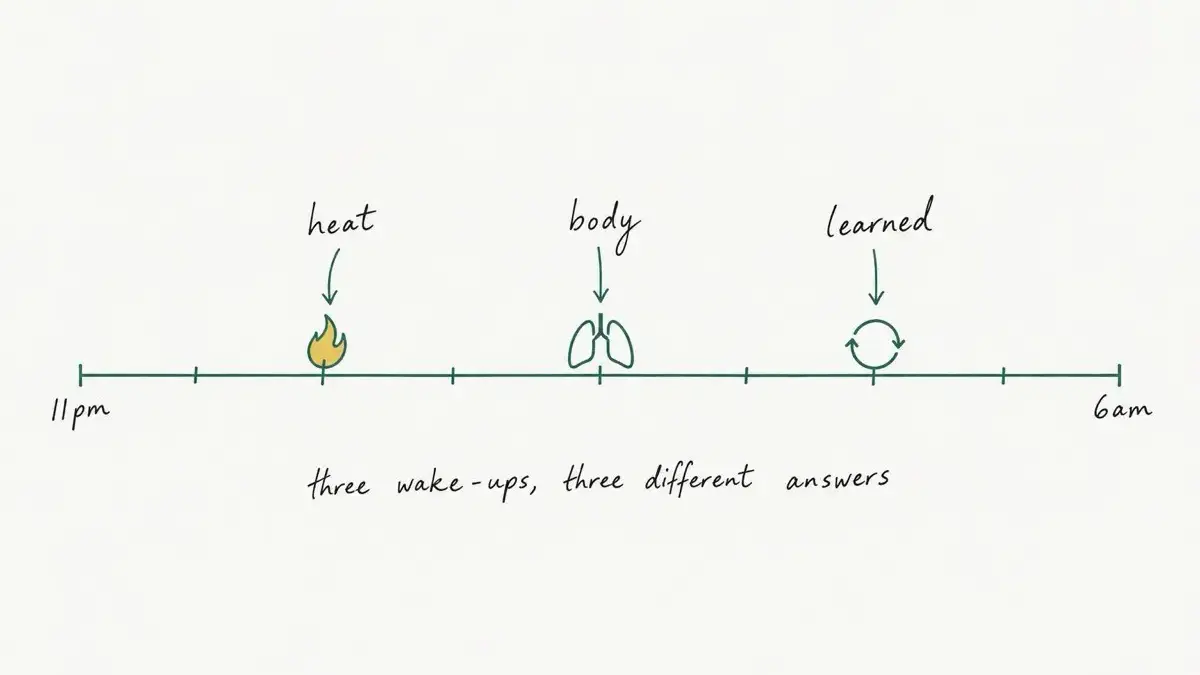
Clinical understanding of menopause-related sleep disruption reveals that it is not a monolithic issue. Instead, it encompasses at least three distinct wake-up patterns wearing the guise of a single symptom: heat-driven awakenings, body-driven awakenings rooted in physiological issues such as disordered breathing, and learned awakenings that persist long after hot flashes have subsided. Applying a remedy designed for one specific pattern yields little to no benefit for the other two. Determining which pattern dominates a person’s nights is the key to transforming an overwhelming list of remedies into an effective, personalized strategy.
Heat-driven waking is the phenomenon most commonly associated with menopausal sleep disruption, and its impact is thoroughly documented. In an actigraphy-monitored study of 168 midlife women, 78% of objectively recorded nocturnal hot flashes coincided directly with an awakening episode. Furthermore, participants were significantly more likely to be awake during the five-minute window immediately following a hot flash than in the minutes preceding it. While chronological concurrence does not definitively prove that every awakening is triggered by a flash, the statistical correlation remains exceptionally strong.
Body-driven waking, conversely, represents a pattern that is frequently overlooked by both patients and primary care providers. Data from the Sleep in Midlife Women Study indicated that the adjusted apnea-hypopnea index—a standard measure of breathing events during sleep—was approximately 31% higher post-menopause than it was pre-menopause. This metric measures disrupted breathing events rather than counting new clinical diagnoses of sleep apnea. What makes this finding vital is its clinical presentation: women suffering from obstructive sleep apnea frequently present to primary care physicians reporting classic insomnia, persistent fatigue, and low mood rather than loud snoring. This atypical presentation is a primary reason the condition remains notoriously underdiagnosed among women.
Learned waking explains why many women remain wide awake at 3:00 a.m. years after their hot flashes have completely faded. Over time, the bed transforms from a place of rest into an environment associated with stressful mental arithmetic regarding the schedule of the following day. This conditioned response is no longer driven by fluctuating hormones, making it a psychological pattern with robust non-drug treatments available.
While categorizing nights into these three distinct groups serves as an organizing framework rather than a rigid clinical classification—and real-world weeks frequently feature overlapping symptoms—the distinction remains valuable. Each identified group points directly toward a different, more targeted next step.
Natural Remedies, Ranked by the Evidence Behind Them
When evaluated strictly through the hierarchy of scientific evidence, natural and non-pharmacological remedies for menopause sleep problems fall into a clear order: cognitive behavioral therapy for insomnia (CBT-I) ranks first, regular physical exercise ranks second, and dietary supplements sit a distant third. In a randomized trial tracking 106 midlife women experiencing frequent hot flashes and insomnia, telephone-delivered CBT-I reduced insomnia severity scores by roughly 5.2 points more than a menopause-education control group at the eight-week mark, with these gains successfully maintained at 24 weeks. To date, no over-the-counter supplement has produced clinical trial evidence approaching that magnitude of improvement.

First in clinical efficacy is CBT-I, which functions as a structured therapeutic treatment rather than a collection of casual lifestyle tips. Typically delivered across four to eight sessions by a trained clinician, therapist, or guided digital program, CBT-I targets the foundational mechanics of sleep. It establishes a consistent wake time to be held rigidly every day, restricts time spent in bed to closely match actual sleeping time, encourages getting out of bed rather than lying awake, and systematically dismantles late-night anxiety thought loops.
Professional medical guidelines reflect this evidence base. The American College of Physicians recommends CBT-I as the initial, first-line treatment for all adults suffering from chronic insomnia, issuing a strong recommendation backed by moderate-quality evidence, while positioning medication as a secondary option for shared decision-making if behavioral therapy alone proves insufficient. While this broad guideline applies to chronic insomnia generally rather than menopause specifically, the clinical trial involving midlife women with hot flashes provides a direct and compelling parallel.
A crucial distinction emphasized by the American Academy of Sleep Medicine is the necessity of the full, multicomponent CBT-I protocol, while advising against relying on generic sleep hygiene as a standalone treatment. The familiar checklist of keeping a dark room, avoiding screens, and cutting off late-day caffeine provides a baseline floor rather than a comprehensive cure.
Exercise occupies the second tier, supported by an honest and measurable effect size. Pooled individual-participant data across four trials conducted by the MsFLASH research network revealed that regular exercise reduced Insomnia Severity Index scores by an average of 2.1 points relative to control groups. While a two-point reduction represents a genuine and modest improvement, it is important to recognize that exercise alone cannot carry the entire therapeutic load.
Dietary supplements occupy the third tier, with their specific evidence—or lack thereof—attached. Because supplements can interact adversely with prescription medications and with one another, medical professionals universally advise discussing any supplement regimen with a clinician or pharmacist prior to use.
Regarding the ubiquitous advice to cool the bedroom environment, controlled clinical evidence demonstrating that lower room temperatures directly treat menopausal insomnia remains sparse. Research examining healthy adults indicates that warming the skin of the trunk and upper legs by less than one degree Celsius shortens sleep-onset latency by approximately three minutes. However, because that study did not focus on menopause or ambient room cooling, it neither definitively validates nor refutes standard cooling advice. Maintaining a cool bedroom, a fan, and breathable bedding remains valuable purely for physical comfort—making night sweats less oppressive—even if a thermostat cannot resolve a conditioned 3:00 a.m. anxiety loop.
What One Week of This Actually Looks Like
In practical execution, addressing midlife sleep disruption systematically often looks refreshingly straightforward. The process begins with selecting a single, non-negotiable wake time and holding it every day, including Saturdays. Each morning involves logging three specific details: the hour of waking, whether a hot flash or heat was involved, and any observations related to breathing or daytime fatigue. Halting the constant introduction of new remedies allows a personal symptom log to reveal which wake-up pattern is truly dictating the night.
Consider the hypothetical profiles of two women illustrating contrasting clinical scenarios. Tricia, aged 49 in early perimenopause, logs four disruptive wakings over seven nights—three accompanied by drenched sheets requiring a change and the activation of a bedroom fan, with zero abnormalities noted in her breathing column. Her pattern is distinctly heat-driven. Rather than making eight simultaneous lifestyle overhauls, her strategy involves fixing her wake time at 6:15 a.m., incorporating regular walks, utilizing breathable bedding, and documenting the frequency of her night sweats to share with her physician at her next appointment. She purchases no new products. Furthermore, her log converts vague complaints of poor sleep into precise clinical data: four out of seven nights disrupted by night sweats over an eleven-week period.
Marlene, aged 54 and two years past her final menstrual period, experiences minimal hot flashes. Yet, she remains consistently awake at 3:10 a.m., her log showing no thermal disruption but revealing a persistent habit of lying in bed for 90 minutes composing mental to-do lists for the following day. Notably, her breathing column is not empty; her partner has mentioned episodes of snoring, and she frequently falls asleep on the sofa by 8:00 p.m. Her log points toward two distinct paths: discussing CBT-I with her doctor to address the learned insomnia pattern, and simultaneously raising the issues of snoring and daytime sleepiness rather than dismissing them as general midlife exhaustion. In the interim, she adopts the practice of leaving her bed after 20 minutes of wakefulness to break the mental association between the bed and active thought.
Both women maintain their logs for a full week before implementing any changes, avoiding the common pitfall of simultaneously adopting magnesium supplements, blackout curtains, specialized pillows, and sleep-tracking applications, which ultimately obscures which intervention, if any, provided relief.
When This Needs a Clinician, Not a Remedy
Certain nocturnal symptoms signal issues that extend far beyond self-care remedies. Loud snoring, breathing that repeatedly stops and starts, gasping or choking sounds during the night, and chronic, severe daytime fatigue are recognized by health authorities as primary clinical indicators of sleep disordered breathing and sleep apnea. Official medical guidance recommends consulting a physician for these symptoms rather than experimenting with over-the-counter solutions. Similarly, sleep difficulties persisting at a frequency of at least three nights per week for three months or longer meet the established diagnostic threshold for chronic insomnia.
Medical professionals caution that dismissing persistent sleep disruption simply as an inevitable consequence of menopause can delay necessary medical evaluation. Because conditions like obstructive sleep apnea frequently present in women as insomnia, chronic fatigue, and low mood rather than overt snoring, professional assessment is vital.
For women whose sleep disruption is closely tied to vasomotor symptoms, hormone therapy remains a prominent option for clinical discussion. According to position statements from professional menopausal societies, hormone therapy is recognized as the most effective FDA-approved treatment for moderate to severe hot flashes and night sweats, yielding secondary improvements in sleep quality when disturbances are directly driven by those symptoms. However, hormone therapy is not prescribed as a standalone treatment for primary insomnia, and its suitability requires a thorough, individualized benefit-risk assessment conducted by a qualified healthcare provider.
Start With One Night, Not Eight Changes
Establishing a clear path forward begins with a simple, foundational step: selecting a consistent wake time before purchasing any remedy. Keeping a bedside log for seven consecutive nights to record wake times, thermal involvement, and breathing or fatigue observations provides a clear diagnostic tool. This straightforward record shifts the management of menopause-related sleep problems away from retail guesswork and toward targeted, evidence-based solutions while providing clinicians with actionable data.