

Starting over after a divorce at 50 can make an ordinary Tuesday feel strangely unfamiliar. The mortgage login has changed, dinner is suddenly for one, and friends often hesitate, unsure whether to invite both parties or how to navigate the shift. Meanwhile, your career still expects the competent, uninterrupted version of you, while sleep, finances, home, family, and identity all seem to demand immediate, simultaneous decisions.
The societal pressure to "make a fresh start" arrives quickly and forcefully. A new apartment, a new body, a new social life, and perhaps an entirely new career are frequently touted as the necessary prescription for healing. While this sounds hopeful at first, the endless list of expectations quickly becomes just another overwhelming demand. The reality is that you do not need to reinvent everything while the very floor beneath you is still moving.
A steadier order is entirely possible. The primary objective is to protect the practical floor, gradually rebuild a trustworthy week, and then test who you want to become through small, reversible choices. Grief can run right beside that work; it does not have to be completely resolved before you pay a bill, ask for help, or take a walk.
For those facing immediate danger, local emergency services should be contacted right away. If a partner or former partner frightens, monitors, threatens, or controls you, the National Domestic Violence Hotline offers confidential safety planning by phone, chat, or text. Experts emphasize that individuals should never announce a plan or attempt couples counseling when safety is uncertain. For mental health, suicide, or substance-use crises in the United States, calling or texting 988 connects individuals to the 988 Lifeline, though neither service replaces localized legal advice.
Starting Over After Divorce at 50 Means Rebuilding in Layers
Navigating life after a major dissolution at this stage works far better as a layered rebuild than as one dramatic, sweeping reinvention. The initial phase requires protecting the absolute foundation: personal safety, housing security, cash access, legal deadlines, health insurance, necessary medications, and sleep. Only after those critical elements are secured should individuals attempt to rebuild a workable week anchored by a few reliable routines.
Only after establishing this baseline does it make sense to test larger identity choices concerning work, home, friendship, love, and purpose. Far from being an act of surrender, stabilization creates the necessary cognitive room for better, more measured decisions.
This approach applies established life frameworks across health, family, work, money, purpose, and leisure while deliberately protecting the time, energy, and decision-making capacity required to sustain them. By breaking the process into distinct layers, individuals can significantly reduce risk, give necessary actions a predictable place, and explore what truly fits before making another permanent commitment. In this context, the sequence of actions matters far more than the speed at which they are taken.
Why Trying to Reinvent Everything at Once Backfires
Attempting an all-at-once reinvention asks a highly stressed mind to manage the maximum number of high-stakes choices simultaneously. Psychological research, however, demonstrates that stress does not uniformly ruin every human decision. A systematic review examining multiple studies found inconsistent effects across economic and everyday tasks, with disruptions appearing more frequently in uncertain economic environments than in hypothetical everyday scenarios. A separate meta-analysis noted that acute stress can indeed disrupt parts of executive control, but the extent depends heavily on the specific task and timing. Consequently, making smaller decisions is not a verdict on one’s overall capability, but rather a vital safeguard against cognitive overload.
Uncertain decisions constantly compete for limited human attention. This is precisely where the fresh-start fantasy becomes costly. While a new city, a new relationship, or a new job might ultimately be the right path, each choice drastically alters multiple variables at a time when the practical floor is still unstable.
Experts advise handling urgent items first, utilizing reversible tests to gather information, and giving identity-level decisions enough time, sleep, and emotional distance to become genuine choices rather than panicked exits from pain. Utilizing a broader life audit can help individuals see the wider domains of their existence without forcing them to draft another exhausting repair list overnight.
Step 1: Protecting the Floor
Protecting the floor means securing the vital areas of life where delay can cause lasting, tangible harm: personal safety, stable housing, access to money and official documents, legal deadlines, health coverage, prescriptions, joint debts, and reliable sleep. This phase is purely triage, not an exhaustive financial or legal master plan. Organizing open issues into distinct categories—such as urgent matters, items for the current month, professional consultations, and items that can wait—allows individuals to focus their limited energy where it is needed most.

Finances demand sober, realistic attention. A longitudinal study focusing on divorce at age 50 or older revealed average declines in the standard of living of approximately 45% for women and 21% for men, as measured by the income-to-needs ratio. Additionally, overall wealth fell by roughly half for both groups. While these figures represent model-based averages rather than a strict individual forecast, and while the study cannot prove that divorce alone caused every financial shift, they clearly illustrate why financial security belongs near the front of the recovery sequence.
Starting with factual realities is essential. For instance, a divorce decree does not automatically terminate a person’s legal responsibility to a creditor on a joint account. According to the Consumer Financial Protection Bureau, simply removing a name from a title does not release a borrower from a shared mortgage or auto loan.
For those starting over with limited cash, focusing strictly on safety, document access, legal deadlines, and a bare-minimum monthly budget is crucial. Funded civil legal-aid organizations can often be located through resources like the Legal Services Corporation finder, though eligibility and family-law services vary by location. Qualified local family-law professionals, tax experts, and financial advisers remain the best resources for addressing individual circumstances.
Step 2: Rebuilding a Week You Can Trust
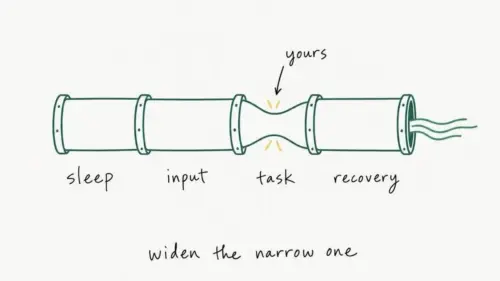
A trustworthy week does not require achieving a flawless daily routine. Instead, it requires four reliable anchors: one dedicated block for divorce and household administration, one action that physically protects the body, one trusted person you can contact honestly, and one period where recovery is allowed to be entirely unproductive. Placing each anchor at a specific time prevents necessary tasks from perpetually arriving as sudden, fresh decisions.
Behavioral science supports the use of structured implementation intentions—often framed as "if-then" plans—to improve goal attainment. Establishing a concrete boundary, such as opening a divorce administration folder for a set period on a specific evening, gives an action both a clear cue and a definitive limit. While psychological meta-analyses note variable results depending on clinical contexts, the formatting structure helps individuals manage overwhelming workloads without burning out.
Similarly, maintaining a support network is vital, but it requires mindful boundaries. Giving a reliable friend one specific job—such as listening for twenty minutes, joining an appointment, or reviewing housing options—prevents the feeling that asking for support is an unbearable burden. When asking for help feels excessively difficult, ingrained people-pleasing habits may be turning natural human support into a debt that feels impossible to repay.
Step 3: Testing the Person You Are Becoming
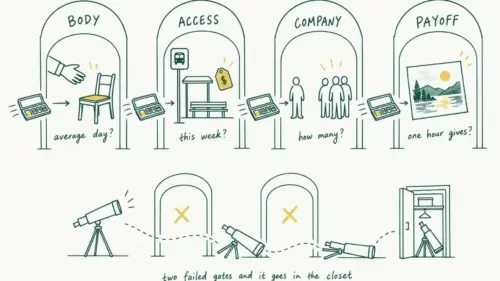
Identity following a divorce is far better tested than declared. Rather than deciding who the "new you" must be, individuals benefit from running small, reversible experiments over a 30-day period. This might involve trying a single class, rearranging one room, reconnecting with a friend, volunteering twice, or spending a Saturday in a new environment. Keeping these experiments small ensures that a disappointing result simply yields useful information rather than triggering emotional collapse.
Observational studies on divorcing adults indicate that higher levels of self-compassion are frequently associated with lower emotional distress over extended periods. Self-compassion in this context does not mean ignoring reality; rather, it sounds like acknowledging that the situation is difficult, that some choices will inevitably be clumsy, and that errors can be corrected without turning into harsh character judgments.
Whether the underlying question involves finding midlife purpose or managing lingering emotional attachments to a former partner, the process remains grounded in steady, deliberate observation rather than sweeping self-reinvention. If an ex-partner remains controlling or frightening, all identity experiments must be paused in favor of prioritizing immediate safety and contacting specialist support services from a secure device.
As individuals move through the first month and beyond, progress is rarely linear. Emotional and financial recovery timelines vary dramatically based on individual circumstances, ranging from rapid resilience to prolonged adjustment periods. By focusing on immediate stability, protecting the practical floor, and making small, reversible choices, individuals navigating life after 50 can slowly construct a secure foundation for the future.

Leave a Reply