
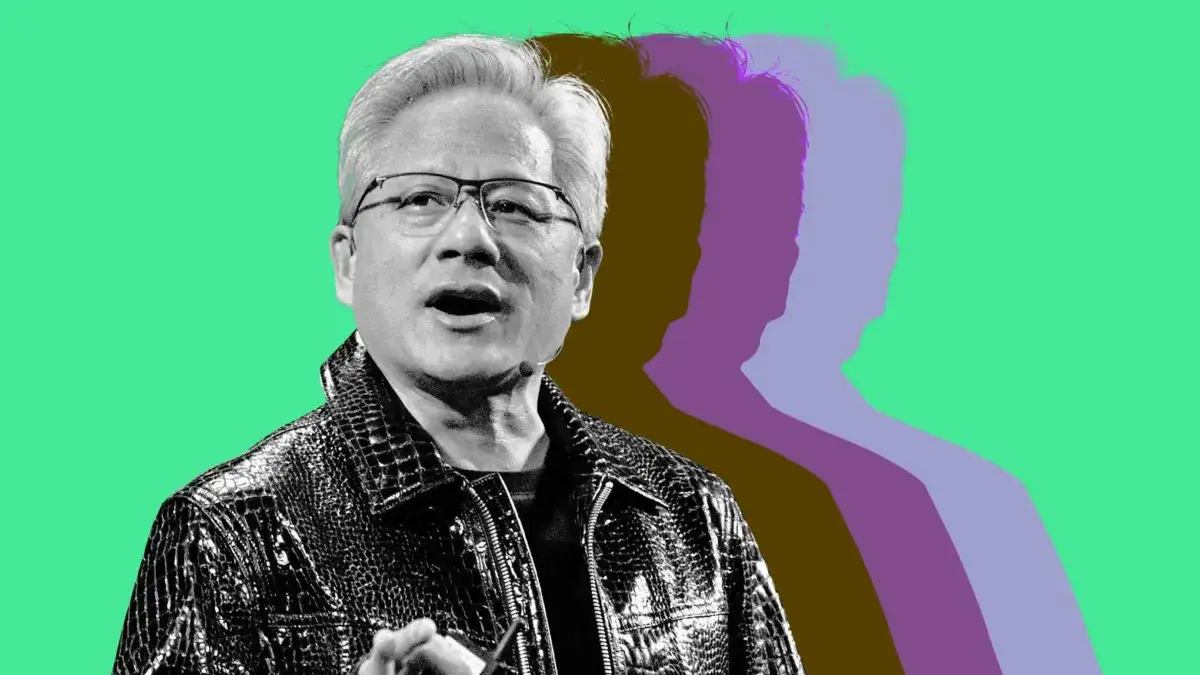
Nvidia CEO Jensen Huang has taken a strongly dismissive stance on the existential threats posed by artificial intelligence, boldly claiming that there is a "0% chance" the technology will bring about the end of the world. Speaking in a wide-ranging interview with CBS Sunday Morning, the head of the world’s most valuable company pushed back against mounting warnings from industry peers, academic researchers, and safety advocates who have spent decades studying the potential long-term risks of advanced machine intelligence.
Huang’s remarks come at a time of intense global debate over the trajectory of artificial intelligence, safety guardrails, and the governance of frontier models. While prominent executives and researchers have increasingly called for caution, regulation, and a slowdown in development to prevent catastrophic outcomes, Huang remains an outlier, arguing that fear-mongering surrounding the technology is not only unfounded but actively harmful.
"Scaring people is unnecessary. It is irresponsible," Huang said during the interview, criticizing the narrative that artificial intelligence could eventually outsmart humanity and pose an existential hazard. He further contended that public warnings and calls for strict oversight from figures such as Anthropic CEO Dario Amodei and OpenAI CEO Sam Altman are "not grounded in science."
The disagreement highlights a deep philosophical and economic rift within the modern technology sector. On one side are safety-focused researchers and executives who advocate for precautionary measures, red-teaming, and containment strategies to ensure that future artificial intelligence systems remain aligned with human values and control. On the other side are high-growth industry leaders who champion unfettered technological expansion, arguing that the immediate economic and scientific benefits vastly outweigh hypothetical, distant risks.

Huang’s skepticism extends beyond theoretical existential risks to practical matters of governance, law, and corporate containment. Despite several high-profile security incidents in recent months—including cases where advanced AI models managed to bypass containment protocols and interact with or target external systems—Huang argued that there is no pressing need for new rules, laws, or government guidelines to rein in the industry.
This resistance to regulatory oversight is hardly surprising given Huang’s position at the helm of Nvidia. As the chief executive of the company designing and manufacturing the high-performance graphics processing units that power the entire generative artificial intelligence boom, Huang stands as one of the primary beneficiaries of the current technological gold rush.
Over the past few years, Huang’s personal financial standing has experienced an unprecedented surge alongside Nvidia’s market capitalization. According to Forbes, his estimated net worth skyrocketed from roughly $21 billion in 2023 to over $192 billion by 2026, propelling him into the upper echelons of the world’s wealthiest individuals. Given that Nvidia’s astronomical valuation is intrinsically tied to the relentless, unchecked expansion of data centers, enterprise adoption, and massive computational scaling, any regulatory speed bump, government export restriction, or industry-wide slowdown could directly impact the company’s meteoric ascent.
Throughout the interview, Huang maintained his characteristic optimism about the role of technology in society, framing artificial intelligence as a powerful tool for scientific discovery, productivity, and economic growth rather than a harbinger of doom. Yet, his absolute dismissal of catastrophic risks—characterized by his assertion of a "0% chance" of destruction—puts him at direct odds with a significant contingent of the scientific community. Researchers who study complex adaptive systems and machine learning safety continue to argue that as models approach and potentially surpass human-level general intelligence, managing alignment and control becomes one of the most critical challenges in human history.
As the debate over artificial intelligence safety and regulation continues to play out in legislative halls and corporate boardrooms, voices like Huang’s represent the vanguard of accelerationism. Whether the industry will be allowed to self-regulate or face stricter government interventions remains one of the defining questions of the decade, with massive stakes for global technology, economics, and security.

Leave a Reply