A wrapped version of Monero (XMR) experienced a catastrophic collapse on Friday, plunging by more than 99% on the Hyperliquid platform. According to findings from blockchain analytics firm Bitquery, the steep decline was triggered after a mysterious wallet—which had directly received tokens from the asset’s deployer account—dumped approximately $13.5 million worth of the asset onto the market in a matter of minutes.
The affected token, identified as XMR1, saw its value evaporate from roughly $500 down to just $1 within a compressed trading window of approximately 30 minutes, marking a staggering 99.8% valuation drop. In the broader cryptocurrency ecosystem, wrapped tokens are specifically designed to represent native cryptocurrencies from different underlying blockchains, thereby enabling them to be traded fluidly outside of their original network constraints. Market observers and analysts were quick to clarify that the market collapse strictly impacted XMR1 and did not touch or compromise Monero’s underlying native cryptocurrency network.
Detailed onchain analysis published by Bitquery revealed that the suspicious wallet initially took possession of 5.2 million XMR1 tokens directly from the project’s official deployer account. Shortly after receiving this massive allocation, the entity behind the wallet executed the massive sell-off on Friday, liquidating roughly $13.5 million worth of the asset and sending shockwaves through the liquidity pools.

Following the sudden and dramatic liquidation, Bitquery’s blockchain sleuths meticulously traced the flow of funds. Their investigation showed that $13.28 million in USD Coin (USDC) was swiftly bridged across to the Arbitrum network. From there, approximately $13.22 million of those funds were swapped for 7,467 Ether (ETH) utilizing the decentralized trading infrastructure provided by the CoW Protocol. The analytics firm noted that the vast majority of this acquired ETH was subsequently bridged over to the main Ethereum network, a common tactic used to obscure the trail or prepare assets for further distribution or laundering through decentralized exchanges and privacy tools.
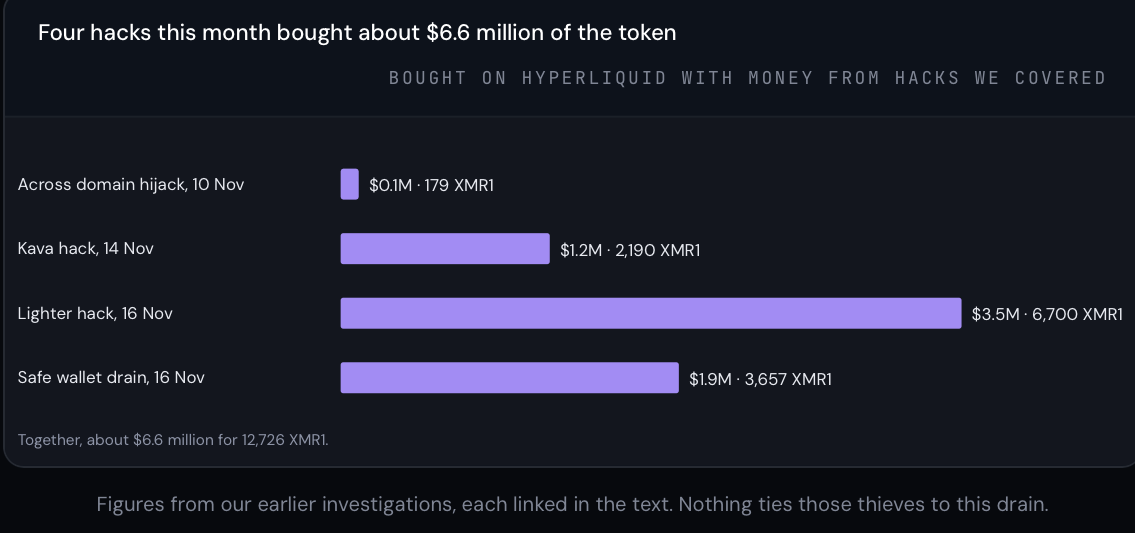
Furthermore, Bitquery’s investigation uncovered a secondary layer of financial activity. The firm discovered that proceeds originating from four separate, unrelated hacks that took place earlier in November—involving platforms such as Across Protocol, Kava, Lighter, and Safe—had previously been used to accumulate approximately $6.6 million worth of XMR1 tokens. Onchain analysts noted that this prior accumulation appeared to serve as a strategic route to convert stolen funds into native Monero or privacy-centric equivalents. However, Bitquery explicitly stated that its ongoing onchain investigation found no direct evidence linking those four earlier November security incidents to Friday’s sudden exploit and subsequent token collapse.
Despite the comprehensive tracking of the stolen funds and token movements, Bitquery acknowledged a crucial missing link in the narrative. The analytics firm reported that its onchain data could not conclusively establish how the deployer account’s private key was originally compromised, nor could it identify the specific individuals or entities who ultimately controlled the private keys during the unauthorized transfers. Consequently, the exact operational circumstances surrounding the suspected security breach remain unconfirmed from an onchain perspective.
Wagyu Operator Blames Suspected Infrastructure Breach
As the crypto community scrambled to understand the root cause of the market crash, PerpetualCow, the pseudonymous operator of Wagyu—the underlying service responsible for issuing and managing XMR1—stepped forward to offer an explanation. According to the operator, the catastrophic event was not a failure of the smart contracts themselves, but rather the result of an alleged infrastructure breach suffered by hosting provider 1984.
PerpetualCow claimed that the third-party hosting provider had been compromised, resulting in the exposure of sensitive customer data and critical internal server files. Elaborating on the mechanics of the alleged incident, the pseudonymous operator stated that the private key used by the XMR1 deployer account had previously been stored on a server that was subsequently deleted by the team. However, the hosting provider allegedly retained server logs and underlying files associated with the decommissioned environment, which could have theoretically allowed an unauthorized actor to recover or reconstruct the sensitive cryptographic material.
In the wake of the incident and the resulting market fallout, PerpetualCow addressed the community directly, making a financial commitment to those who suffered losses. The operator pledged to personally reimburse all affected traders who were caught in the sudden liquidity crash. Additionally, PerpetualCow indicated that the Wagyu project intends to relaunch its operations and services at a later, yet-to-be-determined date, though no concrete timeline or roadmap was provided for the recovery and redeployment process.
Representatives from media outlets, including Cointelegraph, reached out to the Wagyu operator seeking further technical clarifications regarding the alleged server breach, the extent of the data compromise at the hosting provider, and the formal mechanics of the promised user reimbursement plan. However, no official response or additional comment had been provided by the time of publication.